|
Concentrated TPM oil-in-water emulsions (monodisperse)
|
dmean = 1.03 µm
|
Prepared by a seeded-growth method; stabilized with 0.5 wt% F108 and 5 mM sodium chloride
|
Σ = 3 mN/m
|
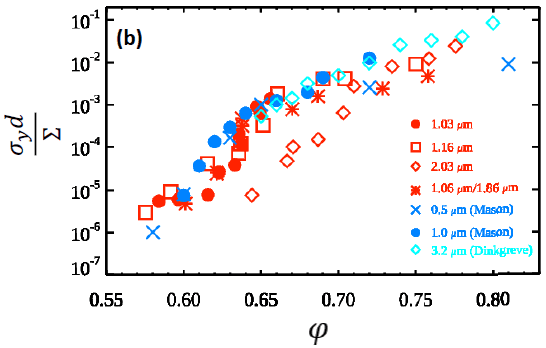
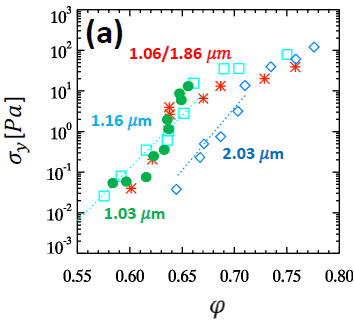
Teff = kBT/ε with ε = Σd²; nondimensional yield stress σ0 = σy d / Σ
|
Anton Paar MC302 rheometer; pendant drop method (Dropometer, made by Dropletlab)
|
Rheology at room temperature (25 °C); 50 mm cone-plate, 1.01° cone angle, 53 µm truncation, roughened bottom plate, solvent trap; 10 s⁻¹ pre-shear for 30 s then 30 s at rest; γ̇ from 10² to 10⁻³ s⁻¹. No temperature or other condition is stated for the pendant-drop surface-tension measurement.
|
Droplet diameters reported based on SEM measurements of polymerized droplets
|
|
Concentrated TPM oil-in-water emulsions (monodisperse)
|
dmean = 1.16 µm
|
Prepared by a seeded-growth method; stabilized with 0.5 wt% F108 and 5 mM sodium chloride
|
Σ = 3 mN/m
|
Teff = kBT/ε with ε = Σd²; nondimensional yield stress σ0 = σy d / Σ
|
Anton Paar MC302 rheometer; pendant drop method (Dropometer, made by Dropletlab)
|
Rheology at room temperature (25 °C); 50 mm cone-plate, 1.01° cone angle, 53 µm truncation, roughened bottom plate, solvent trap; 10 s⁻¹ pre-shear for 30 s then 30 s at rest; γ̇ from 10² to 10⁻³ s⁻¹. No temperature or other condition is stated for the pendant-drop surface-tension measurement.
|
SEM imaging performed after polymerizing a portion of each sample (AIBN; 80 °C oven for at least 2 hours)
|
|
Concentrated TPM oil-in-water emulsions (monodisperse)
|
dmean = 2.03 µm
|
Prepared by a seeded-growth method; stabilized with 0.5 wt% F108 and 5 mM sodium chloride
|
Σ = 3 mN/m
|
Teff = kBT/ε with ε = Σd²; nondimensional yield stress σ0 = σy d / Σ
|
Anton Paar MC302 rheometer; pendant drop method (Dropometer, made by Dropletlab)
|
Rheology at room temperature (25 °C); 50 mm cone-plate, 1.01° cone angle, 53 µm truncation, roughened bottom plate, solvent trap; 10 s⁻¹ pre-shear for 30 s then 30 s at rest; γ̇ from 10² to 10⁻³ s⁻¹. No temperature or other condition is stated for the pendant-drop surface-tension measurement.
|
Used in the paper’s discussion of a jamming-like transition and scaling in Fig. 5(b)
|
|
Concentrated TPM oil-in-water emulsions (bidisperse)
|
dsmall = 1.06 µm, dlarge = 1.86 µm (1:1 ratio in volume)
|
Prepared by a seeded-growth method; stabilized with 0.5 wt% F108 and 5 mM sodium chloride
|
Σ = 3 mN/m
|
Nondimensional yield stress scaling in Fig. 5(b)
|
Anton Paar MC302 rheometer; pendant drop method (Dropometer, made by Dropletlab)
|
Rheology at room temperature (25 °C); 50 mm cone-plate, 1.01° cone angle, 53 µm truncation, roughened bottom plate, solvent trap; 10 s⁻¹ pre-shear for 30 s then 30 s at rest; γ̇ from 10² to 10⁻³ s⁻¹. No temperature or other condition is stated for the pendant-drop surface-tension measurement.
|
For Fig. 5(b), the paper states d = 1.06 µm is used to scale the bidisperse data
|