Primary surface measurement reported
Water contact angle measurements on Parafilm® surfaces (before vs. after laser ablation of the paper).

Client Citation Analysis
Water contact angle measurements on Parafilm® surfaces (before vs. after laser ablation of the paper).
Water contact angle was assessed using Dropometer (Droplet Lab) in the device characterization methods.
The contact-angle comparison was used to investigate whether laser ablation of the paper alters the hydrophobicity of the Parafilm® layer used in the fabrication method, with results presented as a before/after comparison.
Figure 3A reports contact-angle values with (n = 3).
Water contact angle of (i) a pristine Parafilm® sheet and (ii) the Parafilm® layer after laser ablation of the paper.
Device characterization included laminated-paper thickness measurements, optical microscopy of the cross-sectional structure, and image/video-based measurements (with ImageJ) of barrier/channel widths and flow speed using dye solutions in HPLC water. Relative humidity and temperature were recorded during flow-speed measurements.
Dropometer (Droplet Lab)
Micrometer (Mitutoyo, Cat. No. 293–832–30)
CO₂ laser cutter (Universal Laser Systems, VLS 2.30DT with a 2.0 lens)
Optical microscope (Westover Scientific)
ImageJ
Thermo-hygrometer (Govee Inc.)
MS Excel 2019
Laboratory oven (Thermo Scientific, Cat. No. 11-475-152)
The authors used Dropometer (Droplet Lab) to measure water contact angle on Parafilm® surfaces as a before/after comparison: a pristine Parafilm® sheet versus the Parafilm® layer following laser ablation of the paper from Parafilm®-laminated paper. For the post-ablation measurement, a 2.5 × 2.5 cm paper area was completely ablated, and the contact angle was measured on the exposed Parafilm® layer.
In the paper’s workflow, this Dropometer-based comparison supports the fabrication discussion by checking whether the laser ablation step used in the PHLC process affects Parafilm® hydrophobicity.
Water contact angle was measured on a pristine Parafilm® sheet and on the Parafilm® layer after laser ablation of the paper to evaluate whether the ablation step affects Parafilm® hydrophobicity.
Nearly identical contact-angle values
The reported contact angles were 108 ± 5° (pristine Parafilm®) and 109 ± 5° (Parafilm® after laser ablation of the paper), presented in Figure 3A.
The authors discuss that laser ablation may alter surface roughness and wettability depending on settings and material, and they attribute the observed similarity in wettability to using laser settings intended to cut the paper with minimal impacts on Parafilm®.
In the characterization section, the Dropometer-based contact-angle measurement appears alongside thickness measurements, optical microscopy, and channel/barrier characterization used to describe the fabricated µPAD structure and dimensions.
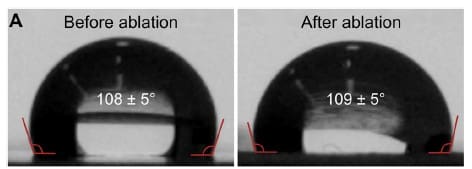
Side-by-side contact-angle images and values comparing unmodified Parafilm® versus Parafilm® after laser cutting/ablation of the paper (reported with n = 3).
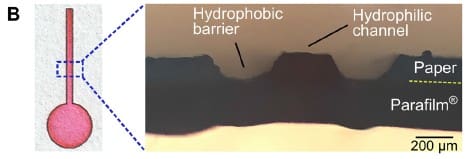
Top-view and cross-sectional microscopic images illustrating the laminated device structure and the hydrophobic barrier / hydrophilic channel geometry that accompanies the contact-angle characterization.
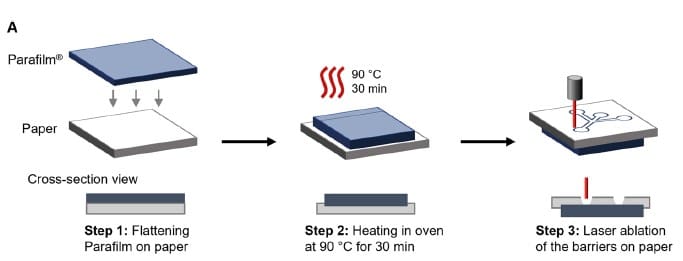
A schematic of the PHLC process showing lamination by oven heating followed by CO₂ laser ablation of patterns on the paper side.
Parafilm® serves as the hydrophobic component in the paper-lamination approach used to fabricate the µPADs in this study. The Dropometer-based water contact-angle measurements provide a direct check on Parafilm® wettability before and after the laser ablation step that patterns the paper side.
Within the authors’ fabrication discussion, the contact-angle comparison supports their assessment of how the chosen laser-ablation settings interact with the laminated Parafilm® layer during device fabrication.
The study measures water contact angle on pristine Parafilm® and after paper laser ablation to assess how the ablation step relates to Parafilm® hydrophobicity.
The post-ablation contact angle is measured on the Parafilm® layer exposed by completely ablating a 2.5 × 2.5 cm paper area from the laminated substrate.
The paper presents the contact-angle comparison in Figure 3A as part of the device characterization narrative around the PHLC fabrication workflow.
Figure 3A reports the contact-angle values with (n = 3).