Primary surface measurement reported
Static sessile-droplet contact-angle (hydrophobicity) measurements were performed on LIG electrode surfaces using 5 µl droplets of buffer solutions and DI water.

Client Citation Analysis
Static sessile-droplet contact-angle (hydrophobicity) measurements were performed on LIG electrode surfaces using 5 µl droplets of buffer solutions and DI water.
Hydrophobicity was analyzed using a Droplet lab DROPOMETER-M (Markham, ON, Canada), with contact angles calculated from a static sessile-droplet image using a polynomial (non-axisymmetric drop) method.
Goniometry was conducted to determine the hydrophobicity of LIG and nPt-LIG surfaces as part of the thesis’ surface characterization work (with methods and results provided in the appendix).
The thesis uses a sessile-droplet goniometry workflow to evaluate hydrophobicity on LIG electrodes. After LIG fabrication and preparation, electrodes were stabilized on the instrument platform using mounts, a 5 µl aliquot of buffer (MES pH 6.2, Tris pH 6.6, HEPES pH 7.5, 2X bicarbonate buffer pH 7.8) or DI water was pipetted onto the working area, and the instrument camera captured a static image in sessile droplet mode for contact-angle calculation. In software, key image features (e.g., edges) were identified following manufacturer recommendations, and contact angles were calculated using a polynomial (non-axisymmetric drop) method.
In the thesis’ surface characterization work, the contact-angle output is used to describe the hydrophobicity of LIG and nPt-LIG electrode surfaces.
The thesis measures hydrophobicity by pipetting a 5 µl droplet onto the LIG electrode working area and capturing a static image in sessile droplet mode for contact-angle calculation.
Contact-angle measurements were carried out using MES (pH 6.2), Tris (pH 6.6), DI water, HEPES (pH 7.5), and 2X bicarbonate buffer (pH 7.8).
The analysis workflow includes identifying key features in the droplet image (e.g., edges) within the software according to manufacturer recommendations.
Contact angle calculations were based on the polynomial (non-axisymmetric drop) method, with the thesis noting that Young–Laplace (axisymmetric) fitting showed significant error for the LIG surface.
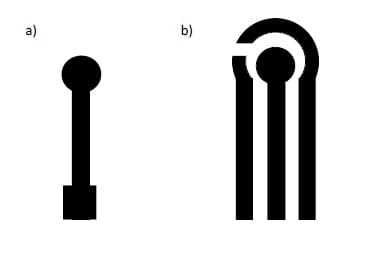
Shows the design of the single LIG electrode and the biochip layout, providing context for the “working area” referenced in the goniometry workflow.
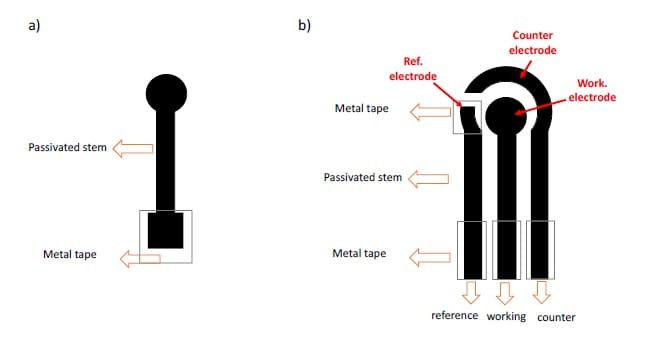
Illustrates the schematic preparation of the single LIG electrode and biochip, including passivated regions and connection areas associated with the sensor platform.
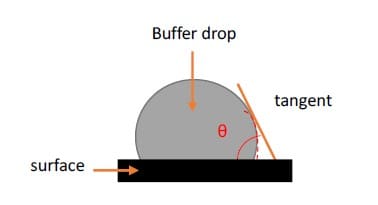
Provides a schematic “polynomial method illustration” showing a buffer drop on a surface with the tangent and contact angle (θ) indicated.
The thesis includes contact-angle goniometry as part of its surface characterization work for LIG-based electrodes used in an electrochemical aptasensor platform. By reporting a defined sessile-droplet workflow (drop volume, test liquids, imaging mode, and analysis approach), the study documents how hydrophobicity was assessed on the electrode material.
These surface measurements are presented alongside electrokinetic analysis used to determine surface charge (zeta potential), collectively describing key surface properties of LIG and nPt-LIG in the thesis’ materials characterization.
The study uses a static-image sessile droplet approach for contact-angle analysis on LIG electrodes.
Hydrophobicity was assessed using multiple aqueous solutions (MES, Tris, HEPES, 2X bicarbonate buffer) plus DI water, each with the pH specified for the buffers.
A consistent 5 µl aliquot was used for each contact-angle measurement condition described.
Contact angles were calculated using a polynomial (non-axisymmetric) method, with the workflow explicitly describing feature identification (e.g., edges) and the fitting approach used for this surface.