Primary surface measurement reported
Surface wettability was reported as water contact angle (θ) measured on instrumented SLA titanium surfaces.

Client Citation Analysis
Surface wettability was reported as water contact angle (θ) measured on instrumented SLA titanium surfaces.
"To evaluate the surface wettability, a droplet shape analyser (Dropometer, Droplet Lab, Canada) was employed to determine the contact angles." / "The images were analysed using dedicated software that utilises a polynomial fit to calculate the contact angle on the right and left sides." — Section 2.3.4, Surface wettability. These are the only two sentences in the paper that name the instrument; no model number, software version is given.
Contact angle results were presented in Table 2 and Fig. 6 and used to compare wettability differences across rotary brush decontamination groups relative to the control. The authors interpret wettability changes alongside the study's surface topography and composition characterisation to describe how mechanical instrumentation modifies implant-relevant surface properties.
"Contact angle measurements were taken from five discs in each group, with five repeat measurements obtained for each disc (n=125, 25 measurements per group). The mean contact angle was then computed for each group to yield a representative value for analysis." (Section 2.3.4). Note that Table 2 in fact reports median (range), not means, because the paper found that "normality assumptions were violated" and analysed the data with Kruskal-Wallis and Dunn-Bonferroni tests. Every contact angle value quoted on this page is a median.
The Dropometer measured water contact angle on the treated discs, producing Fig. 6 and one of the seven data columns in Table 2 — one of the paper's six figures. It was not the primary measurement instrument. Surface damage was established by FE-SEM (Fig. 4), surface chemistry by SEM-EDX (Fig. 5), and the other six Table 2 columns (Sa, Sz, Ssk, Sku, Sdq, Sdr) by optical profilometry. Wettability is the fourth and last of the study's four stated objectives.
Surface wettability was measured as contact angle (θ) using ultrapure water droplets deposited on treated SLA titanium surfaces and analysed by droplet shape analysis.
Surface morphology/topography was evaluated by field emission scanning electron microscopy (FE-SEM) and gross surface photography. Surface elemental composition was measured by SEM-EDX, and surface roughness was measured by 3-D optical profilometry using three-dimensional parameters (Sa, Sz, Ssk, Sku, Sdq, Sdr) following ISO 25178–2:2012.
EOS 600D (CANON, Japan)
Field Emission Scanning Electron Microscope (FE-SEM) (Quanta FEG 250, FEI Company, Hillsboro, Oregon, USA)
Energy-Dispersive X-ray Spectrometry (SEM-EDX; X-Max, Oxford Instruments, Oxford, England)
Aztec 3.3 (Oxford Instruments, Oxford, England)
3-D optical surface profilometer (TopMap Micro.View, Polytech, Baden-Württemberg, Germany)
TMS 4.2 (Polytech, Baden-Württemberg, Germany)
droplet shape analyser (Dropometer, Droplet Lab, Canada)
The authors used a droplet shape analyser (Dropometer, Droplet Lab, Canada) to determine water contact angles as a measure of surface wettability. An automated dispenser deposited a 3 µl ultrapure water droplet onto each treated surface at 23 °C, images were captured after 5 s, and dedicated software applied a polynomial fit to calculate contact angles on the right and left sides of the droplet; group mean contact angles were then computed as representative values for analysis.
In this study, Dropometer-derived contact angles were used to compare how different rotary brush decontamination methods changed wettability relative to the untreated control. The paper computes no statistical relationship between contact angle and any other measured property — the only correlation it reports is between two roughness parameters ("a strong positive correlation between Sa and Sdr (rs = 0.891, p<0.001)"). The link between wettability and the topographic and chemical changes is offered as an interpretation, not a measured association: "Interdependencies exist among implant surface properties; thus, modifying one property results in the alteration of others. Based on this, it is plausible to find that IB had the greatest impact on surface wettability because it has significantly changed surface topography and elemental composition."
"Results for the contact angle measurements (θ) are presented in Table 2 and Fig. 6. The Kruskal-Wallis test indicated significant differences between the decontamination groups (p<0.001)." (Section 3.4). Kruskal-Wallis was used because "normality assumptions were violated"; post hoc comparisons were Dunn-Bonferroni, and all reported values are medians with ranges.
Further analysis showed that the LB group's contact angle was similar to the control (p > 0.05), with medians of 85.9° (range 17.0) for LB and 84.8° (range 21.0) for the control in Table 2. This is the study's only null result on wettability, and it matches the Labrida BioClean group's null results on roughness and elemental composition — the soft marine-polymer brush left the surface essentially unchanged on all four measurements.
The paper's sentence covers three groups, not two: "the IB, NiTiB, and PIB groups exhibited significantly higher wettability (p<0.05) compared to the control, indicated by their significantly lower contact angles. The IB and PIB groups reduced the contact angle to a similar extent, while the NiTiB group reduced it to a lesser degree." Table 2 medians (range): IB 67.45° (12.50), PIB 65.3° (25.7), against a control of 84.8° (21.0). Note that PIB's median is the lowest in the study, below IB's — see the discrepancy flagged in Finding 4's card and in Practical Takeaway 3.
The NiTiB group was reported as significantly more wettable than the control (p < 0.05) but reduced contact angle to a lesser degree than IB and PIB (Table 2 median: 81.0°, range 18.3). One inconsistency inside the paper is worth flagging: the Discussion states that "IB had the greatest impact on surface wettability", but Table 2's lowest median contact angle belongs to PIB (65.3°) rather than IB (67.45°). The Results section treats the two as statistically indistinguishable, so the Discussion's superlative does not follow from the tabulated values.
The study's stated conclusion is about surface damage, not wettability: "Mechanical decontamination of implant surfaces utilising rotary brushes can alter implant surface properties. The brush material, design, and decontamination parameters, such as rotational speed, influence their effect on implant surface properties. i-Brush1, NiTiBrush Nano, and peri-implantitis brushes induced significant alterations in titanium implant surface properties, while Labrida BioClean brush demonstrated minimal impact on surface properties." The null hypothesis — that rotary brushes do not alter implant surface properties — was rejected. Contact angle was one of four measurements supporting that conclusion, alongside SEM morphology, EDX composition and optical profilometry.
EDX found that the i-Brush1 group's surface was no longer predominantly titanium: "SEM-EDX of the surfaces instrumented with IB reveal the presence of cobalt (Co), chromium (Cr), and molybdenum (Mo) as predominant elements on the surface, alongside iron (Fe), carbon (C), aluminium (Al), and traces of silicon (Si)" — deposited from the brush's stainless steel bristles. Nickel was detected on the NiTiBrush Nano surfaces, reflecting its nickel-titanium bristles, and the Labrida group showed raised carbon from marine-polymer bristle breakage. The paper attributes the wettability change to this combination of chemical and topographic alteration rather than to brushing alone: IB "had the greatest impact on surface wettability because it has significantly changed surface topography and elemental composition." A lower contact angle in the IB group is therefore a reading taken partly on deposited stainless steel, not on the implant alloy.
Roughness fell significantly in the IB, NiTiB and PIB groups across every parameter (p < 0.001 overall), while Labrida BioClean matched the control. Sa dropped from a control median of 1.53 µm to 0.88 µm for IB, and Sdr from 121.10% to 63.27%; the paper reports "a strong positive correlation between Sa and Sdr (rs = 0.891, p<0.001)". SEM showed the SLA honeycomb structure replaced by flattened, scratched islands, with loose abraded titanium particles on the IB, NiTiB and PIB surfaces. The authors note this "can modify cellular responses, which could negatively impact the re-osseointegration process," that "scratches and grooves created by brushes could lead to plaque attachment," and that titanium particles "may contribute to undesirable biological events, such as the development of peri-implantitis and osteolysis."
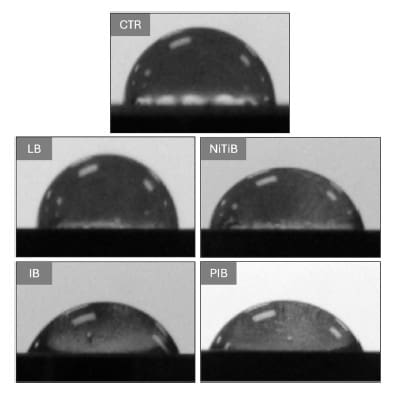
Shows representative water droplets used for contact-angle assessment of surface wettability across the decontamination groups.
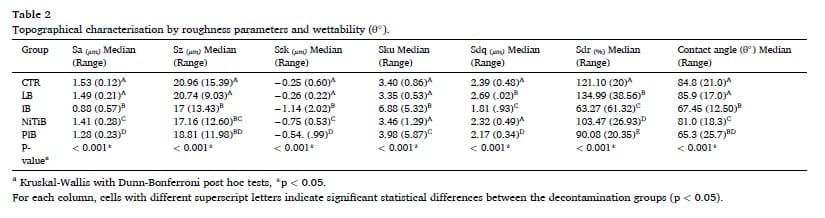
Lists median (range) values by group for six optical-profilometry roughness parameters — Sa, Sz, Ssk, Sku, Sdq, Sdr — plus one column of Dropometer contact angle (θ°). Contact angle is one of the table's seven data columns. Superscript letters mark statistically distinct groups under Dunn-Bonferroni post hoc testing; in the contact angle column the control and LB share letter A, IB and PIB share B, and NiTiB is C.
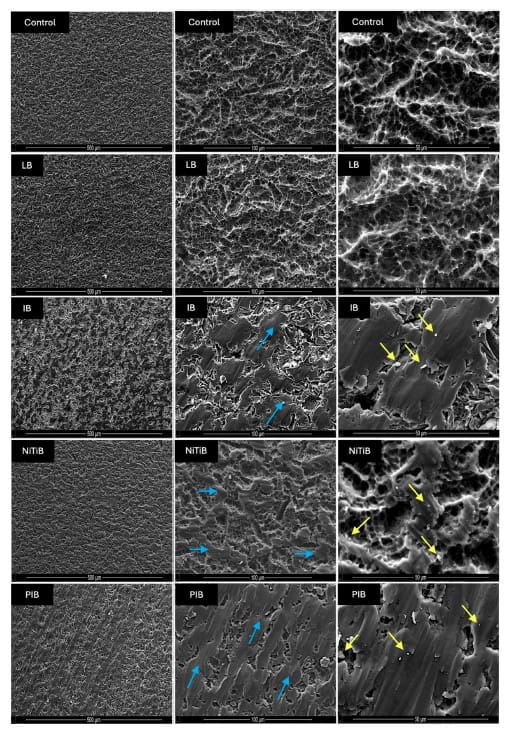
Provides FE-SEM images illustrating how rotary brush instrumentation altered SLA surface morphology, which the paper discusses alongside wettability results.
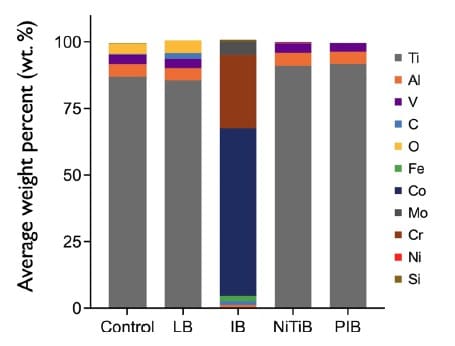
Summarises elemental composition (wt%) after mechanical instrumentation. LB, PIB and NiTiB broadly match the control (Ti, Al, V, O), with raised carbon after LB from polymer bristle breakage, slightly elevated titanium after PIB and NiTiB from abraded particles, and trace nickel after NiTiB. The IB group is the outlier: cobalt, chromium and molybdenum appear as predominant surface elements, with iron, carbon, aluminium and traces of silicon — stainless steel transferred from the brush bristles.
The authors frame peri-implantitis decontamination as a process that can modify implant surface properties, and they evaluate these changes by combining wettability (contact angle) with surface morphology, roughness, and elemental composition measurements. Within this approach, the contact angle data provide a direct, quantitative comparison of how different rotary brush systems influence surface wettability of SLA titanium.
The authors are explicit that the clinical value of the wettability change is unproven. Their Discussion reads: "Using metallic rotary brushes for implant surface decontamination represents a potential biological benefit as it improves implant surface wettability. However, most of the clinically marketed dental implants are hydrophobic, and the impact of enhancing the implant wettability on re-osseointegration is still unclear." They also note that the same instrumentation smoothed the surface, which "can modify cellular responses, which could negatively impact the re-osseointegration process," and deposited loose titanium particles that "may contribute to undesirable biological events, such as the development of peri-implantitis and osteolysis." The measurement is a characterisation result, not a demonstration of clinical benefit.
The study's own stated limits: "This study has certain limitations. Firstly, titanium discs were used instead of dental implants to ensure more precise surface characterisation, as working on implants with screw threads can be challenging. Additionally, only SLA titanium surfaces were examined, potentially limiting the applicability of our findings to other implant surfaces." All wettability values were taken on flat Grade 5 Ti 6Al-4V discs, five per group, at a single time point 5 s after droplet deposition. Every group in the study control and treated sat between 65° and 86°, so no surface tested here approaches the near-zero contact angles associated with the high-energy implant surfaces discussed in the wettability literature.
The study reports a defined protocol using a droplet shape analyser (Dropometer, Droplet Lab, Canada) with a 3 µl ultrapure water droplet, imaging at 5 s, and polynomial-fit analysis of left/right angles.
Contact angle results show that wettability changes depended on the rotary brush system, with IB, NiTiB and PIB reported as significantly more wettable than the control (p 0.05). In this study the brushes that raised wettability were the same brushes that flattened the SLA topography and left brush-derived elements on the surface, so a wettability shift here is a marker of surface alteration rather than a selection criterion.
The paper reports median (range) contact angles for each group — CTR 84.8° (21.0), LB 85.9° (17.0), IB 67.45° (12.50), NiTiB 81.0° (18.3), PIB 65.3° (25.7) — to compare decontamination methods on a common wettability metric. The card says "median (range)" but the ranges are as informative as the medians: PIB has both the lowest median and the widest spread in the study, while IB has the narrowest.
The contact angle results are discussed in the context of FE-SEM morphology, 3D roughness parameters, and SEM-EDX elemental composition to describe how mechanical instrumentation alters multiple surface properties.