Primary surface measurement reported
Water contact angle of HPLC grade water on permanent-marker–treated Whatman® Grade 4 filter paper was measured.

Client Citation Analysis
Water contact angle of HPLC grade water on permanent-marker–treated Whatman® Grade 4 filter paper was measured.
Contact angle measurements were performed using “a device called a Dropometer (Droplet Smart Tech Incorporation, Toronto, ON, Canada),” with images analyzed using the installed “Sessile” mobile application.
The authors used water contact angle (alongside leakage analysis) to compare four permanent marker colors and select inks with favorable hydrophobic barrier performance for µPAD fabrication.
Each bar in the reported contact angle comparison represents the mean of three individual experiments ± standard deviation.
Water contact angle of HPLC grade water on permanent-marker–treated Whatman® Grade 4 filter paper was used to compare marker ink hydrophobicity.
Elution (wicking) velocity was determined for multiple Whatman paper grades by dipping paper strips into HPLC grade water and observing wicking versus time at room atmospheric conditions. Leakage analysis was used to compare barrier performance of devices fabricated with different marker colors. The µPAD outputs were also evaluated via colorimetric response for qualitative and quantitative determination of total water hardness.
Dropometer (Droplet Smart Tech Incorporation, Toronto, ON, Canada); Sessile mobile application
Hewlett-Packard LaserJet P4015× Printer (EconoMode setting)
GraphPad Prism 8 software
smart-phone or mobile scanner; ImageJ software
oven (Thermo ScientificTM PrecisionTM Compact Gravity Convention, ThermoFisher Scientific, Mississauga, ON, Canada); conditioned laboratory refrigerator (4 °C)
The Dropometer was used to measure the water contact angle on paper surfaces treated with permanent marker inks. The Whatman® Grade 4 filter paper was cut into 2 cm × 2 cm squares, the four marker colors (blue, green, red, black) were applied, and HPLC grade water was dispensed via the sample application syringe onto each treated square sheet. Images were captured and analyzed using the installed Sessile mobile application to obtain contact angle results.
In the study workflow, the Dropometer contact angle results were used to compare marker ink hydrophobicity and support the selection of marker colors for creating hydrophobic barriers in the fabricated µPAD.
After 10 s, the reported contact angles were 144 deg. (black), 151 deg. (blue), 145 deg. (red), and 158 deg. (green) on Whatman® Grade 4 filter paper.
Based on water contact angle, the authors reported the hydrophobic strength order as green marker > blue marker > red marker ≈ black marker.
An investigation of contact angles over 60 s showed similar results to those at 10 s, which the authors interpret as the pigments retaining hydrophobicity over time.
Using water contact angle together with leakage analysis, the authors selected the green and blue markers for creating hydrophobic barriers in the µPAD.
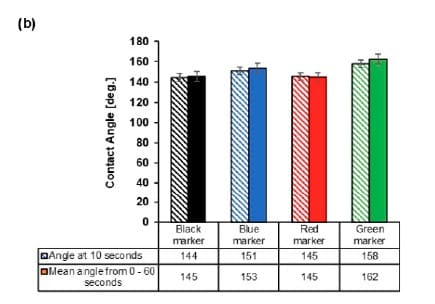
Shows contact angle measurement over time for black, blue, red, and green markers on Whatman® Grade 4 filter paper upon exposure to drops of HPLC grade water (including measurement at 10 s and mean measurement over 60 s).
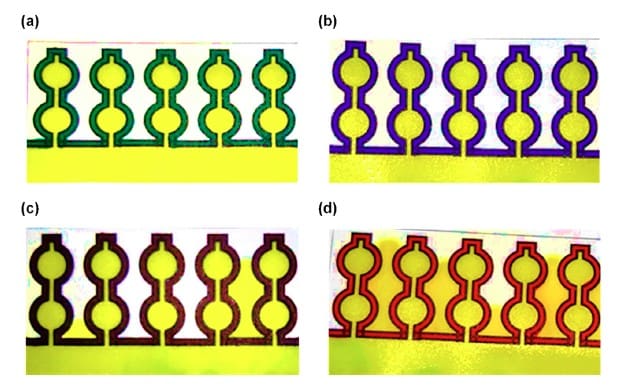
Shows leakage outcomes for devices fabricated with different marker colors after dipping into colored HPLC grade water, used to support selection of green and blue inks.
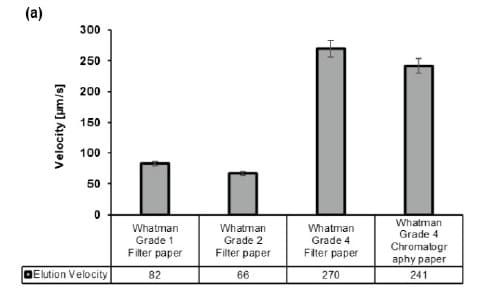
Shows elution velocity of distilled water in different paper grades and supports the choice of Whatman® Grade 4 filter paper for faster wicking.
The paper’s fabrication approach relies on forming well-confined hydrophilic channels on paper using hydrophobic barriers created by permanent marker inks. Within that workflow, the contact angle measurements provide a quantitative wettability comparison across marker colors applied to the chosen paper substrate.
By pairing contact angle results with leakage analysis, the authors used surface wetting behavior to inform practical fabrication decisions (marker color selection) that affect barrier performance in the µPAD used for total water hardness determination.
The study uses Dropometer-measured water contact angle to compare hydrophobicity across four permanent marker ink colors applied to Whatman® Grade 4 filter paper.
Contact angles were reported at 10 s after droplet deposition and also evaluated over 60 s to compare short-time and time-extended behavior.
The fabrication workflow combines contact angle measurements with leakage analysis (colored HPLC grade water dipping) to select marker colors for hydrophobic barriers.
Paper grade selection was informed by elution (wicking) velocity measurements prior to finalizing the substrate used for the µPAD.