Primary surface measurement reported
Water contact angle of HPLC-grade water on Whatman® Grade 4 filter paper treated with four permanent-marker colors (blue, black, green, red).

Water contact angle of HPLC-grade water on Whatman® Grade 4 filter paper treated with four permanent-marker colors (blue, black, green, red).
Contact angle measurements were determined using the “Dropometer (Droplet Smart Tech Incorporation, Toronto, ON, Canada),” with images captured and analyzed using the installed Sessile mobile application.
Contact-angle results were used to compare marker-color hydrophobicity and guide selection of marker colors used to create hydrophobic barriers in the paper-based device, alongside leakage analysis.
Figure 4-1 caption states each bar represents the mean of three individual experiments ± standard deviation.
Water contact angle measured on permanent-marker-treated Whatman® Grade 4 filter paper using HPLC-grade water, reported at a 10 s timepoint and as a mean over 60 s (Figure 4-1(b)).
Elution velocity of water in different grades of paper was measured to support paper-type selection (Figure 4-1(a)). Leakage analysis was performed by dipping marker-fabricated devices into colored water for 4 minutes to evaluate boundary resistance (Figure 4-2).
Dropometer (Droplet Smart Tech Incorporation, Toronto, ON, Canada)
Contact angle image analysis: Installed Sessile mobile application
Calibrated Micropipettes (Sartorius)
Microsoft PowerPoint 2019 software
Hewlett-Packard LaserJet P4015× Printer (EconoMode printer setting)
The Dropometer was used to determine the contact angle of HPLC-grade water on permanent-marker-treated paper substrates. Grade 4 Whatman filter paper was cut into 2×2 cm square sheets, four permanent marker colors were applied, HPLC water was fed into the sample application syringe and an aliquot was ejected on each square sample, and the droplet image was captured and analyzed using the installed Sessile mobile application to obtain contact-angle values.
The resulting contact-angle comparisons supported marker-color selection for creating hydrophobic barriers in the microfluidic paper-based device.
After 10 seconds, contact angles were observed as 144 deg. (black), 151 deg. (blue), 145 deg. (red), and 158 deg. (green) for HPLC-grade water on marker-treated Whatman® Grade 4 filter paper.
Based on the water contact-angle measurements, hydrophobic strength was reported as green marker > blue marker > red marker ≈ black marker.
Contact angles investigated over 60 seconds showed similar results to the 10-second measurements, and this was linked to marker pigments retaining hydrophobicity over time.
Devices fabricated with green and blue marker boundaries did not show any sign of leakage, while black and red marker fabricated devices leaked after 4 minutes in colored water.
Following wettability and leakage evaluation, the green and blue markers were utilized to create hydrophobic barriers for flow through the device.
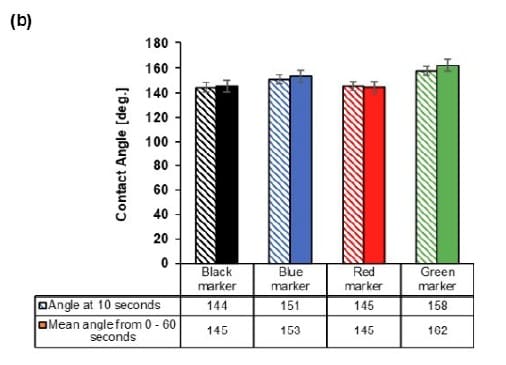
Shows contact angle measurement over time for black, blue, red, and green markers on Whatman® Grade 4 filter paper, including a 10 s measurement and a mean over 60 s.
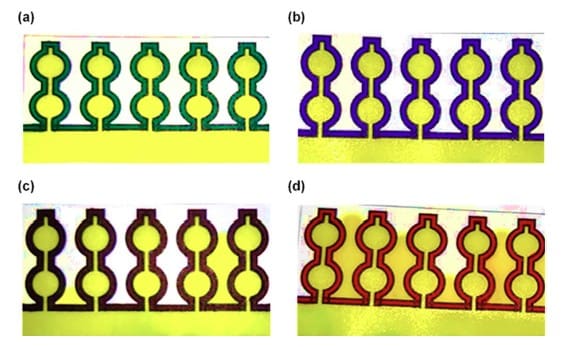
Shows leakage analysis images for devices fabricated with green, blue, black, and red marker colors.
In the fabrication optimization workflow for the microfluidic paper-based analytical device, the contact-angle measurements from the Dropometer provided a quantitative basis for comparing the hydrophobic behavior of different permanent-marker inks on the selected paper substrate.
These wettability results were used alongside leakage analysis to justify which marker colors were used to form hydrophobic barriers that support confined flow paths in the device.
The study measured water contact angle on Whatman® Grade 4 filter paper after applying different marker colors to compare their hydrophobic strength.
Contact angles were evaluated at 10 seconds and also investigated over 60 seconds to compare marker performance over a short time window.
Leakage analysis by dipping devices into colored water for four minutes was used alongside contact-angle results to evaluate barrier resistance.
The thesis uses the combined wettability and leakage outcomes to select green and blue markers for creating hydrophobic barriers in the device.