Primary surface measurement reported
Water contact angles (sessile DI water drops) on blade-cast elastomer films.

Client Citation Analysis
Water contact angles (sessile DI water drops) on blade-cast elastomer films.
The paper states that “the shape of the droplet was captured by using the Droplet Lab Dropometer,” with contact angles determined in “smart mode” in Droplet Lab’s Sessile software using Young–Laplace and polynomial methods.
Water contact angles were reported for TES-1 and spacer-grafted samples (DMFS and TMAS series) as a function of graft ratio to compare fluorine- and nitrogen-containing spacers and interpret changes in surface hydrophilicity/hydrophobicity (Figure 4c).
For each sample, a total of five measurements were conducted.
Water contact angles were measured using sessile DI water droplets on elastomer films prepared by blade-casting on glass slides.
The study reports rheological testing under UV illumination, tensile testing, NMR measurements, FTIR measurements, and GPC testing, alongside demonstrations of UV forming/healing and 3D printing.
Droplet Lab Dropometer; Droplet Lab’s Sessile software (“smart mode”)
TA HR 20 discovery hybrid rheometer; Omnicure S2000 spot UV curing system
Tension geometry attachment to the TA HR 20 discovery hybrid rheometer
JEOL ECZ400S 400 MHz spectrometer
Thermo Fisher Scientific Nicolet iS-50 FT-IR spectrometer with diamond attenuated total reflection (ATR)
Agilent 1260 Infinity system (refractive index detector)
Anycubic Mono 4 DLP printer
Thinky mixer
A droplet (~5 µL) of deionized (DI) water was applied to blade-cast elastomer films (~100 µm thick), and the droplet shape was captured by using the Droplet Lab Dropometer to obtain water contact angles. Contact angles were determined in “smart mode” in Droplet Lab’s Sessile software, which the authors state employs both Young–Laplace and polynomial methods for calculation.
In the Results section, the contact-angle measurements are used to compare how fluorine- and nitrogen-containing spacer grafts shift surface hydrophobicity/hydrophilicity as a function of graft ratio (Figure 4c).
The paper reports that “the water contact angle increases with increasing fluorine content.” When no fluorine is present, the contact angle is 98.4°, and incorporation of 0.32% fluorine raises it to 118°.
At a graft ratio of 1.56% (fluorine case), the reported water contact angle increases to 125°.
The paper reports that water contact angle decreases with increasing nitrogen content, with incorporation of 1.56% TMAS resulting in a decrease of approximately 10° in contact angle (described as a slight increase in surface hydrophilicity).
The authors state that incorporating different spacers demonstrates a clear structure–property relationship, and the contact-angle results are part of the evidence that spacers can serve as a modular design element for property tuning.
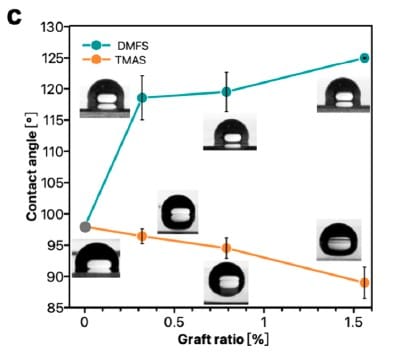
Plots water contact angles for TES-1, DMFS-1/2/3, and TMAS-1/2/3 as graft ratios increase, showing opposite-direction trends for fluorine vs nitrogen spacer series.
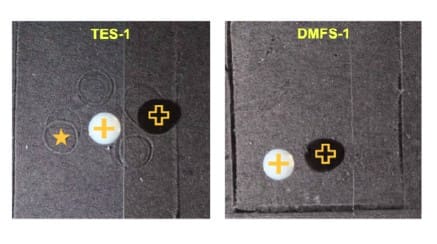
Shows images of milk droplets rolling on TES-1 and DMFS-1 surfaces, illustrating a difference in surface behavior (including traces and shadows noted in the caption).
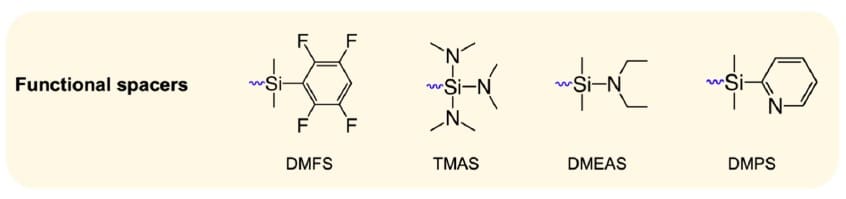
Provides a visual summary of how functional spacers relate to reported responsive material properties, including the surface-property change associated with fluorinated spacers.
The study’s spacer-grafting strategy is presented as a way to tune bottlebrush elastomer properties by attaching small silane molecules as spacers on the polymer backbone. Within that framework, the water contact-angle measurements provide a direct surface-property readout showing how fluorine- and nitrogen-containing spacers shift hydrophobicity/hydrophilicity.
In the paper’s discussion, these contact-angle trends support a structure–property relationship argument: small changes in spacer chemistry and graft ratio correspond to measurable, directional changes in surface wettability, alongside the broader UV-responsive forming/healing behavior reported for the elastomer system.
Blade-cast films (~100 µm) were tested with ~5 µL DI water droplets, with droplet shape captured by using the Droplet Lab Dropometer and contact angles computed in Droplet Lab’s Sessile software (“smart mode”).
The paper reports a change from 98.4° (no fluorine) to 118° at 0.32% fluorine, and up to 125° at a 1.56% graft ratio (fluorine case).
At 1.56% TMAS, the paper reports an approximately 10° decrease in contact angle, interpreted as a slight increase in surface hydrophilicity.
The paper uses contact-angle vs graft-ratio comparisons (Figure 4c) to distinguish fluorine- vs nitrogen-containing spacer effects on surface wettability within the broader elastomer design space.