Primary surface measurement reported
Sessile water contact angles were measured on FL‑CNx films prepared with 0%, 10%, 20%, and 30% N₂ plasma discharge gas to summarize surface wettability.
Client Citation Analysis
Sessile water contact angles were measured on FL‑CNx films prepared with 0%, 10%, 20%, and 30% N₂ plasma discharge gas to summarize surface wettability.
A commercially available contact angle instrument (“Dropometer, Droplet Lab, Toronto, ON”) is cited as the reference used to verify PTFE contact-angle measurements from the authors’ microscope-based setup.
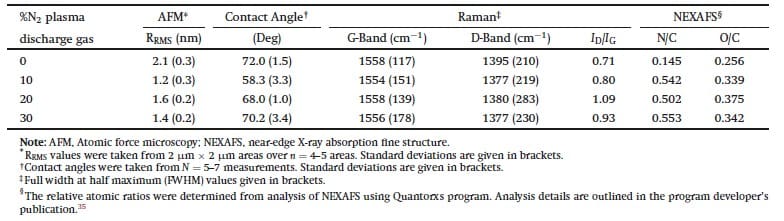
Water contact angles are summarized across the four FL‑CNx film conditions (Table 1) and are compared with SPR association kinetics for fibrinogen and human serum albumin as a function of the N₂ plasma discharge gas fraction (Fig. 4).
Contact angles were taken from N = 5–7 measurements, with standard deviations reported in brackets (Table 1 note).
Sessile water contact angle (degrees) was reported as a surface wettability metric for FL‑CNx films prepared with different %N₂ plasma discharge gas (Table 1).
Film surface topography/roughness was characterized by AFM and reported alongside Raman spectroscopy and NEXAFS-derived atomic ratios in Table 1. Protein–surface binding kinetics (HSA and fibrinogen) were measured by SPR and compared with wettability trends (Fig. 4).
The paper cites a commercially available contact angle instrument as a verification reference for the authors’ home-built sessile contact-angle setup. The authors measured the contact angle of a PTFE film as 107.3 ± 2.2°, and report that this value falls within the measured range (108.7 ± 2.5°) of a commercially available contact angle instrument specified as “Dropometer, Droplet Lab, Toronto, ON.”
In the study workflow, the resulting water contact-angle dataset is used to compare wettability across FL‑CNx films prepared with different %N₂ plasma discharge gas and to present wettability alongside SPR association kinetics for HSA and fibrinogen (Fig. 4).
The authors report a PTFE contact angle of 107.3 ± 2.2° from their setup, and state it falls within the measured range (108.7 ± 2.5°) of a commercially available contact angle instrument (“Dropometer, Droplet Lab, Toronto, ON”).
Water contact angles reported in Table 1 are 72.0 (1.5)° (0% N₂), 58.3 (3.3)° (10% N₂), 68.0 (1.0)° (20% N₂), and 70.2 (3.4)° (30% N₂).
The conclusions state that nitrogen incorporation improved hydrophilic surface properties, with FL‑CNx‑10 showing the best wettability.
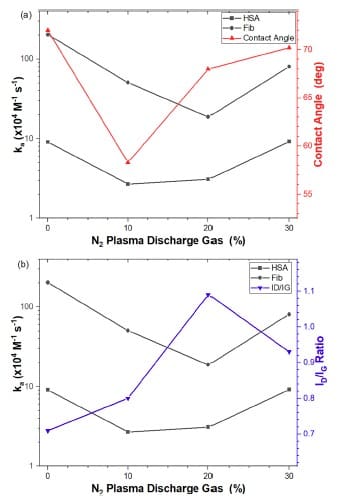
Figure 4 compares ka kinetics for fibrinogen and human serum albumin with the film surface wettability across the %N₂ plasma discharge gas series.
The discussion around Fig. 4 states that introducing higher at% N into the films (FL‑CNx‑10 and FL‑CNx‑20) reduced ka values by an order of magnitude for both HSA and fibrinogen, and that this trend reverses for the FL‑CNx‑30 film.
Lists water contact angle (Deg) for FL‑CNx‑00/10/20/30 alongside AFM roughness, Raman parameters, and NEXAFS-derived atomic ratios.
Shows the comparison of ka kinetics (HSA and fibrinogen) with the film surface wettability for films prepared with different %N₂ plasma discharge gas.
The paper frames surface coatings for biomedical contexts in terms of chemistry at the outer surface interface, where proteins adsorb rapidly after contact with biofluids and can mediate subsequent interactions. Within this context, the authors report water contact angles as a wettability descriptor for FL‑CNx films prepared across a controlled N₂/Ar plasma discharge gas series.
The contact-angle dataset (Table 1) is then used as part of the paper’s comparison between film surface properties and protein–surface interaction behavior, including a direct comparison between wettability and SPR association kinetics for human serum albumin and fibrinogen (Fig. 4).
The paper credits “Dropometer, Droplet Lab, Toronto, ON” as the commercially available contact angle instrument used as a reference range for verifying PTFE contact-angle measurements from the authors’ setup.
Water contact angles are reported for films prepared with 0%, 10%, 20%, and 30% N₂ plasma discharge gas, enabling a direct wettability comparison across the deposition series (Table 1).
Table 1 reports the contact angle minimum at 10% N₂ (58.3 (3.3)°), and the conclusions describe FL‑CNx‑10 as showing the best wettability.
The paper presents contact angle (wettability) together with SPR association kinetics (ka) for fibrinogen and HSA across the %N₂ series (Fig. 4), and discusses order-of-magnitude changes in ka with nitrogen incorporation and a reversal at the 30% N₂ condition.