Contents

Client Citation Analysis

Fluorophilic boronic acid copolymer surfactant for stabilization of complex emulsion droplets with fluorinated oil

This communication introduces a fluorophilic boronic acid (FBA) copolymer surfactant and uses pendant-drop surface tension measurements to quantify how FBA and poly(vinyl) alcohol (PVA) alter fluorinated oil–water interfacial tension in support of emulsion-stabilization conclusions.

At-a-Glance Summary

Primary surface measurement reported

Pendant-drop surface tension measurements of fluorinated oil–water interfaces, reported as surface tension values and distributions across additive conditions.

Dropometer attribution in the paper

Surface tensions are characterized using the pendant drop method on the “droplet lab tensiometer” and analyzed with the OpenDrop package.

How the surface-tension / contact-angle data were used in the study

The surface tension outputs are used to compare PFH–water interfaces with and without FBA (in PFH) and/or PVA (in water), and to contextualize the observation that lasting stabilization against coalescence is obtained for the combined FBA–PVA system.

Paper Details

Title
Fluorophilic boronic acid copolymer surfactant for stabilization of complex emulsion droplets with fluorinated oil
Authors
Zhang Wu; Brendan T. Deveney; Jörg G. Werner; Stefano Aime; David A. Weitz
Journal
Lab on a Chip
Year
2025
Volume
25
Pages / Article
2315–2319

Journal context

What it is
Journal-level metrics for the publication venue (not a rating of this specific article).
How to read it
Compare metrics within category; updates are annual and lag current-year publications.

Scopus metrics (Elsevier / Scopus rating 2024)

CiteScore 2024

10.8

CiteScore subject ranks (CiteScore 2024)
  • Q1 - Biochemistry, Genetics and Molecular Biology - Biochemistry (47/441)
  • Q1 - Chemistry - Chemistry (all) (51/404)
SNIP 2024

1.163

SJR 2024

1.201

Journal Impact Factor (Clarivate JCR)

Journal Impact Factor (JCR 2024)

5.4

What Was Measured

Primary surface / interfacial measurement

Surface tension of fluorinated oil–water interfaces was quantified via pendant-drop tensiometry, including PFH–water interfaces compared across additive conditions involving FBA (in PFH) and PVA (in deionized water).

Supporting measurements

Interfacial rheology was used to assess the rheological properties of the FBA–PVA interfacial film using oscillatory amplitude and frequency sweeps with a double wall ring configuration. Imaging (bright-field and fluorescent confocal micrographs) was used to characterize droplet and microcapsule morphologies at room temperature and approximately 0 °C.

Role of the Dropometer

Using the pendant drop method on the “droplet lab tensiometer,” the authors characterized surface tensions of fluorinated oil–water interfaces and analyzed droplet shapes with the OpenDrop package to obtain surface tension values (mN m−1) for PFH–water interfaces under different additive conditions.

These pendant-drop surface tension measurements provide a quantitative comparison of how FBA in the fluorinated oil phase and PVA in the aqueous phase change PFH–water interfacial tension alongside the study’s coalescence-stabilization observations.

Method Snapshot

Method Snapshot Table

System / interface (as shown) Fluorinated oil phase Aqueous phase Surface measurement output Analysis approach Data figure(s) Conditions / notes
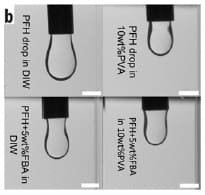
PFH/DIW PFH Deionized water (DIW) Surface tension distribution (boxplot + individual points) Pendant drop method on the “droplet lab tensiometer”; OpenDrop analysis Fig. 2b–c PFH–water drop interfaces presented as grayscale pendant-drop images and boxplots
PFH + FBA/DIW PFH + FBA (in PFH phase) DIW Surface tension distribution (boxplot + individual points) Pendant drop method on the “droplet lab tensiometer”; OpenDrop analysis Fig. 2b–c Condition explicitly compared against PFH/DIW
PFH/PVA–water PFH PVA in DIW phase (“PVA–water”) Surface tension distribution (boxplot + individual points) Pendant drop method on the “droplet lab tensiometer”; OpenDrop analysis Fig. 2b–c Condition explicitly compared against PFH/DIW
PFH + FBA/PVA–water PFH + FBA (in PFH phase) PVA in DIW phase (“PVA–water”) Surface tension distribution (boxplot + individual points) Pendant drop method on the “droplet lab tensiometer”; OpenDrop analysis Fig. 2b–c Surface tension compared against single-additive cases; presented as boxplots with outliers marked

Key Findings

FBA lowers PFH–water interfacial tension

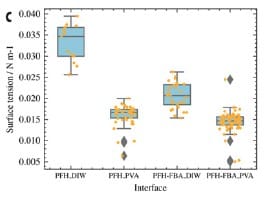
Adding FBA to PFH reduces the interfacial tension of the PFH–water interface to around 20 mN m−1, compared to approximately 30 mN m−1 without additives.

PVA lowers PFH–water interfacial tension

Adding PVA to water reduces the interfacial tension of the PFH–water interface to around 17 mN m−1.

Combined FBA + PVA yields similar surface tension

A similar surface tension is obtained when using the combination of FBA-in-PFH and PVA-in-water, as shown in the surface tension measurements.

Lasting stabilization aligns with the combined FBA–PVA system

Lasting stabilization against coalescence of fluorocarbon–water emulsions is obtained for the combined FBA–PVA system, and the authors conclude that synergistic interfacial assembly of FBA and PVA is necessary for stabilization.

Figures & Visuals

Figure 2b — Pendant-drop images supporting the tensiometry workflow

What it shows

Selected grayscale pendant-drop images for PFH–water interfaces with and without FBA in the PFH phase or PVA in the DIW phase.

Figure 2c — Surface tension distributions across PFH–water interface conditions

What it shows

Boxplots and individual data points show the distribution of surface tension values for PFH/DIW, PFH/PVA–water, PFH + FBA/DIW, and PFH + FBA/PVA–water interfaces.

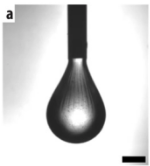
Figure 2a — Visual interfacial behavior presented alongside the surface measurements

What it shows

Transient wrinkle formation during retraction of an HFE-7500 drop containing FBA from a water bath containing HEPES and PVA is shown as a visual indicator of interfacial film behavior in the combined-component system.

Why It Matters

The pendant-drop surface tension measurements provide the paper’s quantitative baseline for how FBA (in PFH) and PVA (in water) change PFH–water interfacial tension, enabling direct comparison across four interface conditions presented in Fig. 2b–c.

Within the paper’s conclusions, the surface tension measurements are interpreted alongside emulsion observations to support the view that similar interfacial tension values can occur across different additive conditions, while lasting stabilization against coalescence is associated with the combined FBA–PVA system and its interfacial assembly.

Practical Takeaways

Condition-to-condition interfacial comparison

Pendant-drop tensiometry is used to compare PFH–water interfaces across baseline, FBA-only, PVA-only, and combined FBA–PVA conditions in a single figure set (Fig. 2b–c).

Distribution-first reporting

Surface tension is presented as boxplots with individual data points and outliers, supporting interpretation based on distributions rather than a single summarized value.

Tie surface tension to formulation outcomes

The study uses the measured PFH–water surface tensions to contextualize emulsion coalescence behavior, highlighting that lasting stabilization is linked to the combined FBA–PVA system even when surface tension values are similar across conditions.

Pair tensiometry with interfacial mechanics when relevant

Surface tension measurements are complemented by interfacial rheology to characterize the interfacial film properties associated with the FBA–PVA system.

Download Experiment