Primary surface measurement reported
Water contact angles (WCAs) were measured on the adaxial surface of refoliated quaking aspen leaves during the 2021 refoliation period.

Client Citation Analysis
Water contact angles (WCAs) were measured on the adaxial surface of refoliated quaking aspen leaves during the 2021 refoliation period.
The Methods attribute WCA measurements to a “contact angle measurement system (Droplet Lab Dropometer).”
WCA data were presented as a function of time during the refoliation period and compared against previously reported seasonal wettability datasets to discuss how refoliated leaves develop and maintain non-wettability after budbreak. The WCA results were also discussed alongside SEM observations of evolving microscale papillae and nanoscale epicuticular wax features.
At least 9 contact angle measurements were conducted per sample, and averages with standard deviations were reported.
Water contact angles (WCAs) on the adaxial (upper) leaf surface, measured using deionized water droplets and reported as averages with standard deviations.
Leaf size was quantified in two directions (parallel and perpendicular to the midrib) using image-based measurement. Leaf surface morphology development during refoliation was characterized by SEM, including measurements of papillae and epicuticular wax (ECW) feature sizes.
contact angle measurement system (Droplet Lab Dropometer)
ImageJ
scanning electron microscope (Hitachi SU7000)
The “contact angle measurement system (Droplet Lab Dropometer)” was used to measure water contact angles on the adaxial surface of refoliated quaking aspen leaves. Leaves were mounted on 2 × 2 × 0.5 cm plexiglass coupons using double-sided tape, and 10 μL deionized water droplets were dispensed on the leaf surface to obtain WCA values reported as averages with standard deviations. The roll-off angle could not be obtained. The Methods state: "The roll-off angle of the water droplets could not be measured accurately. This was due to the poor adhesion of the droplets to the surface which caused the droplets to immediately roll off with the slightest disturbance, e.g. the engagement of the tilt stage on the contact angle measurement system." The leaf surface was too non-adhesive for the tilt stage to produce a usable measurement; an instrument limitation on this sample, and also direct evidence of how little the droplets stick.
In this study, Dropometer-derived WCA data function as the quantitative wetting metric used to track refoliated leaf non-wettability over time and to support comparisons against prior seasonal wettability datasets discussed by the authors.
The 2012 comparison series plotted in Figs. 3 and 4 are from Tranquada & Erb (2014), a prior publication. The remaining columns of Table 1 (papillae base diameter, peak-valley height, ECW height, length and platelet thickness) are SEM measurements.
During the July 18–August 26, 2021 study period, the paper reports average WCA values ranging from 139.7° ± 3.5° to 150.1° ± 1.9° (summarized in Supplementary Materials S7, Table S2).
The Results describe Fig. 2(b–c) as evidence that the leaf surface attained a superhydrophobic wetting state, with a measured WCA > 145°.
When comparing refoliated leaves (2021) to an initial growth-stage dataset from 2012 from Tranquada & Erb (2014), the paper states that leaves collected 2 days after budbreak (July 18, 2021) were already highly hydrophobic, and that the maximum average WCA after 13 days was 150.1° ± 1.9° (Table S2 in Supplementary Materials S7).
In the comparison presented in Fig. 3, the paper reports that refoliated 2021 leaves maintained strong non-wettability until July 31, followed by a slight decrease of WCA in August; this is discussed alongside the seasonal “transition period” described for the 2012 dataset from Tranquada & Erb (2014)
The paper ties WCA behavior to surface structure development by discussing SEM-observed papillae and epicuticular wax (ECW) morphology through the refoliation period and presenting a correlation table (Table 1) linking micro/nano roughness metrics with wetting properties.
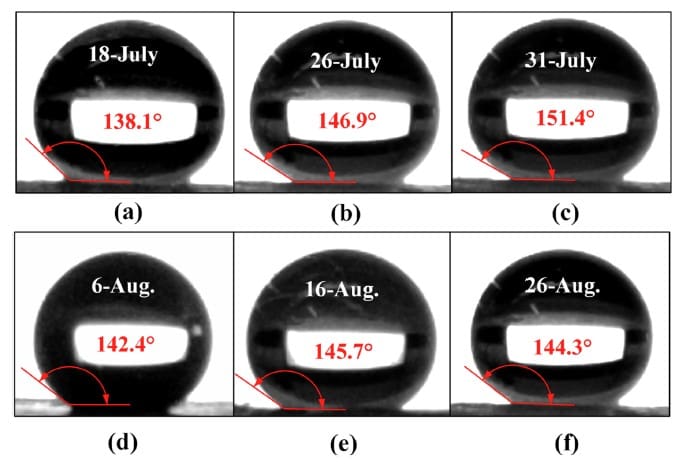
Shows example contact angles of individual water droplets on refoliated leaf surfaces for collection dates spanning July 18 through August 26, 2021.
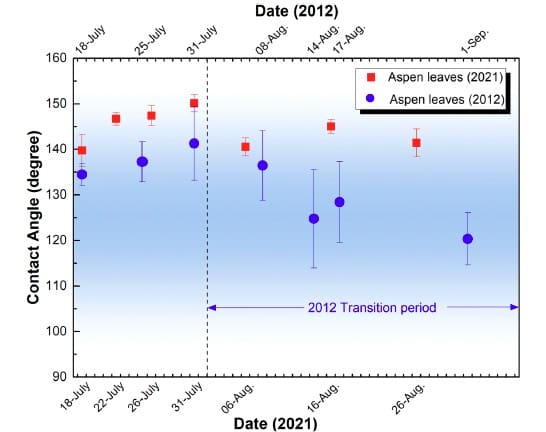
Compares average WCAs (with standard deviations) for the 2021 refoliation period against a same-calendar-window dataset from a normal growth season (2012).
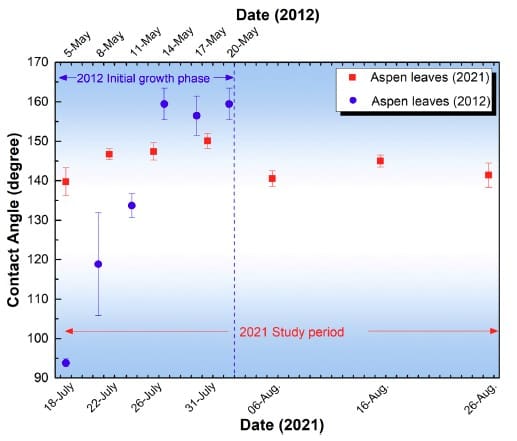
Compares average WCAs (with standard deviations) from the 2021 refoliation period against an initial growth and development phase dataset from 2012.
In this paper, water contact angle is the primary quantitative metric used to assess non-wettability of refoliated aspen leaves and to track how that wetting behavior evolves across the refoliation period.
By combining Dropometer-based WCA measurements with SEM-based descriptions of papillae and epicuticular wax development, the authors connect wetting behavior to evolving dual-scale surface structure and use comparisons to prior seasonal datasets to frame how refoliation differs from a normal growth season.
The Methods describe mounting leaves on 2 × 2 × 0.5 cm plexiglass coupons using double-sided tape to support WCA measurement on the adaxial surface.
The paper reports dispensing 10 μL deionized water droplets for WCA measurements.
The paper reports at least 9 contact angle measurements per sample and presents averages with standard deviations.
WCA measurements were used to track refoliated leaf wetting behavior across multiple collection dates and to support comparisons to previously reported seasonal wettability datasets discussed in the Results.
Tilt-stage roll-off measurement failed on refoliated aspen leaves: droplets rolled off at the slightest disturbance, including engaging the tilt stage itself. If you are characterising very low-adhesion surfaces, expect roll-off angle to be the limiting measurement and plan a lower-disturbance approach.