Primary surface measurement reported
Contact angles (static and dynamic) and roll-off angles were measured on ski wax prototypes, commercial ski waxes, and ingredients using water and ethylene glycol at 23 °C, plus ethylene glycol at −5 °C.

Client Citation Analysis
Contact angles (static and dynamic) and roll-off angles were measured on ski wax prototypes, commercial ski waxes, and ingredients using water and ethylene glycol at 23 °C, plus ethylene glycol at −5 °C.
The report credits the supplier, not a product model: "A portable contact angle instrument (tensiometer) was rented from Droplet Lab (Toronto, Canada) to perform contact angle measurements in sub-zero temperatures" (Section 2.2.2). The report does not name which Droplet Lab instrument was used.
Contact angle and roll-off angle outputs were used to compare hydrophobicity of bio-based prototypes versus commercial ski waxes and to evaluate differences among individual ingredients, including sub-zero (−5 °C) conditions relevant to ski wax use. Surface-tension components for the test liquids (water and ethylene glycol) are provided (Table 1) as values obtained from the Dataphysics software.
In total 4-5 droplets per sample were analysed" (Section 2.2.2). This replicate count applies to the sub-zero Droplet Lab measurements only.
The rented Droplet Lab device produced one dataset: static contact angles and approximate roll-off angles with ethylene glycol at −5 °C, shown in the report's Figure 13. All room-temperature contact angle work — water and ethylene glycol, static, advancing, receding and roll-off — was done on a Dataphysics OCA 40 with a tilt-table. Hardness, biodegradation and on-snow glide testing used separate equipment entirely. Of the report's 20 figures, one contains Droplet Lab data.
Hydrophobicity was quantified using contact angle measurements (static and dynamic) and roll-off angles for ski wax prototypes, commercial ski wax products, and ingredients in room temperature (23 °C, 50% RH) and at −5 °C (ethylene glycol).
Hardness of ski waxes was measured at −5 °C using a compression test (with reported parameters including hardness, work of penetration, and resistance to probe withdrawal). Biodegradation was evaluated via a respiration test in compost where conductivity measurements were used to calculate sodium carbonate concentration and convert results to produced mg CO₂/g VS and mg CO₂/g TOC, and glide performance was assessed via outdoor snow glide tests.
OCA 40 Micro from Dataphysics with a tilt-table
“portable contact angle instrument (tensiometer) … rented from Droplet Lab (Toronto, Canada)”
Texture Analyser (Stable Microsystems, UK) equipped with a temperature-controlled chamber
A portable contact angle instrument rented from Droplet Lab (Toronto, Canada) was placed in a freezer room at RISE at −5 °C to measure contact angles at sub-zero temperature. The report describes it only as "a portable contact angle instrument (tensiometer)" and does not name a model. Measurements used ethylene glycol as the liquid, with static contact angles and approximate roll-off angles reported for ski waxes and ingredients in Figure 13. Sample surfaces were prepared the day before by melting a wax layer onto a microscope glass surface; waxes were analysed in a pre-randomised order.
These −5 °C contact-angle and roll-off outputs are used alongside the room-temperature contact-angle dataset to benchmark hydrophobicity of bio-based prototypes and ingredients against commercial ski wax products under winter-relevant conditions.
The report is candid about this instrument's limits. It describes the device as "a less sensitive but portable device," notes that "the measurements in room temperature were more controlled compared to the manual tilting done with the portable device in the freezer room," and concludes that "in future projects it seems like contact angles with the more advanced instrument using water is better instead of measuring contact angles with ethylene glycol in a freezer room with a portable device with less resolution." The report also recommends that any future portable sub-zero work use an instrument with a tilting stage. The value the portable instrument delivered here was access to a −5 °C freezer room, where a benchtop instrument could not go; the report's own position is that the benchtop instrument is better where it can be used.
At −5 °C using ethylene glycol and the portable Droplet Lab contact angle instrument, all ski waxes showed similar static contact angles (Figure 13).
Roll-off angles at −5 °C showed similar behaviour to room temperature, with less differences between ski waxes at −5 °C (Figure 13).
The report is candid about the portable instrument's limits, and states three things. It calls the device "a less sensitive but portable device" (Summary). It notes that "the measurements in room temperature were more controlled compared to the manual tilting done with the portable device in the freezer room" (Section 3.3). And it concludes that "in future projects it seems like contact angles with the more advanced instrument using water is better instead of measuring contact angles with ethylene glycol in a freezer room with a portable device with less resolution" (Section 7). The tilting-stage recommendation is conditional on repeating the portable approach at all: "If new measurements were to be done with a portable device at sub-zero temperatures, an instrument with a tilting stage is recommended." What the portable instrument delivered here was access to a −5 °C freezer room that a benchtop instrument could not enter; the report's position is that the benchtop instrument is better wherever it can be used.
(Dataphysics OCA 40, 23 °C) For water measurements at 23 °C, static contact angles were above 90°, and water drops started to roll easily on all measured ski waxes (rolling angle <25°); commercial ski waxes showed slightly lower roll-off angles compared with the corresponding bio-based prototypes (Figure 9).
(Dataphysics OCA 40, 23 °C) At room temperature, contact angles were generally lower with ethylene glycol than with water, and roll-off trends differed between bio-based prototypes and corresponding commercial waxes, which the report relates to different surface energy and polarity of the two liquids (Figure 10; Table 1).
(Dataphysics OCA 40, 23 °C) Greater differences were obtained between ingredients than between the different ski waxes; ingredient I3 displayed the lowest static/advancing/receding contact angles and the highest roll-off angle, and the report identifies ingredients I1, I2, I4 and I5 as most promising to incorporate in ski wax based on the stated hydrophobicity/roll-off hypothesis (Figures 11–12).
The sub-zero measurements used ethylene glycol because water freezes. The report finds contact angles are generally lower with ethylene glycol than with water on the same wax and states that "this observation indicates that ethylene glycol may not be the best liquid to use to screen ski wax for hydrophobicity," concluding "it should be water that is relevant when considering ski wax."
On-snow glide testing in Örnsköldsvik at −4 °C, with 4 skiers over 8 randomised blinded runs per ski pair, gave total times between 137 s and 143 s. "A one-way ANOVA with Tukey post-hoc analysis confirms that there are no significant differences between the tested ski waxes." The bio-based prototypes performed comparably to commercial products on snow.
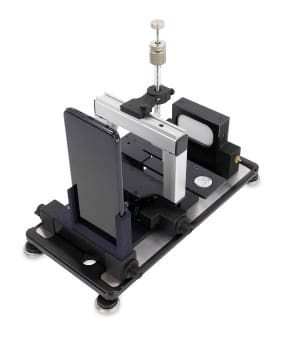
Report Figure 3: "Photo of portable contact angle device from Droplet Lab used to quantify hydrophobicity of ski wax in sub-zero temperatures."
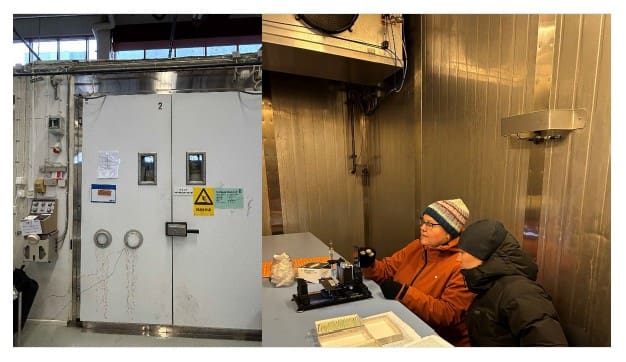
Photos of activities in the freezer room where contact angles were measured at −5 °C.
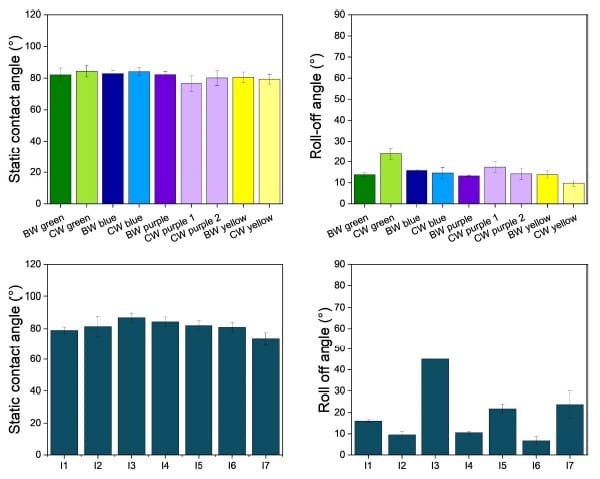
Report Figure 13: "Measured static contact angles and approximate roll-off angles with ethylene glycol obtained in freezer room at -5 °C. Bio-based prototypes and commercial ski wax products are shown in the top row and ingredients in the bottom row."
The report frames contact angle as a hydrophobicity metric relevant to ski/snow interaction and uses contact-angle and roll-off measurements to compare bio-based prototypes to commercial PFAS-free ski waxes and to differentiate ingredient candidates for wax formulation.
Sub-zero contact-angle measurements at −5 °C extend the hydrophobicity benchmarking into winter-relevant conditions using ethylene glycol as a polar, lower-freezing-point liquid, because water freezes before the temperature of interest is reached. The report is direct about what this workflow cost: the manual tilting in the freezer room was less controlled than the room-temperature tilt-table, and it concludes that future work is better served by "the more advanced instrument using water" than by "a portable device with less resolution" in a freezer room. It also flags the liquid itself — "ethylene glycol may not be the best liquid to use to screen ski wax for hydrophobicity", since "it should be water that is relevant when considering ski wax". The value delivered here was access to a temperature a benchtop instrument could not reach.
A portable contact angle instrument rented from Droplet Lab was placed in a −5 °C freezer room to quantify static contact angles and approximate roll-off angles using ethylene glycol. The report does not name a model, describing it only as "a portable contact angle instrument (tensiometer)".
The report uses contact-angle and roll-off outputs to compare bio-based prototypes and commercial waxes and to identify larger hydrophobicity differences among individual ingredients.
Room-temperature measurements show lower contact angles with ethylene glycol than with water on the same wax, and the report links differing trends to differences in surface energy/polarity of the two liquids. The report draws a conclusion from this: "ethylene glycol may not be the best liquid to use to screen ski wax for hydrophobicity", because "it should be water that is relevant when considering ski wax".
The report contrasts controlled tilt-table measurements at room temperature with manual tilting in the freezer room, and its primary recommendation is to avoid the portable freezer-room route where possible: "in future projects it seems like contact angles with the more advanced instrument using water is better instead of measuring contact angles with ethylene glycol in a freezer room with a portable device with less resolution." Only if the portable approach is repeated does the tilting-stage recommendation apply: "If new measurements were to be done with a portable device at sub-zero temperatures, an instrument with a tilting stage is recommended."
Ingredient I3 is highlighted as having low contact angles and high roll-off, while ingredients I1, I2, I4 and I5 are identified as most promising to incorporate based on the report's stated hydrophobicity/roll-off hypothesis.