Primary surface measurement reported
The study reports water contact angle (WCA) as a surface-wetting metric for the optimized SCR film.

Client Citation Analysis
The study reports water contact angle (WCA) as a surface-wetting metric for the optimized SCR film.
The paper attributes sessile-drop water contact angle measurement to a “Dropometer (Droplet Lab, Canada)”, using smartphone image capture and sessile drop software to calculate WCA.
WCA is used as the study’s quantitative indicator of film surface hydrophobicity/wettability for the optimized film, and is discussed using a hydrophilic/hydrophobic interpretation threshold alongside comparisons to other film types cited in the discussion.
An average value from triplicate measurements is reported.
Water contact angle (WCA) was measured on the film surface and reported as a wettability/hydrophobicity indicator for the optimized SCR film.
The optimized film is characterized with mechanical properties (tensile strength and elongation at break), water vapor permeability, optical behavior (UV/visible/IR transmittance and transparency), and additional film property measurements that contextualize packaging performance in the study.
Dropometer (Droplet Lab, Canada)
Texture Analyzer from Stable Micro Systems (Model TA-HD plus; serial no: 5529)
Nix color sensor Pro 2 (Model no: NIXPRO002, Canada)
digital Vernier caliper (RexBeti, China)
UV–Vis spectrophotometer (VWR International, USA, Model no: UV-1600PC, 10037–436)
FTIR spectrophotometer Spectrum 100 from PerkinElmer
Design Expert 13 (Trial version); R software (RStudio 2022.07.01); Microsoft Excel for Mac (version 16.80) Solver add-ins
The study uses the Dropometer to measure sessile-drop water contact angle on the film surface: the film is placed on the instrument mount, a water droplet is deposited on the surface, the droplet is imaged using a smartphone interfaced with the equipment, and sessile drop software is used to calculate the water contact angle.
In the Results/Discussion, the reported WCA is interpreted as a wettability/hydrophobicity descriptor for the optimized film and is discussed using a stated hydrophilic/hydrophobic threshold and literature comparisons.
The optimized SCR film is reported with a water contact angle of 72.6°, presented as the film’s “hydrophobicity” metric in the abstract and as the WCA result in the wettability section.
The authors state that WCA 90° indicates hydrophobic behavior, using this criterion to interpret the film’s surface.
The WCA is visually presented as a sessile droplet image with tangent construction in Fig. 2f, where the film is described as hydrophilic with a low water contact angle.
The discussion cites a low-density polyethylene film WCA of 98.6° as a hydrophobic reference point in contrast to the optimized SCR film’s WCA.
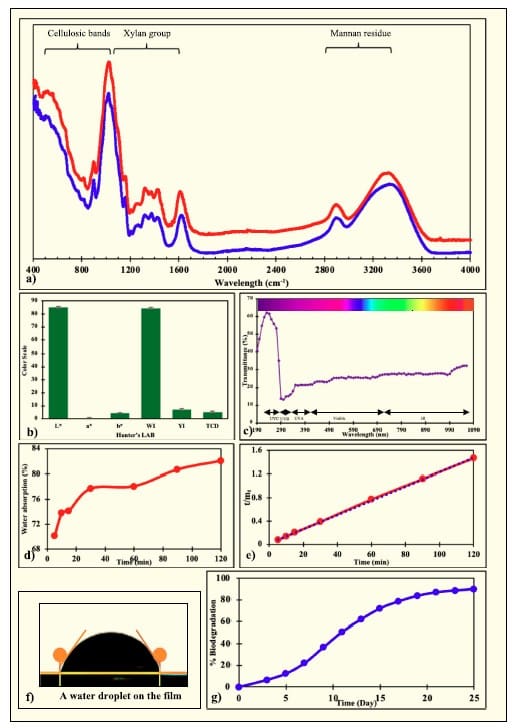
This figure compiles the optimized film’s characterization outputs and includes the water contact angle panel (2f) alongside optical, water-uptake, and biodegradation visuals.
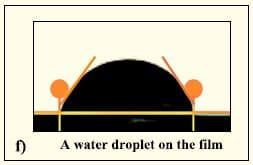
This panel shows the sessile droplet on the film surface with tangent construction and labels the reported WCA = 72.6°.
In the context of developing soyhull cellulosic residue-based biodegradable films for post-harvest raspberry packaging, the paper uses water contact angle as a direct, quantitative descriptor of the optimized film’s surface wettability/hydrophobicity.
The Dropometer-based WCA result is integrated into the study’s broader characterization set (mechanical, barrier, optical, and shelf-life outcomes) to describe the optimized film’s surface interaction with water.
The paper’s Dropometer workflow is described as mounting the film, placing a water droplet, capturing a smartphone image, and calculating WCA using sessile drop software.
The optimized SCR film is reported with a water contact angle of 72.6°.
The authors use a 90° cutoff to classify surfaces as hydrophilic (below 90°) or hydrophobic (above 90°).
The contact-angle result is presented as a droplet image with tangent construction in Fig. 2f, aligned with the numeric WCA value.
The discussion references a low-density polyethylene film WCA value (98.6°) as a hydrophobic comparator when discussing the optimized SCR film’s WCA.