Contents

Client Citation Analysis

Multifunctional, Flexible, Electrospun Lignin/PLA Micro/Nanofiber Mats from Softwood Kraft, Hardwood Alcell, and Switchgrass CELF Lignin

This study compares electrospun 1:1 lignin/PLA micro- and nanofiber mats made from multiple lignin sources, extraction methods, and fractions, with water contact angle used to quantify hydrophobicity alongside thermal, mechanical, morphological, and antioxidant properties.

At-a-Glance Summary

Primary surface measurement reported

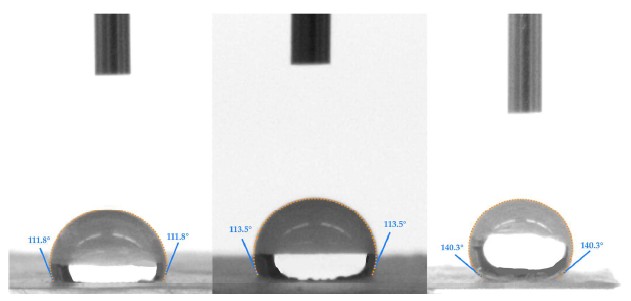
Water contact angle on electrospun lignin/PLA fiber mats, measured with deionized water by sessile drop under ambient conditions, with average values reported in Table 3 and representative images shown in Figure 9.

Dropometer attribution in the paper

The paper states that water contact angle was measured using the “Droplet Lab smartphone-based tensiometer (Toronto, ON, Canada)” with the Sessile drop method, and contact angle was calculated using Young–Laplace fitting.

How the surface-tension / contact-angle data were used in the study

The contact-angle data were used to compare hydrophobicity across lignin biomass origins, isolation methods, and fractions, and to interpret those trends together with thermal behavior, hydroxyl-group content, and mechanical stiffness. The authors use these combined results to differentiate formulations suited to flexible, hydrophobic, or antioxidant-focused end uses.

Replication / reliability statement

Triplicate measurements were taken within 10 s by applying the water droplet in three different areas of each sample, and the average contact angle was calculated for each sample.

Paper Details

Title
Multifunctional, Flexible, Electrospun Lignin/PLA Micro/Nanofiber Mats from Softwood Kraft, Hardwood Alcell, and Switchgrass CELF Lignin
Authors
Dorota B. Szlek; Emily L. Fan; Margaret W. Frey
Journal
Fibers
Year
2025
Volume
13
Pages / Article
129
License
CC BY 4.0

Journal context

What it is
Journal-level metrics for the publication venue (not a rating of this specific article).
How to read it
Compare metrics within category; updates are annual and lag current-year publications.

Scopus metrics (Elsevier / Scopus rating 2024)

CiteScore 2024

7.4

CiteScore subject ranks (CiteScore 2024)
  • Q1 - Civil and Structural Engineering (66/407)
  • Q1 - Ceramics and Composites (32/130)
  • Q1 - Mechanics of Materials (76/403)
SJR 2024

0.677

Journal Impact Factor (Clarivate JCR)

Journal Impact Factor (JCR 2024)

3.9

5-Year Impact Factor

4.1

JCR category rank

Q2 - Materials Science, Multidisciplinary

What Was Measured

Primary surface / interfacial measurement

The primary surface measurement reported is water contact angle of electrospun 1:1 lignin/PLA fiber mats. Average water contact angle values are listed for KL/PLA, AIKL/PLA, ASKL/PLA, EIKL/PLA, ESKL/PLA, ALE40/PLA, ALE60/PLA, ALE100/PLA, ALE100INS/PLA, SGL/PLA, and neat PLA in Table 3.

Supporting measurements

The paper pairs contact-angle data with suspension conductivity, fiber diameter, and SEM-observed morphology, as well as FTIR-based lignin structural analysis, DSC thermal behavior, DMA mechanical properties, and DPPH antioxidant activity. These measurements are used to interpret hydrophobicity differences across lignin source, extraction route, and fractionation condition.

Role of the Dropometer

Water contact angle measurement was carried out using the Droplet Lab smartphone-based tensiometer with the Sessile drop method under ambient conditions. A droplet of deionized water was generated on each sample surface using a Hamilton Gastight #1750 syringe fitted with an 18-gauge needle, and the resulting contact angle was calculated using Young–Laplace fitting; analysis was performed automatically by Droplet Lab software at the time of measurement collection.

In the study workflow, these Dropometer-derived contact-angle results were used to compare hydrophobic performance across lignin formulations and to interpret those differences together with FTIR, DSC, and DMA trends.

Method Snapshot

Method Snapshot Table

Sample / system Biomass origin Isolation method / fraction Blend composition Surface output reported Instruments / analysis Conditions Notes
KL/PLA Softwood Kraft lignin as received PLA:lignin 50:50 by weight; 22% w/v suspension Average water contact angle = 131.37 ± 4.56° Droplet Lab smartphone-based tensiometer; sessile drop; Young–Laplace fitting Ambient conditions; deionized water; Hamilton Gastight #1750 syringe with 18-gauge needle; triplicate within 10 s One of the higher-WCA Kraft-based mats
AIKL/PLA Softwood Acetone-fractionated insoluble Kraft lignin PLA:lignin 50:50 by weight; 22% w/v suspension 114.47 ± 1.86° Same as above Same as above Lower WCA than ASKL/PLA
ASKL/PLA Softwood Acetone-fractionated soluble Kraft lignin PLA:lignin 50:50 by weight; 22% w/v suspension 126.72 ± 1.14° Same as above Same as above About 15° higher than AIKL/PLA in the discussion
EIKL/PLA Softwood Ethanol-fractionated insoluble Kraft lignin PLA:lignin 50:50 by weight; 22% w/v suspension 125.66 ± 7.06° Same as above Same as above Higher WCA than ESKL/PLA
ESKL/PLA Softwood Ethanol-fractionated soluble Kraft lignin PLA:lignin 50:50 by weight; 22% w/v suspension 110.62 ± 2.30° Same as above Same as above Representative droplet image shown in Figure 9
ALE40/PLA Hardwood Alcell (40%) ethanol-soluble lignin PLA:lignin 50:50 by weight; 22% w/v suspension 122.09 ± 6.52° Same as above Same as above Intermediate Alcell wettability
ALE60/PLA Hardwood Alcell (60%) ethanol-soluble lignin PLA:lignin 50:50 by weight; 22% w/v suspension 138.67 ± 4.37° Same as above Same as above Highest average WCA in Table 3; representative droplet image in Figure 9
ALE100/PLA Hardwood Alcell (100%) ethanol-soluble lignin PLA:lignin 50:50 by weight; 22% w/v suspension 115.76 ± 2.75° Same as above Same as above Lower than ALE60/PLA and ALE100INS/PLA
ALE100INS/PLA Hardwood Alcell (100%) ethanol-insoluble lignin PLA:lignin 50:50 by weight; 22% w/v suspension 136.16 ± 5.10° Same as above Same as above Among the highest-WCA samples
SGL/PLA Switchgrass Co-Solvent Enhanced Lignocellulosic Fractionation (CELF) lignin PLA:lignin 50:50 by weight; 22% w/v suspension 130.26 ± 2.63° Same as above Same as above High WCA combined with highest tensile strength in Table 3
PLA control Neat PLA Neat PLA control 110.75 ± 2.98° Same as above Same as above Baseline control for comparison

Key Findings

Lignin addition raised hydrophobicity

Across nearly all formulations, adding lignin to PLA increased the hydrophobicity of the fiber mats relative to neat PLA. This is visible in Table 3, where most lignin/PLA samples have average water contact angles above the PLA control value of 110.75 ± 2.98°.

Highest average contact angles were concentrated in select Alcell, Kraft, and CELF systems

Table 3 reports the highest average water contact angles for ALE60/PLA at 138.67 ± 4.37° and ALE100INS/PLA at 136.16 ± 5.10°, with KL/PLA and SGL/PLA also high at 131.37 ± 4.56° and 130.26 ± 2.63°, respectively. In the discussion, the authors group KL-, SGL-, and ALE60-containing mats among the strongest hydrophobic performers.

Fractionation effects were system-specific

The paper shows that solvent fractionation did not shift contact angle in one uniform direction. In the Kraft series, ASKL/PLA was higher than AIKL/PLA, while EIKL/PLA was higher than ESKL/PLA, and the discussion links these differences to solvent hydrogen-bonding capacity and hydroxyl-group content.

Hydrophobicity tracked with thermal and structural trends

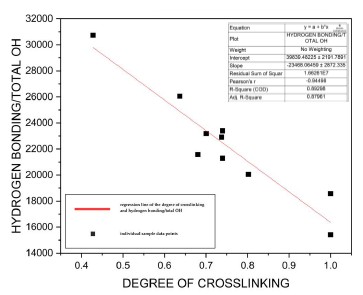
The authors report that higher-performing hydrophobic samples tended to correlate with higher Tg values (r = 0.45), while contact angle showed a moderate inverse correlation with relative total hydroxyl-group content (r = −0.43). Earlier in the paper, they also note a negative correlation between the ~3400 cm⁻¹ FTIR peak area and contact angle measurements.

Mechanical stiffness contributed to wettability interpretation

The paper links hydrophobicity to the mechanical character of the mats, reporting a strong correlation between hydrophobicity and Young’s modulus (r = 0.79). This is especially relevant for Alcell-based mats, which combined high contact angles with stiff, brittle mechanical behavior, while SGL/PLA paired high contact angle with stronger and more flexible performance.

Figures & Visuals

Figure 9 — Direct contact-angle comparison

What it shows

Figure 9 shows representative water contact angle images for ESKL/PLA, neat PLA, and ALE60/PLA, making the wettability contrast visible at a glance.

Figure 6 — Fiber morphology context for wettability interpretation

What it shows

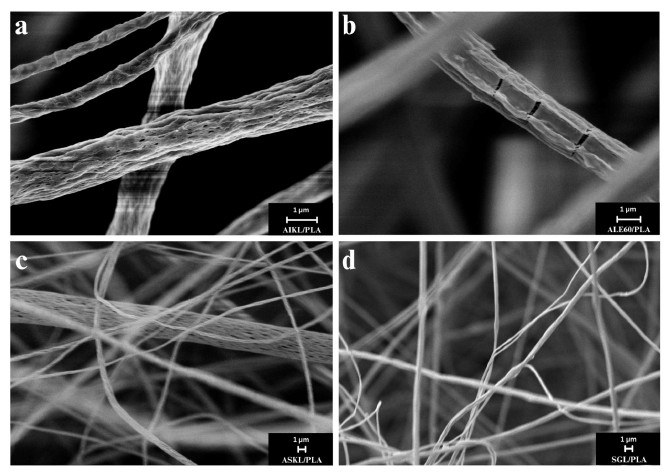
Figure 6 provides SEM views of AIKL/PLA, ALE60/PLA, ASKL/PLA, and SGL/PLA, which the authors use alongside contact-angle results when discussing surface roughness, rigidity, and hydrophobic behavior.

Figure 4 — Chemistry-to-wettability relationship

What it shows

Figure 4 supports the paper’s interpretation that lignin hydrogen bonding / total OH content and crosslinking relationships connect to thermal behavior and contact-angle trends.

Figure 5 — Mat-level sample comparison

What it shows

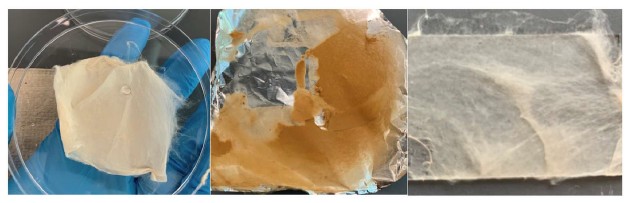
Figure 5 shows photographs of KL/PLA, ALE60/PLA, and SGL/PLA mats, the same classes of materials highlighted in the paper’s wettability and application discussion.

Why It Matters

In this paper, contact angle is one of the core functional readouts used to distinguish how lignin source, extraction method, and fractionation reshape electrospun lignin/PLA mat performance. The Dropometer-derived wettability data are not treated in isolation; they are interpreted together with FTIR, DSC, DMA, SEM, conductivity, and antioxidant results to separate formulations that behave as more flexible, more rigid, more hydrophobic, or more antioxidant-active materials.

That matters because the authors use those combined property maps to recommend different lignin/PLA systems for different end-use directions. In their conclusions, SGL/PLA is associated with air filtration, KL/PLA with wound dressings or cosmetic care, and Alcell/PLA with packaging and water-filtration-type barrier applications; the contact-angle data help define the hydrophobic side of those distinctions.

Practical Takeaways

Use contact angle as a formulation discriminator

The paper uses average water contact angle to separate performance across lignin origin, extraction route, and fraction, with ALE60/PLA and ALE100INS/PLA sitting at the top of the Table 3 wettability range.

Interpret wettability with chemistry, not alone

The authors tie contact-angle behavior to hydroxyl-group content, hydrogen bonding, crosslinking, and thermal response, which makes the Dropometer output more informative when paired with FTIR and DSC.

Expect fractionation effects to depend on solvent and lignin class

The acetone- and ethanol-fractionated Kraft samples do not move in one uniform direction, so the wettability gain depends on the specific fraction and solvent history rather than fractionation by itself.

Match hydrophobicity with mechanical behavior

In the paper’s interpretation, Alcell-based mats combine high contact angle with higher stiffness, while SGL/PLA and KL/PLA combine high contact angle with more favorable strength–flexibility balances for their proposed application contexts.

Keep the measurement workflow simple and localized

The reported contact-angle workflow is practical and direct: deionized-water sessile drops, Young–Laplace fitting, triplicate measurements, and three locations per sample.

Download Experiment