Primary surface measurement reported
Water contact angle of electrospun lignin/PLA fiber mats and a neat PLA control, measured by the sessile drop method under ambient conditions.

Client Citation Analysis
Water contact angle of electrospun lignin/PLA fiber mats and a neat PLA control, measured by the sessile drop method under ambient conditions.
The methods state that water contact angle measurement was carried out using the “Droplet Lab smartphone-based tensiometer (Toronto, ON, Canada)” with the sessile drop method, and the resulting contact angle was calculated using Young–Laplace fitting with automatic Droplet Lab software analysis.
The contact-angle data were used to compare hydrophobicity across lignin biomass origins, isolation methods, and fractions within a common 50:50 lignin/PLA electrospinning platform. The authors then interpreted those wettability trends together with hydroxyl-group content, crosslinking behavior, thermal transitions, modulus, and morphology to discuss application-relevant differences among the mats.
Triplicate measurements were taken within 10 s in three different areas of each sample, and the average contact angle was calculated for each sample.
The paper reports water contact angle as the surface measurement used to assess hydrophobicity of electrospun 1:1 lignin/PLA mats and a neat PLA control. Average contact-angle values are summarized in Table 3, with representative sessile-drop images shown in Figure 9.
The authors also measured suspension conductivity, fiber diameter, fiber morphology by SEM, chemical structure by FTIR, thermal behavior by DSC, mechanical properties by DMA, and antioxidant activity by DPPH reduction/UV-Vis. These measurements were used together with contact angle to interpret how lignin origin, isolation route, and fraction changed fiber performance.
Droplet Lab smartphone-based tensiometer (Toronto, ON, Canada)
Hamilton Gastight #1750 syringe with 18-gauge needle
Carl Zeiss AG LEO 1550 Field Emission Scanning Electron Microscope with InLens and SE2 detectors
ImageJ.JS analysis of SEM micrographs from SEM Keck (FEI Company, Hillsboro, OR, USA)
FTIR-ATR Perkin Elmer Spectrum spectrometer
TA Instruments DSC Q2000, V24.9, Build 121
TA Instruments DMA Model Q800DMA
BioTek Synergy Neo2 multimode microplate reader
Water contact angle measurement was carried out under ambient conditions using the Droplet Lab smartphone-based tensiometer and the sessile drop method. A droplet of deionized water was generated on each sample surface using a Hamilton Gastight #1750 syringe fitted with an 18-gauge needle, and the resulting contact angle was calculated using Young–Laplace fitting; the paper also states that Droplet Lab software performed the analysis automatically at the time of measurement collection.
In the study workflow, these Dropometer outputs served as the direct hydrophobicity readout used to compare lignin source, pretreatment method, and fraction within the electrospun 1:1 lignin/PLA system.
If you compare water contact angle across electrospun fiber mats or lignin blends, we can show you the same sessile drop workflow on your samples.
Nearly every lignin/PLA mat showed a higher average water contact angle than neat PLA, which was reported at 110.75 ± 2.98°. The highest tabled values were ALE60/PLA at 138.67 ± 4.37° and ALE100INS/PLA at 136.16 ± 5.10°, with KL/PLA and SGL/PLA also high at 131.37 ± 4.56° and 130.26 ± 2.63°, respectively.
Within Kraft lignin fractions, ASKL/PLA reached 126.72 ± 1.14° while AIKL/PLA was 114.47 ± 1.86°, and EIKL/PLA reached 125.66 ± 7.06° while ESKL/PLA was 110.62 ± 2.30°. The authors connected these differences to solvent hydrogen-bonding capacity and differences in hydroxyl-group content across the fractions.
The paper reports a moderate inverse correlation between relative total hydroxyl-group content and contact angle (r = −0.43), along with positive relationships between contact angle and higher glass transition temperature (r = 0.45) and Young’s modulus (r = 0.79). In the authors’ interpretation, wettability was therefore tied to OH content, rigidity, and surface roughness of the fiber mats.
ALE60/PLA combined the highest average water contact angle with the highest Young’s modulus and the lowest elongation at break among the mechanically tested mats. The paper also notes that SEM micrographs of Alcell-based fibers showed cracked lignin fiber cores encased in a more flexible PLA skin, reinforcing the distinct structural profile of this group.
In the conclusions, the authors suggest SGL/PLA for air filtration (ductility and small fiber diameter), KL/PLA for biomedical and cosmetic care products (antioxidant benefits and ductility), and Alcell/PLA for water filtration and packaging systems (barrier properties, rigidity, and dimensional stability). Hydrophobicity is named explicitly for insoluble Alcell lignin/PLA fibers in battery separator membranes and supercapacitors.
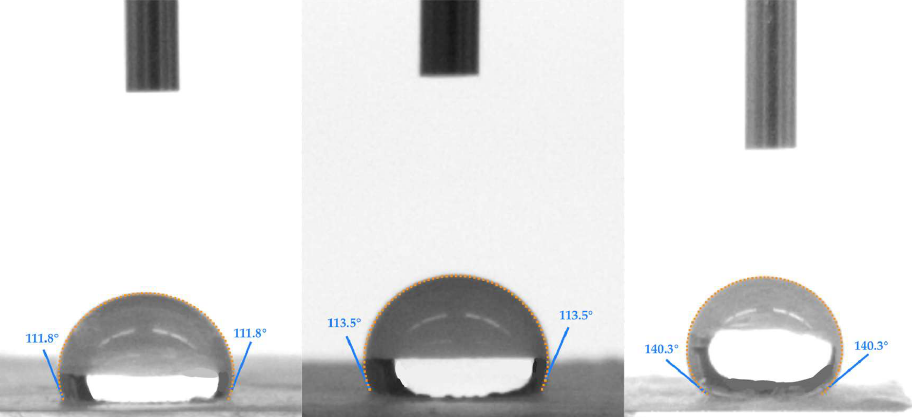
Figure 9 shows example sessile-drop contact-angle images for ESKL/PLA, neat PLA, and ALE60/PLA, giving a visual comparison of lower, baseline, and higher hydrophobic responses within the study.
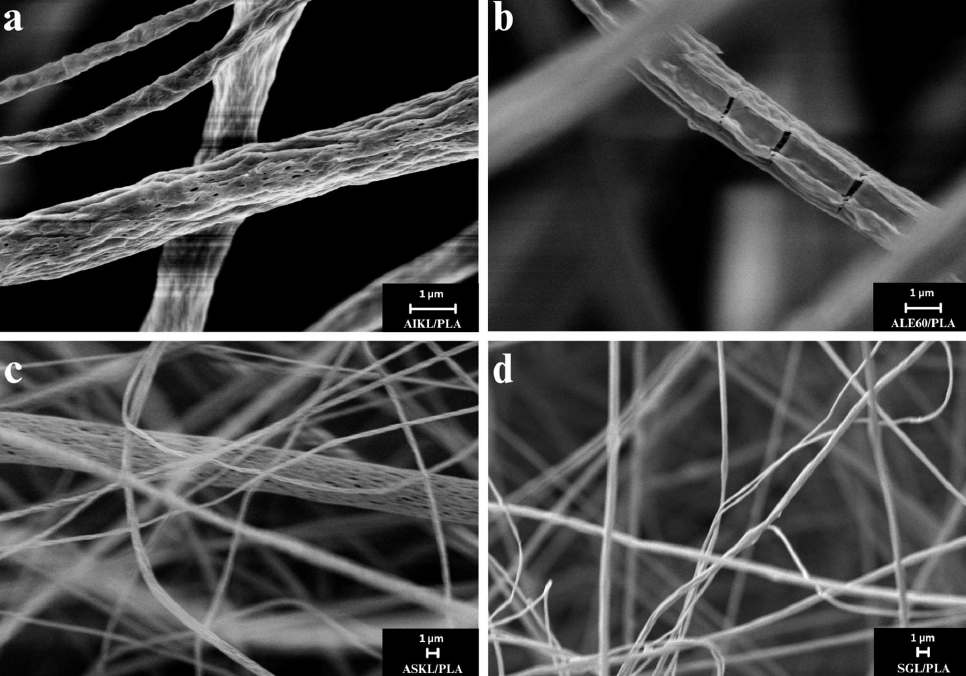
Figure 6 provides SEM views of AIKL/PLA, ALE60/PLA, ASKL/PLA, and SGL/PLA fiber mats, which the authors discuss in terms of surface morphology and the more rigid structure of hardwood lignin.
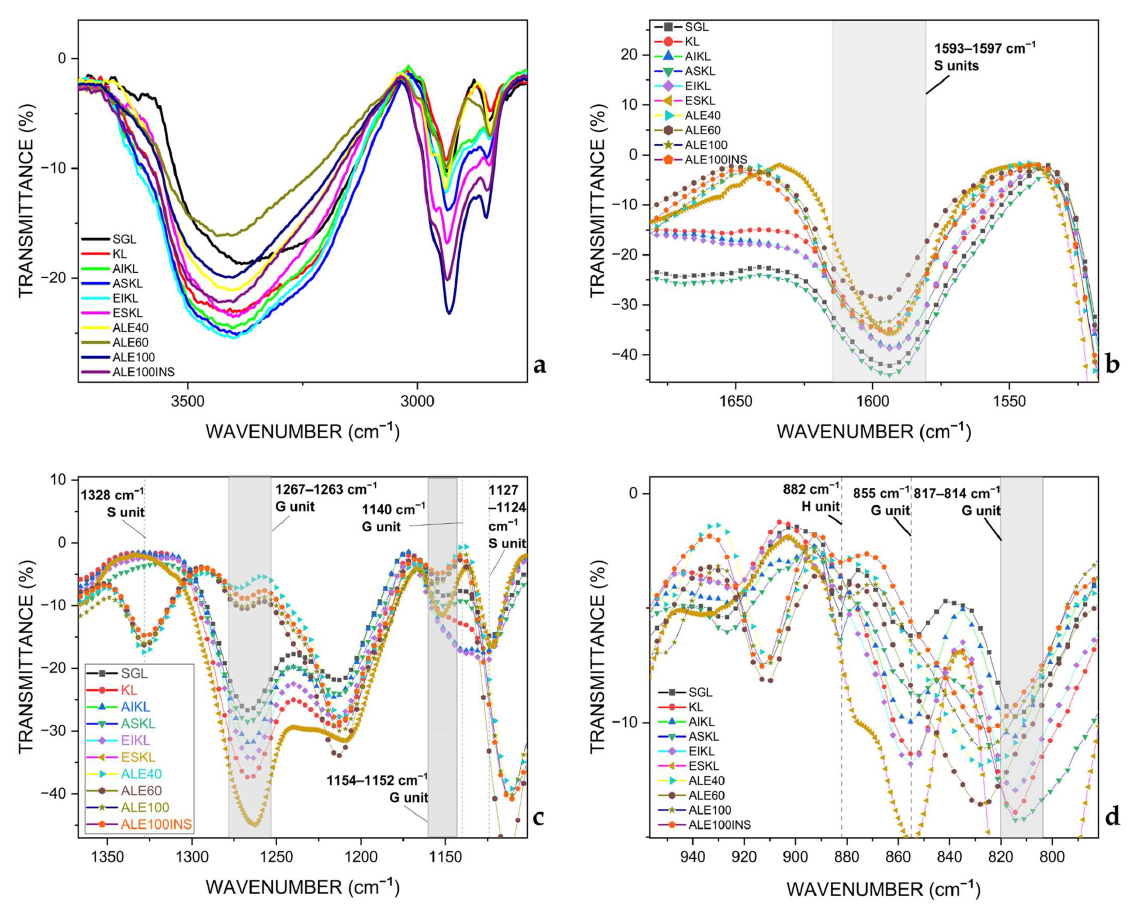
Figure 3 maps OH-related and monolignol-related FTIR features that the authors later use to interpret differences in thermal behavior and contact angle across the lignin series.
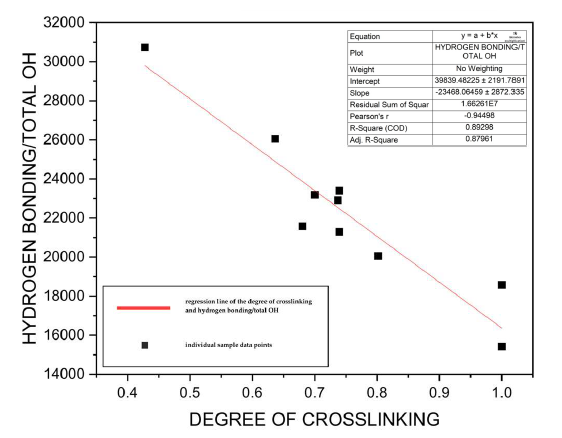
Figure 4 visualizes the inverse relationship between degree of crosslinking and hydrogen bonding / total OH content, which supports the paper’s chemistry-based reading of wettability trends.
In this paper, contact angle is one of the functional measurements that separates otherwise similarly processed 1:1 lignin/PLA electrospun mats. Because the electrospinning framework was held constant while lignin source and fraction changed, the Dropometer data gave the authors a direct way to compare how lignin selection shifted surface hydrophobicity across the series.
Those wettability results were then read together with FTIR, DSC, DMA, SEM, conductivity, and antioxidant data to build a fuller property map for the mats. In practical terms, contact angle was one of several properties, alongside mechanical, thermal, fiber diameter, and antioxidant results, that the authors considered when suggesting applications for the different lignin/PLA mats.
With a fixed 50:50 lignin/PLA formulation and common electrospinning settings, average water contact angle still varied substantially across lignin families and fractions, showing that lignin selection materially changed surface behavior.
The separation between AIKL/PLA and ASKL/PLA, and between ESKL/PLA and EIKL/PLA, shows that solvent-based fraction choice changed the contact-angle result even within the same Kraft-lignin family.
ALE60/PLA and ALE100INS/PLA provided the top average water contact angles in Table 3, and the paper discusses these materials together with rigidity and barrier-oriented application directions.
The paper notes in Section 3.5 and the Conclusions that KL/PLA and SGL/PLA combined strong hydrophobicity with broader functional performance without requiring an extra fractionation step for fiber formation.
It measured water contact angle on ten electrospun 1:1 lignin/PLA fiber mats and a neat PLA control, using what the paper calls the Droplet Lab smartphone-based tensiometer with the sessile drop method under ambient conditions. Deionized water drops were placed in three areas of each sample within 10 s, angles were calculated by Young-Laplace fitting in the Droplet Lab software, and averages are reported in Table 3.
Neat PLA measured 110.75 ± 2.98°, and nearly every lignin/PLA mat measured higher. The highest averages were ALE60/PLA at 138.67 ± 4.37° and ALE100INS/PLA at 136.16 ± 5.10°, while KL/PLA reached 131.37 ± 4.56° and SGL/PLA 130.26 ± 2.63°. The study reports static angles only; sliding, advancing and receding angles were outside its scope.
The authors report that adding lignin generally increased fiber mat hydrophobicity, with no consistent trend between soluble and insoluble fractions. They link higher contact angles to lower hydroxyl group content (r = −0.43) and higher glass transition temperature (r = 0.45), and expect mat roughness and rigidity to play a part given the strong correlation with Young's modulus (r = 0.79).