Primary surface measurement reported
Water contact angle of fabricated and surface-coated LIG electrodes, used to characterize wettability during comparison of four DADMAC/GO-PDDA functionalization methods.

Client Citation Analysis
Primary surface measurement reported
Water contact angle of fabricated and surface-coated LIG electrodes, used to characterize wettability during comparison of four DADMAC/GO-PDDA functionalization methods.
Dropometer attribution in the paper
The authors report that all goniometry experiments used a “Droplet lab DROPOMETER-M (Markham, ON, Canada),” with contact angle calculated by the non-axisymmetric (polynomial) method.
How the surface-tension / contact-angle data were used in the study
The contact-angle data were part of the comparative functionalization study, alongside electrochemical and microscopy data, and showed that GO-PDDA-modified LIG had contact angles above 120°, while DADMAC-coated LIG was below 45°. The authors' stated reasons for advancing GO-PDDA-coated electrodes into sensor-performance testing were electroactive surface area, specific capacitance and coating adherence (Section 3.2).
Replication / reliability statement
Goniometry experiments were repeated in triplicate.
Primary surface / interfacial measurement
The paper reports water contact angle measurements on LIG electrodes after fabrication and after surface coating, using those data to characterize wettability across the compared functionalization routes. In the comparative study, GO-PDDA-modified LIG showed contact angles above 120°, while DADMAC-coated LIG showed contact angles below 45°.
Supporting measurements
Supporting measurements included zeta potential of GO-PDDA suspensions, cyclic voltammetry, electrochemical impedance spectroscopy, open-circuit-potential water-layer tests, SEM, EDS, pH measurement, and EPA 365.3 colorimetric comparison in creek-water samples.
Water contact angle
Droplet lab DROPOMETER-M (Markham, ON, Canada)
Zeta potential
Malvern Zetasizer Nano ZS instrument (Malvern Analytical, UK)
pH
Thermo Scientific ORION Star A211 Benchtop pH Meter
Scanning electron microscopy
S-3400 N backscatter variable pressure scanning electron microscope
Energy-dispersive spectroscopy
SU5000 Schottky field emission scanning electron microscope
Electrochemical testing (CV / EIS)
MultiPalmSens4 potentiostat (PalmSens, Houten, Netherlands)
EPA 365.3 colorimetric analysis
Ocean Optics UV-VIS spectrometer
The Dropometer was used in Section 2.5 to measure water contact angle on LIG sensor chips after fabrication and after surface coating. The chips were positioned in sample mounts, a 2 µl aliquot was dispensed with the microneedle system, and contact angle was calculated using the non-axisymmetric (polynomial) method.
In the paper’s workflow, the wettability data served as a surface-state comparison across the four LIG functionalization routes and helped separate GO-PDDA-coated surfaces from DADMAC-coated surfaces within the broader optimization study.
If you compare water contact angle across electrode coatings or functionalization routes, we can show you the same sessile drop workflow on your samples.
Clear wettability split by coating chemistry
Contact-angle measurements separated the two coating families cleanly: GO-PDDA-modified LIG showed contact angles above 120°, while DADMAC-coated LIG showed contact angles below 45°. In the paper, this wettability readout sat alongside SEM, EDS, and electrochemical data in the four-method comparison.
GO-PDDA coatings delivered the strongest electrochemical surface response
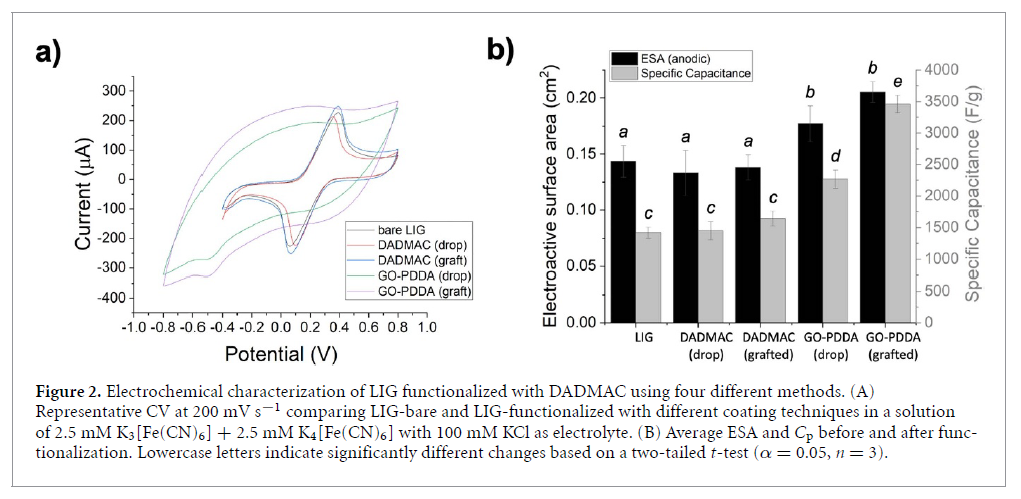
GO-PDDA functionalization increased electroactive surface area relative to bare and DADMAC-coated electrodes, and the highest reported specific capacitance was for grafted GO-PDDA at 3463 ± 230 F g⁻¹. This is the surface family the authors advanced into the dip-and-read orthophosphate workflow.
Grafted GO-PDDA gave the strongest calibration performance
Using net capacitance at 10 mHz, grafted GO-PDDA sensors showed linearity from 10 ppb to 200 ppb and extended to 2 ppm, with sensitivity of 138 ± 15 mF ppm⁻¹ and LOD of 20 ± 4 ppb. These values were better than those of the drop-cast GO-PDDA configuration.
Selectivity improved in the mildly alkaline regime
The grafted GO-PDDA sensors were at least 93% selective over chloride and nitrate and more than 97% selective over bicarbonate, Tris, and potassium hydrogen phthalate, while sulfate gave the largest interference. The authors also report higher sensitivity at pH 8–9 than at pH 7.
Field-facing validation supported reuse and creek-water testing
Creek-water measurements were highly correlated with EPA method 365.3, and regenerated sensors retained at least 90% of analytical sensitivity through four uses. This positions the final grafted GO-PDDA/LIG design as the paper’s preferred reagent-free dip-and-read format.
What it shows
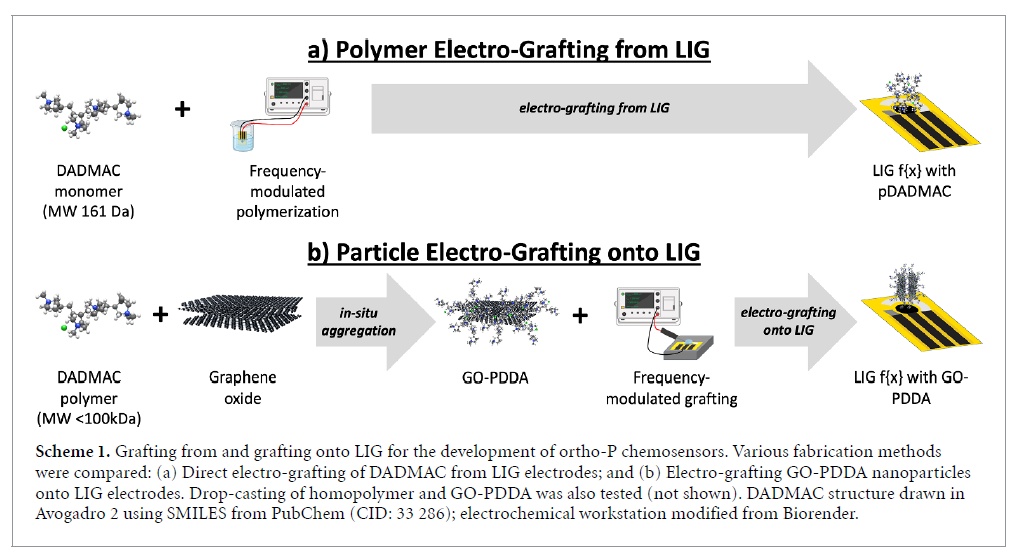
The scheme shows the two electro-grafting routes for LIG (drop-casting, also tested, is not shown); all four routes were later compared by contact angle, electrochemistry, and microscopy.
What it shows
Figure 2 shows how the coating comparison translated into electroactive surface area and specific capacitance, which the authors discuss together with the wettability results from the comparative study.
In this paper, the Dropometer’s role is tightly defined and practical: it gives a surface-wettability readout for the same LIG coatings that are later judged by electrochemical performance. The paper describes this comparative study as based on surface morphology, wettability and electrochemical behavior.
For a prospective Droplet Lab audience, the key point is that the Dropometer was used in a real sensor-development workflow to help distinguish which electrode coatings created markedly different wetting states before the authors committed to full calibration, selectivity, regeneration, and creek-water validation of the final sensor architecture.
Wettability separated coating families.
In this study, Dropometer measurements distinguished GO-PDDA-modified LIG (>120°) from DADMAC-coated LIG (<45°), giving a screen for surface-state differences during electrode optimization.
Contact angle was used as part of a multi-metric surface screen.
The authors reported wettability together with SEM, EDS, CV, and water-layer test data rather than in isolation, as one input to the coating comparison.
Grafted GO-PDDA was the winning surface architecture.
That configuration carried forward into the main sensor study and delivered the paper’s strongest range, sensitivity, and LOD.
The final sensing workflow favored mildly alkaline samples.
Higher sensitivity at pH 8–9 shaped the preferred operating regime reported by the authors for orthophosphate detection.
Regeneration supported repeated use.
A 5 min regeneration step in pH 5 buffer preserved at least 90% analytical sensitivity through four uses in the reported workflow.
It measured water contact angle on laser-induced graphene (LIG) sensor chips after fabrication and after surface coating, using what the paper names a Droplet lab DROPOMETER-M. A 2 µl drop was dispensed with the microneedle system, the angle was calculated by the non-axisymmetric (polynomial) method, and measurements were repeated in triplicate.
The paper reports contact angles above 120° for LIG modified with GO-PDDA and below 45° for DADMAC coated LIG, with the data shown in supplemental figure S4. The authors note that the drop-cast and grafted DADMAC electrodes were not statistically different from each other.
Wettability was one of three data types, alongside surface morphology and electrochemical behavior, in the authors' comparison of four coating methods. The paper bases the move to GO-PDDA sensors mainly on electroactive surface area, specific capacitance and coating adherence, and the orthophosphate results, including a detection limit of 20 ± 4 ppb, come from capacitive electrochemical measurements.