Primary surface measurement reported
Water contact angle (WCA) was measured on the ACR control film and nine ACR-carrageenan composite films, with reported values ranging from 74.7 ± 0.4° for ACR to 60.9 ± 0.1° for ACR-l1.5%.

Client Citation Analysis
Primary surface measurement reported
Water contact angle (WCA) was measured on the ACR control film and nine ACR-carrageenan composite films, with reported values ranging from 74.7 ± 0.4° for ACR to 60.9 ± 0.1° for ACR-l1.5%.
Dropometer attribution in the paper
The methods state: “The water contact angle was measured using a dropometer by placing a water droplet and recording the resulting angle.”
How the surface-tension / contact-angle data were used in the study
The contact-angle data were used to compare how iota-, kappa-, and lambda-carrageenan changed film hydrophilicity across concentration series and to interpret the films’ water absorption behavior in the packaging study.
Primary surface / interfacial measurement
The paper reports water contact angle (WCA) for the ACR control and the ACR-i, ACR-k, and ACR-l films at 0.5%, 1.0%, and 1.5% carrageenan levels. Reported WCA values decrease across the film set from 74.7 ± 0.4° for ACR to 60.9 ± 0.1° for ACR-l1.5%.
Supporting measurements
The same film matrix was also characterized for tensile strength, elongation at break, water vapor permeability, moisture content, water solubility, water absorption and kinetics, color, UV-Vis-IR transmittance, FTIR, antioxidant activity, and soil biodegradation. These measurements were used alongside WCA to interpret the films’ mechanical performance, moisture interaction, light-blocking behavior, and biodegradation behavior.
Water contact angle
dropometer
Tensile strength / elongation at break
Texture Analyzer (Stable Micro Systems, Model TA-HD plus, serial no: 5529)
Color
Nix Pro 2 color sensor
Transparency / transmittance
UV-Vis spectrophotometer
Infrared spectra
FTIR
The dropometer was used during film characterization to place a water droplet on each film and record the resulting contact angle. The reported output is WCA in degrees for the ACR control and each ACR-carrageenan formulation, with the values compiled in Table 2.
Within the paper’s workflow, these measurements provided the wettability comparison across carrageenan type and concentration that the authors used to discuss hydrophilicity and its relationship to water absorption.
If you compare water contact angle across biodegradable film formulations, we can show you the same sessile drop workflow on your samples.
Carrageenan lowered the contact angle across the film set
WCA decreased from 74.7 ± 0.4° for the ACR control to values between 70.5 ± 0.4° and 60.9 ± 0.1° in the composite films. The authors interpret this shift as increased hydrophilicity after carrageenan addition.
Lambda-carrageenan produced the lowest reported WCA
Among the reported formulations, ACR-l1.5% showed the lowest WCA at 60.9 ± 0.1°. Within the lambda series, WCA decreased from 70.5 ± 0.4° at 0.5% to 65.0 ± 1.2° at 1.0% and 60.9 ± 0.1° at 1.5%.
Wettability tracked with stronger water uptake
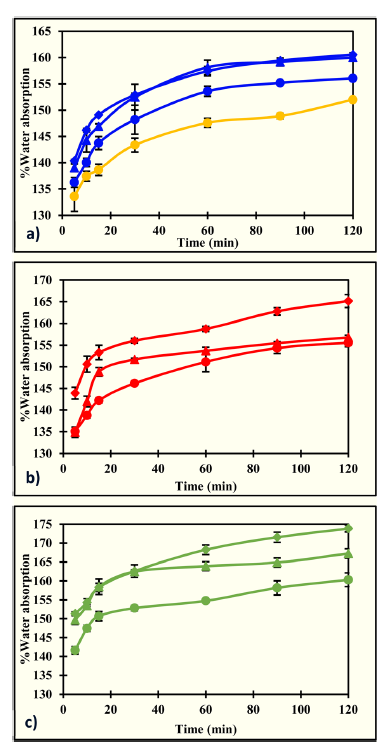
All carrageenan films, which had lower WCA than the control, also showed higher water absorption at 120 minutes. The ACR control reached 152.0 ± 0.2%, while ACR-l1.5% reached 173.9 ± 0.9%, which the paper discusses alongside the hydrophilic character introduced by carrageenan.
The same formulations combined lower WCA with higher strength
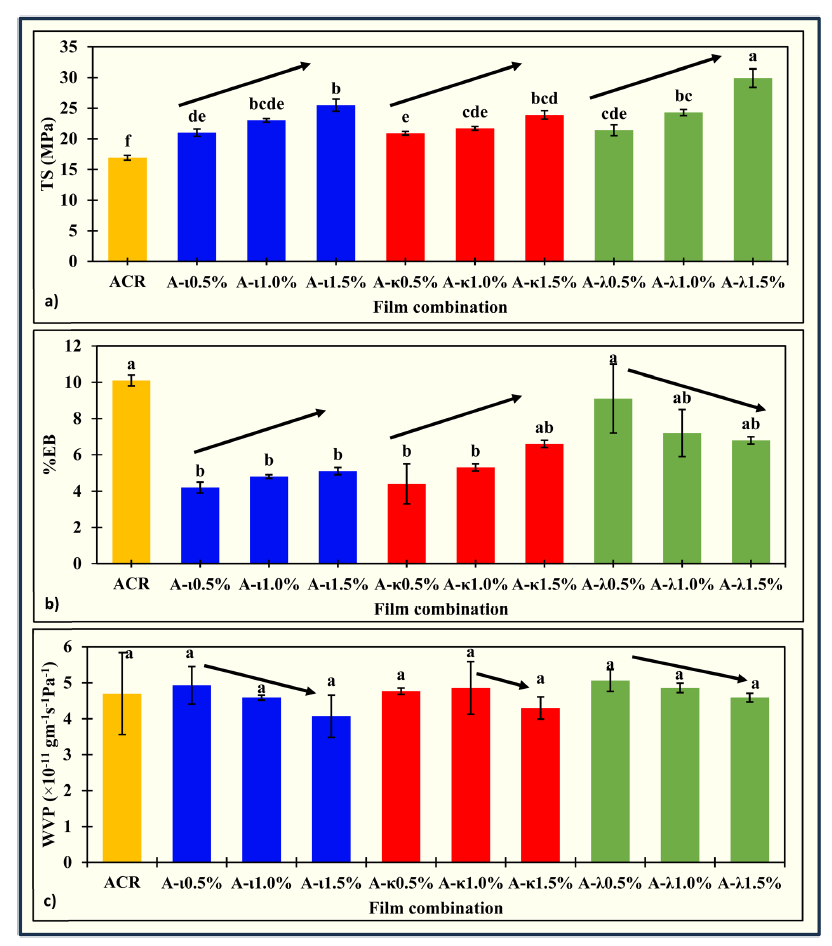
Across the same ACR-carrageenan matrix, tensile strength increased from 16.9 ± 0.4 MPa for ACR to 29.9 ± 1.5 MPa for ACR-l1.5%, while WCA moved downward across the composite set. In the paper’s overall interpretation, carrageenan reinforced the films while also making them more hydrophilic.
Contact-angle results sat within a broader packaging-property screen
The WCA data were reported alongside water solubility, water absorption kinetics, WVP, UV-Vis-IR transmittance, antioxidant activity, and biodegradation. That made wettability one of the property axes used to compare the ten film formulations for sustainable food-packaging use.
What it shows
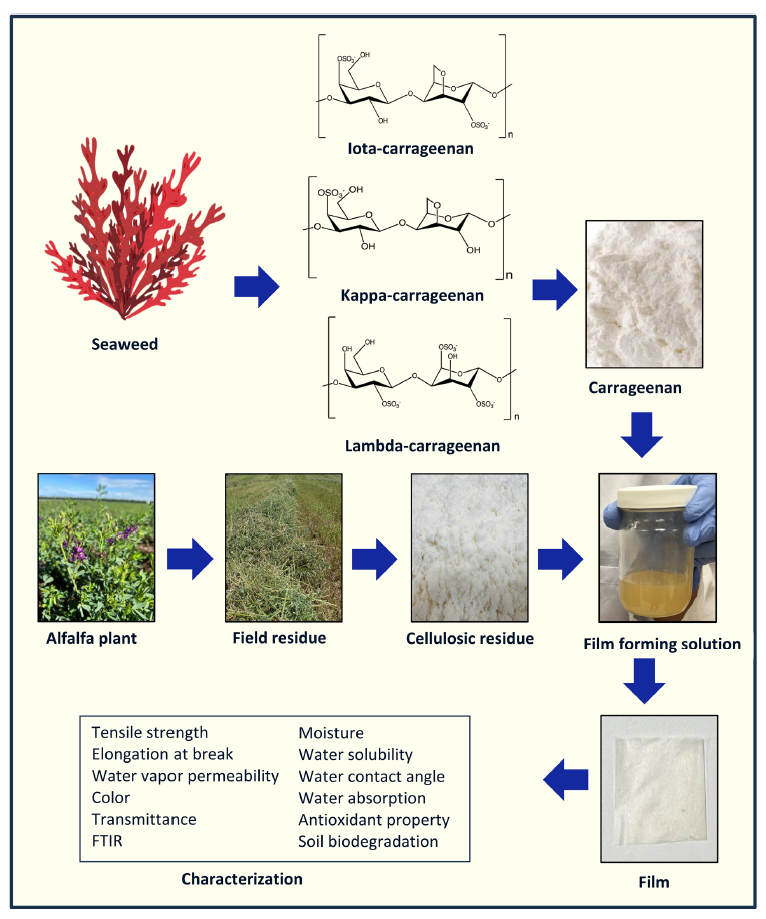
On page 3, the experimental overview shows the ACR/carrageenan film-making workflow and lists water contact angle among the characterization outputs used for the film matrix.
What it shows
On page 5, Fig. 2 presents tensile strength, elongation at break, and WVP across the same ACR, ACR-i, ACR-k, and ACR-l formulations whose WCA values are reported in Table 2.
What it shows
On page 7, Fig. 3 shows water-absorption curves for the control and carrageenan-containing films, providing the moisture-interaction context discussed alongside the WCA results.
What it shows
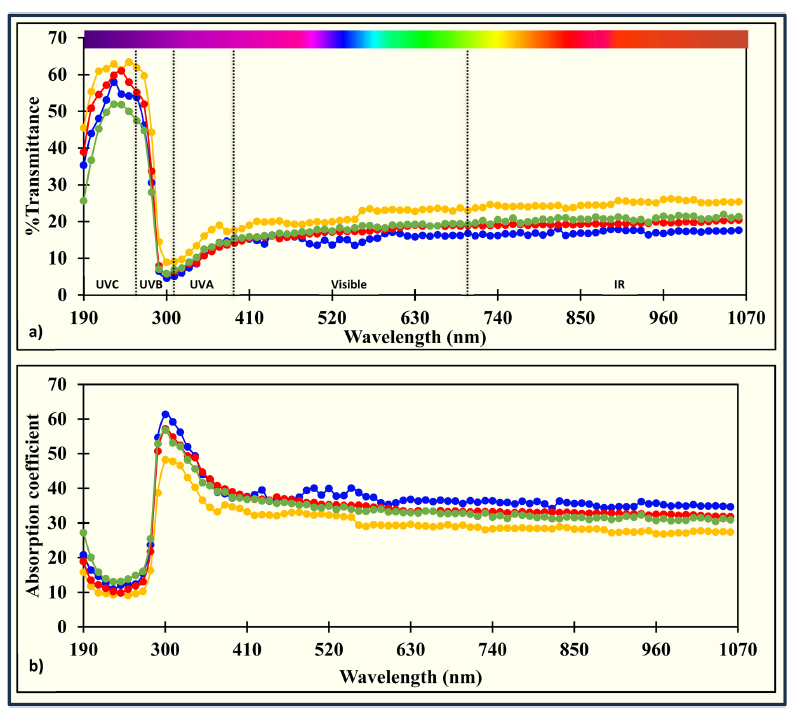
On page 8, Fig. 4 shows UV-Vis-IR transmittance and absorption-coefficient data for the ACR control and the three 1.5% carrageenan films, complementing the same formulation comparisons used in the contact-angle analysis.
In the paper’s packaging context, the dropometer-derived WCA values show how adding carrageenan changed the surface wetting behavior of alfalfa-cellulose films. That mattered because the same films were also being evaluated for moisture interaction, barrier performance, light-blocking behavior, antioxidant activity, and biodegradation as potential biodegradable food-packaging materials.
The contact-angle results showed how carrageenan type and loading changed wettability within the ACR film system. In particular, the lowest WCA value, for the ACR-l1.5% film, aligned with its highest water solubility and water absorption, consistent with the hydrophilicity shift the paper describes across the composite formulations.
Carrageenan loading shifted surface wetting in a consistent direction
The reported WCA values moved downward as carrageenan was incorporated into the ACR films, making contact angle a clear comparison point across formulations.
Lambda-carrageenan stood out for the strongest hydrophilicity shift
The lambda series reached the lowest reported contact angle and the highest reported water absorption at 120 minutes within this study.
Contact angle was most useful when read beside uptake and solubility
In this paper, WCA was interpreted together with water solubility and water absorption rather than as an isolated surface number.
The same film set delivered a multi-property comparison
The dropometer outputs were part of a broader screening that also covered strength, WVP, transmittance, antioxidant activity, and biodegradation for the same formulations.
The application lens was food packaging
The authors positioned these ACR-carrageenan films as biodegradable packaging materials, with wettability contributing to how moisture interaction was understood in that use case.
It measured water contact angle on ten films: the alfalfa cellulosic residue (ACR) control and ACR films with iota, kappa or lambda carrageenan at 0.5%, 1.0% and 1.5%. The paper states that a water droplet was placed on each film and the resulting angle recorded, with values reported in Table 2.
Water contact angle fell from 74.7 ± 0.4° for the ACR control to 60.9 ± 0.1° for ACR-l1.5%, the lowest value in the set. Within the lambda series it decreased from 70.5 ± 0.4° at 0.5% to 65.0 ± 1.2° at 1.0% and 60.9 ± 0.1° at 1.5%.
The authors attribute the lower contact angles to the hydrophilic sulfate and hydroxyl groups in carrageenan and read them alongside higher water absorption at 120 minutes, which rose from 152.0 ± 0.2% for ACR to 173.9 ± 0.9% for ACR-l1.5%. They note that further research is needed to improve the hydrophobicity of the films and expand their use on dried surface products.