Contents

Client Citation Analysis

Engineering Asymmetric Nanoscale Vesicles for mRNA and Protein Delivery to Cells

This study engineered asymmetric nanoscale lipid vesicles for mRNA and protein delivery and used pendant-drop interfacial tension measurements to relate lipid composition at the oil/water interface to vesicle formation yield and delivery performance.

At-a-Glance Summary

Primary surface measurement reported

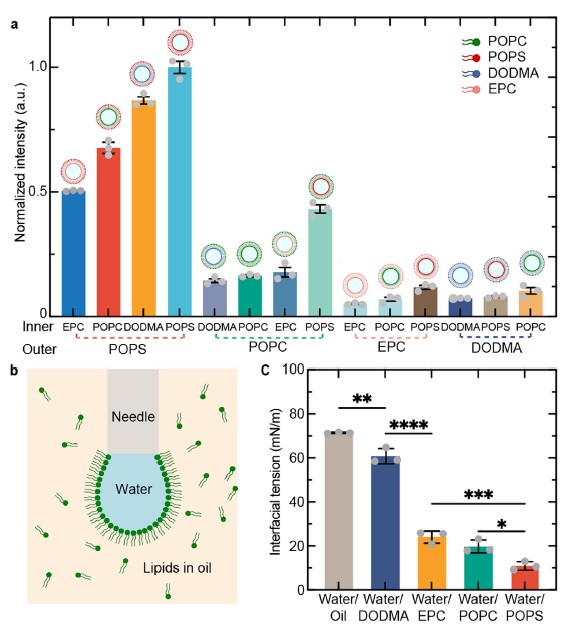
Interfacial tension between mineral oil and aqueous PBS phases containing different lipid formulations was measured using the pendant drop method.

Dropometer attribution in the paper

The paper describes the use of the “pendant drop method (Droplet Lab)” with Young–Laplace fitting to determine interfacial tension.

How the surface-tension / contact-angle data were used in the study

The interfacial tension data were used to compare lipid formulations during asymmetric vesicle formation and to correlate lower interfacial tension with increased vesicle yield. The measurements supported formulation selection for asymmetric lipid vesicles used in mRNA and protein delivery experiments.

Replication / reliability statement

Mean ± SD, n = 3.

Paper Details

Title
Engineering Asymmetric Nanoscale Vesicles for mRNA and Protein Delivery to Cells
Authors
Chenjing Yang, Julian Menge, Nene Zhvania, Miao Yu, Hualiang Yang, Dong Chen, Zongli Zheng, David A. Weitz, Kevin Jahnke
Journal
Advanced Functional Materials
Year
2025
Volume
35
Pages / Article
2505738
License
© 2025 Wiley-VCH GmbH

Scopus metrics (Elsevier / Scopus rating 2024)

CiteScore 2024

19.96

CiteScore subject ranks (CiteScore 2024)
  • Q1 - Biomaterials
  • Q1 - Electrochemistry
  • Q1 - Nanoscience and Nanotechnology
  • Q1 - Electronic, Optical and Magnetic Materials
5.439

Journal Impact Factor (Clarivate JCR)

Journal Impact Factor (JCR 2024)

19.0

5-Year Impact Factor

19.4

JCR category rank

Q1 - Physics, Applied (9/187)

What Was Measured

Primary surface / interfacial measurement

The study measured interfacial tension between mineral oil and PBS containing different lipid formulations using the pendant drop method. Measurements compared DODMA, EPC, POPC, and POPS lipid systems and quantified their effect on water/oil interfacial behavior during asymmetric vesicle formation.

Supporting measurements

The study also characterized vesicle size distributions using dynamic light scattering and TEM, vesicle asymmetry using dithionite fluorescence quenching, zeta potential, vesicle uptake by cells, mRNA transfection efficiency, cytotoxicity, membrane fluidity, encapsulation efficiency, and gene-editing performance.

Role of the Dropometer

The Dropometer by Droplet Lab was used to measure interfacial tension between mineral oil and PBS solutions containing different lipid compositions during asymmetric vesicle formation. In the pendant drop workflow, lipid-containing mineral oil droplets were introduced into aqueous PBS, the droplet contour was imaged, and Young–Laplace fitting was applied to determine interfacial tension values.

The resulting interfacial tension measurements were used to compare lipid formulations and identify relationships between lower interfacial tension and higher asymmetric vesicle yield during the inverted emulsion assembly process.

Method Snapshot

Method Snapshot Table

System / Experiment Lipid Composition Measurement Output Instrument / Technique Conditions Notes
Interfacial tension screening DODMA in mineral oil Interfacial tension Pendant drop method (Droplet Lab) Lipid concentration: 0.06 mM in mineral oil Highest measured interfacial tension
Interfacial tension screening EPC in mineral oil Interfacial tension Pendant drop method (Droplet Lab) Lipid concentration: 0.06 mM in mineral oil Intermediate interfacial tension
Interfacial tension screening POPC in mineral oil Interfacial tension Pendant drop method (Droplet Lab) Lipid concentration: 0.06 mM in mineral oil Lower interfacial tension than EPC
Interfacial tension screening POPS in mineral oil Interfacial tension Pendant drop method (Droplet Lab) Lipid concentration: 0.06 mM in mineral oil Lowest measured interfacial tension
Vesicle yield comparison DODMA, EPC, POPC, POPS combinations Fluorescence intensity proportional to vesicle yield Fluorescence measurement Asymmetric vesicles formed by inverted emulsion method Higher yield observed for lower interfacial tension systems
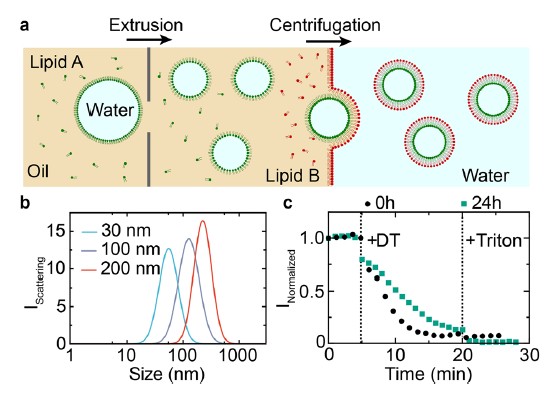
Vesicle asymmetry characterization NBD-PE labeled outer leaflet Fluorescence quenching Dithionite quenching assay NBD fluorescence measured every minute Asymmetry up to >90%
Vesicle size characterization Vesicles extruded through 30, 100, or 200 nm membranes Hydrodynamic diameter Dynamic light scattering Extrusion through polycarbonate membranes Vesicle size tuned by membrane pore size
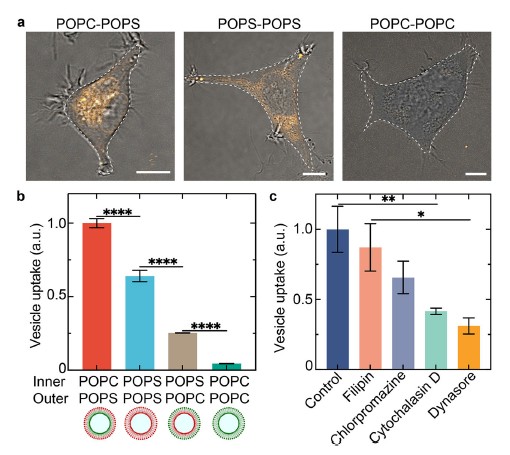
Cell uptake experiments POPC-POPC, POPS-POPS, POPC-POPS vesicles Cellular uptake Confocal microscopy and flow cytometry HEK293 cells incubated with vesicles POPC-POPS showed highest uptake
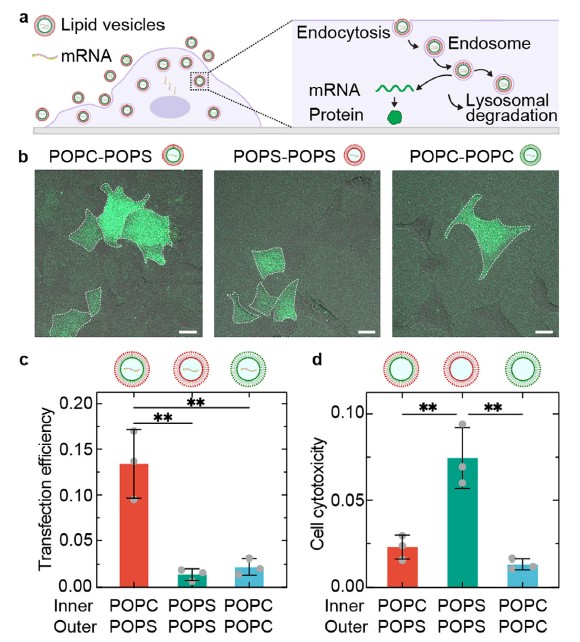
mRNA delivery GFP-encoding mRNA-loaded vesicles Transfection efficiency Confocal microscopy 48 h post-incubation POPC-POPS produced highest transfection efficiency
Protein delivery Cas9, IgG, Streptavidin, B-Phycoerythrin Protein localization and delivery Confocal microscopy HEK293 cells Functional delivery demonstrated

Key Findings

Lower interfacial tension increased vesicle yield

POPS-containing systems produced the lowest interfacial tension values and corresponded to the highest asymmetric vesicle yields. DODMA-containing systems exhibited the highest interfacial tension and lower vesicle formation efficiency.

Pendant-drop measurements linked interface physics to vesicle formation

The interfacial tension measurements revealed a relationship between lipid-dependent interfacial behavior and successful translocation of emulsions through the second lipid monolayer during asymmetric vesicle formation.

Asymmetric vesicles enhanced cellular uptake

POPC-POPS asymmetric vesicles exhibited approximately twofold higher uptake than symmetric POPS-POPS vesicles in HEK293 cells.

Asymmetric vesicles improved mRNA transfection

POPC-POPS vesicles achieved transfection efficiencies nine times higher than POPC-POPC vesicles and seven times higher than POPS-POPS vesicles.

Asymmetric vesicles reduced cytotoxicity

POPC-POPS vesicles showed lower cytotoxicity than symmetric POPS-POPS vesicles despite higher uptake efficiency.

Protein and gene-editing cargo delivery was demonstrated

The asymmetric vesicles successfully delivered fluorescent proteins, GFP-fused Cas9, and Cas9/sgRNA complexes capable of producing genome edits in HEK and HeLa cells.

Figures & Visuals

Figure 3 — Interfacial tension comparison across lipid systems

What it shows

Shows the pendant drop measurement workflow and compares interfacial tension values for DODMA, EPC, POPC, and POPS lipid formulations.

Figure 1 — Asymmetric vesicle fabrication and characterization

What it shows

Illustrates the inverted emulsion workflow and validates vesicle asymmetry and size control.

Figure 4 — Cellular uptake of asymmetric vesicles

What it shows

Demonstrates enhanced uptake of POPC-POPS asymmetric vesicles using confocal microscopy and flow cytometry.

Figure 5 — mRNA transfection performance

What it shows

Shows GFP expression after mRNA delivery and compares transfection efficiencies between symmetric and asymmetric vesicles.

Why It Matters

This work used interfacial tension measurements to connect lipid interfacial behavior with asymmetric vesicle assembly efficiency. The pendant-drop data provided a direct experimental framework for comparing lipid formulations during nanoscale vesicle engineering.

The resulting asymmetric vesicles demonstrated improved cellular uptake, increased mRNA transfection efficiency, reduced cytotoxicity, and delivery of functional proteins and ribonucleoprotein complexes. The study positioned asymmetric lipid organization as a controllable design parameter for drug delivery systems.

Practical Takeaways

Interfacial tension correlated with vesicle yield

Lower interfacial tension lipid systems, particularly POPS-containing formulations, produced higher asymmetric vesicle yields during inverted emulsion assembly.

Pendant-drop measurements informed formulation selection

The Dropometer-derived interfacial tension measurements enabled direct comparison of lipid formulations used during asymmetric vesicle fabrication.

Leaflet composition affected delivery performance

Changing lipid composition between the inner and outer leaflets altered uptake efficiency, transfection behavior, and cytotoxicity.

Asymmetric vesicles supported multiple cargo classes

The vesicle platform delivered mRNA, siRNA, proteins, and Cas9/sgRNA complexes using related assembly workflows.

Surface and membrane properties influenced cellular interactions

The study connected membrane asymmetry, interfacial behavior, and vesicle softness with enhanced uptake and intracellular delivery outcomes.