Contents

Developing AI for Automating Contact Angle Measurement: From Concept to Innovation

320ff2382c3d1dd1dc62fedeb6ec388e8d01d671cedc8a9309742b9dddef8882?s=100&d=m
Written by
abhimanyu
No biography added yet.
Read More
320ff2382c3d1dd1dc62fedeb6ec388e8d01d671cedc8a9309742b9dddef8882?s=100&d=m
Written By

No biography added yet.

The study of liquid behavior on surfaces enables scientists to understand how liquids spread, bead or repel which reveals information about surface energy, adhesion and coating performance. The analysis depends on contact angle measurement which determines the angle between a liquid droplet and a solid surface. The process has historically required expert intervention for manual operation. Our project aimed to build an AI system which would detect contact angles automatically while delivering results that match human expert performance.

In this article we explore the full lifecycle of this AI system development, covering research, data development, model construction, and training optimization.

Why Automate Contact Angle Measurement?

Interfacial phenomena play a vital role in studying how liquids interact with different surfaces. The evaluation of contact angle measurement functions as the primary method to assess surface wetting and adhesion properties for applications that include coatings, adhesives, biomaterials and filtration membranes. The measurements enable scientists and quality control personnel to evaluate material bonding strength, moisture resistance or substance interaction which proves essential for various sectors including electronics , aerospace, food packaging, healthcare.

The traditional method requires human operators to identify the exact point where a droplet touches the surface. This process demands extensive time commitment while producing subjective outcomes which rely on both staff experience and equipment performance especially monitor contrast and lighting conditions. The process of distinguishing droplets from their reflections becomes extremely challenging when dealing with hydrophobic surfaces that have contact angles above 90° and superhydrophobic surfaces that exceed 150° because it needs advanced technical skills.

The reliability of manual measurements faces challenges from multiple factors which include droplet shape differences, variable lighting conditions, camera resolution and even substrate quality. This generates data inconsistencies between different laboratories, research projects and user groups which produces delays in decision-making and reduces trust in the results.

Our AI system operates by replicating expert decision making to produce consistent results at fast speeds while maintaining scalability.

Step 1: Researching AI Methods

We started our investigation by examining current machine learning and image processing methods which included studying convolutional neural networks (CNNs) and transfer learning techniques. These methods work best for visual detection tasks which include droplet identification.

Keras 300x93

We picked Keras because this open-source deep learning framework provides both adaptable features and a wide range of tools.

The research established a solid basis for creating a model which understands the specific characteristics of interfacial phenomena.

Step 2: Building the Dataset

The main foundation of every AI system depends on data. We created a dataset that contains more than 30,000 labeled images which represent every possible wetting pattern:

  • Superhydrophilic
  • Hydrophilic
  • Hydrophobic
  • Superhydrophobic

The research team dedicated special attention to hydrophobic and superhydrophobic materials because these substances create the most difficult measurement conditions. The combination of expert annotation with new image generation methods produced precise labels which expanded the dataset to include complex situations.

Step 3: Designing the Model

The Keras framework enabled us to test various CNN network designs. The contact angle detection system uses transfer learning to enhance existing models which undergo specific training for this task. The model achieved robustness through multiple essential design choices which directed its development process.

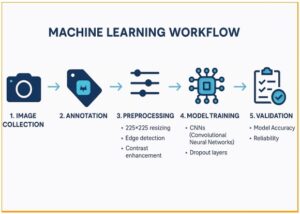
  • Image preprocessing: Standardizing all images to 225×225 pixels ensured compatibility with CNNs.The evaluation results demonstrated that linear resizing without cropping performed better than all other methods.
  • The model learned to detect droplets through edge detection and contrast enhancement methods which operated under difficult imaging circumstances.
  • Two Dropout layers receive a 30% dropout rate which helps prevent overfitting while improving model generalization.
  • The testing process showed that a batch size of 8 produces the best balance between performance and memory usage.
Step 4: Training and Validation

The dataset was divided into two parts: 85% for training and 15% for validation. The model underwent development through the assessment of accuracy, precision, loss and validation loss metrics.

Through multiple testing cycles the AI system demonstrated its ability to reach high performance levels.

  • Training loss: 4.8805e-04
  • Validation loss: 6.9776e-04

The AI system demonstrated human-level contact point detection accuracy through its ability to differentiate between droplets and their reflections which stands as a major challenge in contact angle measurement.
Keras 300x93

Step 5: Fine-Tuning with Edge Cases

Our evaluation process included specific difficult images to test the AI system for its ability to learn new things using images with
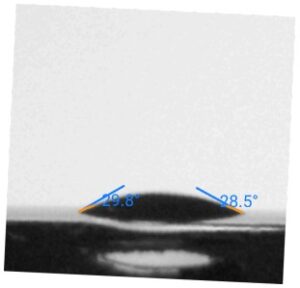
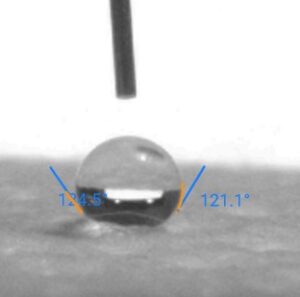
Out-of-focus droplets
  •  
Low-contrast conditions
  •  
Strong reflections
Strong reflections
Images with significant noise or distracting objects

The use of these difficult cases for training made the model more reliable for real-world situations which experts would normally disagree about.

The project produced multiple important achievements during its development process.

  • The AI system delivers constant precise contact point detection across all surface types including hydrophobic and superhydrophobic materials.
  • The process which took experts hours to complete now operates at lightning speed without human intervention.
  • The model adapts to various sample types, different imaging conditions and experimental setups.
  • The system will continue to improve through additional data collection and enhancement work which will lead to new AI-based approaches for surface science research.

The practical benefits of this innovation extend across multiple sectors:

  • Faster R&D Cycles: Scientists and engineers can analyze results in real-time, enabling faster iteration in developing new coatings, adhesives, and treatments
  • Consistent QC: In industrial settings, this AI provides consistent, repeatable results that enhance process control and product certification
  • Lower Barrier to Entry: Labs without trained surface science specialists can now perform high-quality measurements with minimal onboarding
  • Education & Training: Schools, universities, and training programs can introduce interfacial phenomena experiments without needing expert supervisors

We’ve already seen this in action at pilot sites where the automated system has been used in settings ranging from universities to Fortune 500 materials divisions.

The development of this AI system builds upon our previous benchmarked work in image processing, including comparison studies with the Krüss DSA100 system published in a peer-reviewed scientific journal. That foundational system achieved industry-leading accuracy using semi-automatic techniques—where the user still needed to input initial baseline estimates.

With DropletAI, we’ve moved beyond semi-automation into fully automated measurement, removing the need for any user intervention while preserving expert-level precision. To visually demonstrate the difference, we’ve produced two short video clips: one showcasing the legacy semi-automatic approach, and the other highlighting the new AI-powered process, clearly illustrating the increased speed, precision, and usability.

Old Process without ML.

New Process with ML

Looking Ahead

The DropletAI initiative aimed to solve traditional contact angle measurement problems by using AI to reproduce human expert evaluation methods. The long-term vision includes the addition of new measurement methods.

The advanced AI model demonstrates superior performance than standard machine vision methods which need human-set thresholds and strong contrast because it can extract meaningful data even from low-contrast, distorted, or liquid-in-liquid images. This makes AI a fundamentally more scalable and resilient approach.

To achieve this, we’ve been exploring:

  • Use of DenseNet201 as the backbone model for transfer learning
  • A dataset of over 20,000 images, generated by applying smart transformations like random blur and contrast variations to high-quality labeled images
  • Image standardization to optimize training
  • Regularization techniques to prevent overfitting
  • Optimal batch size for consistent training without memory saturation

These strategies are expected to deliver a model with training loss of 7.7985e-04 and validation loss of 9.1347e-04, showing both accuracy and generalization potential.

The work enables immediate application of this AI technology for advanced measurement tasks which include liquid–liquid interfaces, live dynamic wetting studies and real-time surface treatment validation.

The Future of Surface Science

The AI module establishes a pathway for making advanced interfacial science operations as simple as standard image uploading. The model receives ongoing development through Droplet Lab which uses new data types for enhancing its capacity to measure both dynamic and real-time phenomena thus establishing a new benchmark for automated intelligent measurement systems.

Our vision includes connecting cloud-based lab data systems and LIMS platforms to improve workflow efficiency and implementing real-time feedback loops for process optimization in automated manufacturing lines.

Our AI system delivers improved surface treatment insights to QC technicians, academic researchers and formulation chemists who want to obtain faster and more accurate results.

Ready to see it in action? Contact us or request a demo today.

Download Experiment