
Contents

Measuring Contact Angles with a Smartphone: A Peer-Reviewed Method

320ff2382c3d1dd1dc62fedeb6ec388e8d01d671cedc8a9309742b9dddef8882?s=100&d=m
Written by
abhimanyu
No biography added yet.
Read More
320ff2382c3d1dd1dc62fedeb6ec388e8d01d671cedc8a9309742b9dddef8882?s=100&d=m
Written By

No biography added yet.

The contact angle of a droplet on a solid surface serves as a fundamental parameter which scientists use to study surfaces. Scientists utilize contact angle measurements to analyze how liquids interact with solids while studying adhesion and contamination. The method serves as a fundamental requirement for multiple industries which include coatings and semiconductors. The traditional process of contact angle measurement needed costly optical equipment which required laboratory settings for operation.

The smartphone-based contact angle instrument from Droplet Lab provides research-level measurement accuracy through its portable design which remains affordable and user-friendly. This article will explain the entire technical process through step-by-step instructions which draw from peer-reviewed studies published in Review of Scientific Instruments.

Why Contact Angles Matter

The contact angle represents the intersection point between the liquid-vapor interface and the solid surface when a liquid drop rests on a solid surface.

Young’s contact angle represents the perfect angle which occurs when a surface has no flaws and maintains uniformity throughout. The actual surfaces exist in a state of roughness or heterogeneity which produces contact angles that fall within the range of two extreme values.

  • Advancing contact angle (θa): as liquid spreads.
  • Receding contact angle (θr): as liquid withdraws.

The measurement of these values provides essential information about surface cleanliness, chemical treatment effectiveness and wetting characteristics making them critical for

  • Coatings and paints: ensuring quality and durability.
  • Semiconductor manufacturing: detecting contamination.
  • Material science: evaluating hydrophobic and hydrophilic surfaces

From Bulky Systems to Smartphones

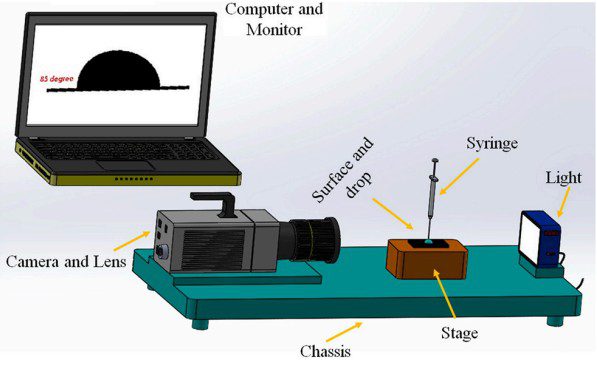
Traditional contact angle systems include:

  • A camera system which includes both optical zoom and adjustable backlighting
    features.
  • Precision stages to hold the solid sample.
  • A syringe system to dispense drops.
  • A computer to analyze the image and compute the angle.

The systems provide precise measurements yet their high cost and large size prevent students from accessing them during fieldwork. Smartphones now integrate a camera, processor, display, and storage in a single device.The addition of a modular stage with syringe and backlight components enables smartphones to perform standard laboratory tasks at a fraction of the cost.

From Bulky Systems to Smartphones

Hardware Setup

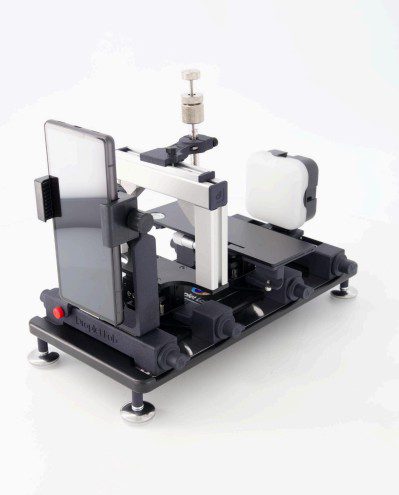
The smartphone-based instrument operates through four separate modular components which connect together.

  • Smartphone (tested with LG G5, Snapdragon 820, 4 GB RAM).The camera needs to have RAW image capture functionality for producing sharp edges. Digital zoom is used (no external lens needed).
  • The drop injection system operates through a 500 µL syringe which contains a threaded plunger for exact manual operation.
  • Stage – holds and levels the solid sample.
  • LED backlight – diffused for high-contrast drop silhouettes.

The modular structure enables users to detach components for maintenance and future enhancements and connection to additional systems.

hardware

Software Subsystem

The software contains two main functions which handle image processing and contact angle
measurement

Step 1: Drop Image Capture
  • A sessile drop of liquid (e.g., water) is placed on the test surface.
  • The camera on the smartphone records the profile which appears against the light source
Step 2: Profile Detection
  • Otsu’s thresholding is applied to extract the drop outline from the image, robust against fuzzy edges from digital zoom.
  • The contact points between liquid and solid material represent the primary focus for detection.

Automatic Contact Point Detection (Core Innovation)

The identification of contact points represents the most complex technical task which Droplet Lab’s smartphone-based approach has developed multiple effective solutions for.
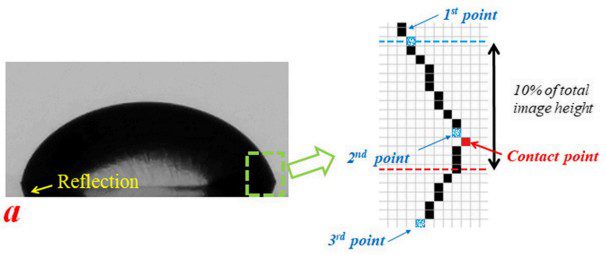
1. Drops with reflection

drops

  • Both drop and reflection profiles are detected.
  • At the contact point, the slope of the profile changes sign.
  • The algorithm tracks neighboring slopes until it finds a change which determines the actual contact point.
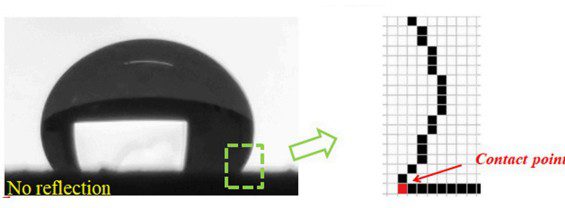
2. Drops without reflection

drops without reflection


  • Profile slope eventually reaches zero after the contact point.
  • The system detects this slope plateau to identify where the liquid touches the surface
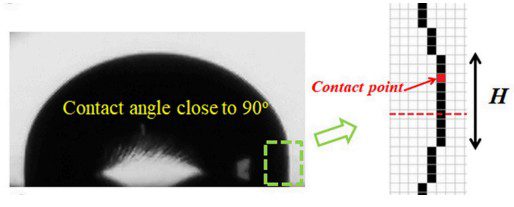
3. Drops near 90°

drops near


  • For nearly vertical drops, slopes may not change sign at all.
  • Algorithm instead checks for continuous vertical profile points (≥8 in a row).
  • The contact point should appear at one-third of the vertical stack according to tests which analyzed around 100 images.

The user starts the process by selecting an estimated contact line through screen tapping. The method provides approximate results which guide the software to the correct area for enhanced false detection prevention. The detection system uses three threshold values which experts established through testing to provide consistent results in various lighting and surface environments.
Angle Calculation Methods

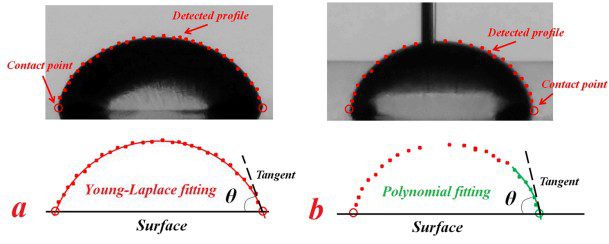
Two fitting methods are used depending on drop geometry:

1. Young–Laplace fitting

  • Fits the entire drop profile to the Young–Laplace equation.
  • Best for axisymmetric drops without needles.
  • The method shows greater resistance to damage from surface imperfections which occur locally.

2. Polynomial fitting

  • Fits only part of the profile with a second-order polynomial.
  • Computationally faster and works when axisymmetry is broken (e.g., with needles)
Polynomial fitting

Measuring Static Angles

The measurement of static contact angles requires scientists to place a sessile drop on the surface. Young–Laplace method and polynomial method both apply.

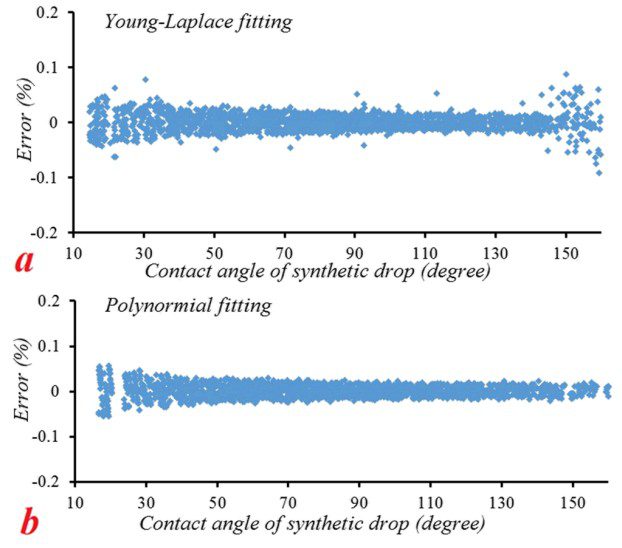
Validation with synthetic drops (2,049 profiles, 10°–162°) showed:

  • Average error: 0.01%
  • Median error: 0.01%
  • Max error: <0.1%

The system delivers measurements which exceed the precision of commercial devices that
operate within a ±1° range.

young pic

Summary of the error for synthetic contact angle measurements using both the Young-Laplace and Polynomial fitting methods.

Fitting method Average error (%) Median error (%) Maximum error (%)
Young-Laplace 0.01 0.01 0.09
Polynomial 0.01 0.01 0.06

Measuring Advancing and Receding Angles

Several industrial and research applications need dynamic contact angles beyond static measurements. The measurements display hysteresis and adhesion forces in addition to showing how liquids move.

How It’s Done with the Smartphone Instrument

● A 50 µL drop is deposited on the test surface.
● Advancing angle (θa): more liquid is added via syringe threads at 3 µL/s.
● Receding angle (θr): liquid is withdrawn at the same rate.
● The needle remains in the droplet, which breaks symmetry.


Because the profile is no longer axisymmetric, only polynomial fitting is suitable. The method uses a local portion of the drop edge, ignoring the distortions introduced by the needle.

Results Compared with Krüss DSA100E

The research tested five different surfaces which included glass and PMMA and PS and Teflon AF and superhydrophobic aluminum. The measurements from the smartphone and Krüss showed identical results for all tested surfaces:


  • The advancing angle measurements showed variations which did not exceed 2°.
  • The receding angle measurements showed deviations which stayed within the error range of about ±2–3°.


The smartphone system demonstrates its ability to measure all wetting characteristics of surfaces through precise data collection which extends beyond basic static angle measurements.

TABLE III. Comparison between measurement results from commercial and smartphone instruments (advancing and receding contact angle measurement). For each of the surface, three different drops were used. The reported values are the average value of three measurements.

Surface name Advancing contact angle (Results in deg) Receding contact angle (Results in deg)
Smartphone Commercial instrument Smartphone Commercial instrument
Glass 46.1 ± 1.5 45.1 ± 2.3 19.05 ± 1.4 19.3 ± 3.0
PMMA 76.3 ± 1.5 76.5 ± 0.7 57.6 ± 1.9 55.7 ± 1.4
PS 108.3 ± 1.8 107.6 ± 1.1 69.0 ± 2.8 67.5 ± 1.0
Teflon AF 124.8 ± 1.2 123.1 ± 2.9 110.3 ± 2.8 110.2 ± 1.5
SHS 150.12 ± 2.8 152.92 ± 1.7 148.3 ± 3.1 150.1 ± 2.7

Validation with Real Surfaces

The researchers selected five different surfaces which represent various points along the wetting scale.


  • Glass & PMMA: hydrophilic (<90°)
  • Polystyrene: ~90°
  • Teflon AF & SH: hydrophobic and superhydrophobic (>150°)


Static measurements were performed simultaneously by smartphone and Krüss from perpendicular angles. The analysis showed that all methods produced similar results within a 1-2 degree range and Young–Laplace fitting demonstrated superior performance because it evaluated the entire droplet profile.


TABLE II. Comparison between measurement results from commercial and smartphone instruments (simultaneous measurements). For each of the surfaces, three different drops were used; note the values shown are for static (or as placed) contact angles.

Surface / Drop name Young-Laplace method (Results in deg) Polynomial method (Results in deg)
Smartphone Commercial instrument Smartphone Commercial instrument
Glass 1a 39.3 39.5 41.7 37.4
Glass 2 37.1 37.8 40.3 36.6
Glass 3 36.9 37.7 37.2 36.8
PMMA 1 74.3 73.8 75.9 73.1
PMMA 2 72.3 73.7 75.1 72.7
PMMA 3 72.7 73.1 73.0 72.3
PS 1 95.5 95.6 92.1 92.5
PS 2 90.3 90.9 89.6 89.7
PS 3 90.0 90.8 88.1 89.7
Teflon AF 1 122.0 123.3 119.5 123.2
Teflon AF 2 119.7 119.9 119.4 118.8
Teflon AF 3 121.8 123.5 119.3 121.7
SHS 1 149.3 152.4 148.2 149.8
SHS 2 156.5 158.8 149.3 154.3
SHS 3 156.4 154.4 145.5 150.5

The contact angle between pure water and smooth glass (ideally) should be close to zero. The relatively large value of the contact angle on glass ( nearly 37 degrees) can be caused by the imperfection of the glass surface. The variations of the absolute value of the glass contact angle from the ideal situation do not change the fact that the measurement results from the two instruments match with each other.

Success Parameters and Performance

  • Synthetic drops: 0.01% accuracy (2,049 profiles).
  • Static angles: smartphone matched Krüss within ~1°
  • Dynamic angles (θa, θr): strong agreement across all surfaces.
  • Robustness: algorithms adapted for reflections, slope changes, and near-90° angles.

Conclusion

The measurement of contact angles serves as the core method to study wetting processes and surface adhesion and treatment effects. The Droplet Lab smartphone instrument delivers 0.01% average error on synthetic drop measurements (2,049 profiles; 10°–162°) according to peer-reviewed research while providing performance that matches the Krüss DSA100E for static and dynamic angle measurements.

The integration of advanced algorithms into a compact smartphone platform has enabled the development of a mobile cost-effective instrument which maintains laboratory-grade scientific accuracy.

References

Download Experiment