


Contents
Case Study

Zeus put lab-grade contact angle QC on the production floor and ended ±5–10° of operator guesswork.

Last Updated
June 4, 2026
Industry
Polymer Extrusion Manufacturing

Reproducible, audit-ready surface-energy measurement that matches a KRÜSS DSA100E reference run by factory-floor inspectors across 24/7 shifts. Zeus reached it with Droplet Lab's $5,000 smartphone-based system, replacing the ~$12,000 manual benchtop it had outgrown.

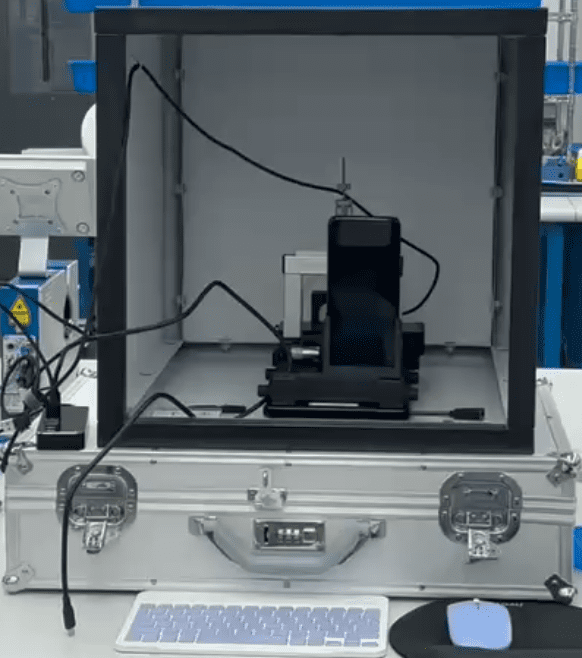
Smartphone-based goniometer system on tubing samples
Abhimanyu Photo
Written by
Abhimanyu Bhandankar
Holds an MBA from Schulich School of Business and a BE in IT. He joined Droplet Lab in July 2019 and now leads sales and marketing.
CEO at Droplet Lab
Read More
Technical Review by
Gurdeep Singh Saini
Holds a BASc in Mechanical Engineering (Ryerson) and an MASc from York University. He focuses on the custom AI behind the instrument.
COO at Droplet Lab
Read More
Abhimanyu Photo
Written By

Abhimanyu Bhandankar

CEO at Droplet Lab

Holds an MBA from Schulich School of Business and a BE in IT. He joined Droplet Lab in July 2019 and now leads sales and marketing.

Reviewed By

Gurdeep Singh Saini

COO at Droplet Lab

Holds a BASc in Mechanical Engineering (Ryerson) and an MASc from York University. He focuses on the custom AI behind the instrument.

Executive Summary

Who

Zeus, a US-based manufacturer of high-performance polymer extrusion and custom tubing, serving medical, aerospace, automotive, and industrial sectors.

Problem

A ~$12K benchtop optical goniometer, read manually, introduced 5–10° of operator-dependent variance in surface energy readings; risking downstream adhesion failures and eroding partner confidence in QC documentation.

Solution

Droplet Lab's $5K smartphone-based goniometer with ML droplet detection, validated against KRÜSS DSA100E and benchmarked in peer-reviewed studies.

Results

±5–10° of operator variance eliminated; readings now reproducible across operators and matched to a KRÜSS DSA100E reference. Five instruments deployed; Gage R&R passed. Factory staff produce lab-grade data — 4 months from first contact, at a fraction of the legacy instrument's cost.

Highlights

~5–10°

Prior method variance (manual analog estimation)

up to 0.01°

New system performance

5 instruments deployed in one facility; used continuously for 3+ months

Rollout

Quote teaser

"Overall, we've been very impressed… it's much more technologically advanced…"

Zeus, at a glance

Industry

Polymer extrusion / custom tubing manufacturing

Applications

Medical, aerospace, automotive, and industrial sectors

QC Stage

In-process inspection

Users

Factory floor inspectors, running 24/7 shifts across multiple plants, with no advanced training in optics or surface science.

Materials / Surfaces Tested

Polymer tubing extrusions

Key Constraints

Minimal workflow disruption; 24/7 operability; high repeatability; multi-facility scalability

A $12K instrument that still couldn't be trusted

How Zeus worked before

Contact angle, the primary method for assessing surface energy on tubing was measured on a ~$12,000 benchtop optical goniometer read manually via the half-angle technique. An inspector aligned a crosshair to the droplet profile and read the angle off an optical protractor by eye. No automated droplet fitting. No digital audit trail. The result depended entirely on the operator at the eyepiece.

Pain points

  • Manual alignment introduced consistent human error, no two operators produced identical readings
  • Repeatability was insufficient for a high-stakes environment; variance ran to ±5–10°
  • At those error levels, adhesion between materials becomes unpredictable, operationally dangerous, not academically inconvenient
  • QC documentation shared with partners carried that uncertainty, eroding confidence in process integrity

What Was at Stake

A 5–10° error in contact angle is a material-behaviour question, not a rounding issue. Poor surface energy readings translate directly into adhesion failures, compromised tubing, and QC rejections that ripple into Zeus's medical and aerospace customers' downstream processes. Every report sent to a partner carried the implicit uncertainty of a method that couldn't be independently verified.

What Success Would Require

  • Sub-degree accuracy achievable in a production environment, not just a lab
  • Operability by factory-floor staff, not only trained technicians
  • Compatibility with existing data workflows, including Oracle ERP
  • Scalability across multiple facilities without per-site re-engineering

Lab-grade measurement, production-floor workflow

What Was Deployed

Droplet Lab's $5K smartphone-based goniometer system, using the Young–Laplace method for contact angle measurement benchmarked against KRÜSS DSA100E and cited in peer-reviewed publications. A custom tube holder was engineered by Droplet Lab's hardware team to fit Zeus's specific tubing geometry.

What changed, measured side by side

Metric Before After
Method ~$12K benchtop optical goniometer; manual half-angle readout by eye $5K smartphone-based goniometer with ML droplet detection
Precision / Variance ±5–10° operator-dependent spread (estimation by eye) Reproducible across operators; matched to a KRÜSS DSA100E reference (0.01° resolution)
Data confidence Operator-dependent; no digital record or audit trail Digital capture, timestamped; Gage R&R study completed and passed
Usability Skilled estimation required; inconsistent across operators Factory floor staff; consistent results across 3+ operators
Cost & scaling ~$12K per bench; lab-bound, identical effort regardless of volume $5K per unit; replicable across facilities with open-source enclosures

Rollout Timeline

Timeline (high level)

Week 0: Discovery

Zeus contacted Droplet Lab via the website; multiple tubing samples shipped for baseline assessment and comparison against the existing benchtop process.

Week 1-2: Validation

  • Virtual demo of system architecture and measurement workflow
  • Side-by-side comparison: Droplet Lab system vs. Zeus's manual benchtop on identical samples
  • Results and accuracy data returned to the Zeus QA team for review
  • Custom tube holder scoped and designed from the sample geometry

Week 3-4: Deployment

Five instruments purchased and delivered to the primary facility; custom tube holder shipped; factory staff onboarded on the test workflow and handling procedures.

Month 2+: Active iteration

24/7 production use generates continuous feedback; ML model retraining, lighting redesign, and ERP integration all initiated from real-world data at this site.

The evidence behind the numbers

Test method

Young Laplace Method

Sample size and operators

100+ samples across 3 operators

Repeatability / reproducibility

Gage R&R study completed and passed

Measured and operational outcomes

Measured Outcomes

Variance eliminated

±5–10° of operator-dependent spread removed readings now reproducible across operators and matched to a KRÜSS DSA100E reference.

Gage R&R

Study completed across 3 operators; instrument passed

Cost & scale

5 instruments at $5K each replaced a ~$12K bench; continuous 24/7 use for 3+ months, no downtime reported.

Operational Outcomes

Factory floor inspectors not lab technicians now consistently produce lab-grade surface energy data as part of standard in-process QC.

Zeus can give partners detailed, traceable, instrument-grade QC documentation instead of operator-estimated readings; a material shift in report credibility.

Continuous production use is generating real-world data that informs ML retraining, hardware refinement, and the ERP integration roadmap.

What Zeus said

"Overall, we've been very impressed. It's been working really well and we really have enjoyed using it. It's a bit different than what we're currently using. It's much more technologically advanced than how we currently do it, which is good. Also, I wanted to let you know we completed our gage R&R study on the unit we have and it performed very well. We’ve been happy with the machine learning add in too, it saves a lot of time on measurements."
Brandon Barbee - Corporate Quality Engineer, Development

An active development partnership

Delivered

5 smartphone-based goniometers deployed at primary facility
Custom tube holder designed and delivered
Gage R&R study completed and passed
Continuous 24/7 production use established

In Pilot

ML baseline detection retraining on client's real-world image sets
Lighting redesign with a brighter LED module, mount elevated 2cm to cut reflection
Splitters supplied for simultaneous charging and mouse use

Planned

Desktop interface to remove phone dependency
Oracle ERP API integration to eliminate manual data entry
Client-fabricated collapsible enclosures from open-source designs
Longer-term migration toward RAW cameras

Next Step

See the same accuracy gap in your own samples?

Request a personalized demonstration. Ship us your samples and we'll return contact angle results alongside a direct comparison with your current method; dyne pens, manual goniometer, or otherwise. It's exactly how the Zeus partnership started.