Primary surface measurement reported
Contact angle measurements of mixed liquor suspended solids (MLSS) were reported to evaluate sludge surface hydrophobicity (Tables 5.2 and 7.2).

Client Citation Analysis
Contact angle measurements of mixed liquor suspended solids (MLSS) were reported to evaluate sludge surface hydrophobicity (Tables 5.2 and 7.2).
Dropometer M-3 (Droplet Smart Tech Inc., Canada) was used to measure water contact angles on MLSS (Chapters V and VII); the Chapter V methods also list membranes as measured specimens.
Contact angle data were reported alongside zeta potential and dewaterability to describe changes in sludge surface hydrophobicity under varying operating conditions (SRT in Chapter V; OLR and HRT in Chapter VII) in the ThSAnMBR.
Measurements were performed on MLSS samples from each operating phase, with an average contact angle calculated for each specimen; exact replicate counts were not specified in the available text.
Static water contact angle (sessile drop, about 3 μL water droplet) on MLSS to assess sludge surface hydrophobicity (Tables 5.2 and 7.2). The Chapter V methods also list PVDF membranes, but contact angle values are reported only for MLSS.
Membrane flux, transmembrane pressure, membrane resistance, SEM-EDX, FTIR, XPS, zeta potential, capillary suction time (dewaterability), and particle size distribution were also analyzed to interpret correlations between surface characteristics and operational performance of the ThSAnMBR.
ZetaPALS analyzer
Triton capillary suction time tester
Dropometer M-3 (Droplet Smart Tech Inc., Canada)
FTIR, XPS
SEM
Laser diffraction
Permeate flux and permeability tests, Omega pressure gauge for TMP
ZetaPALS analyzer
Triton capillary suction time tester
The Dropometer was used to measure static contact angles of water droplets on MLSS particles (Chapters V and VII); the Chapter V methods also list membrane surfaces, but contact angle values are reported only for MLSS. Contact angles were recorded to assess changes in sludge hydrophobicity with SRT and OLR. These measurements were reported alongside zeta potential and dewaterability as part of the MLSS surface property analysis.
If you track water contact angle on sludge solids or membranes, we can show you the same sessile drop workflow on your samples.
MLSS contact angles were lower at the longer SRTs (32 d: 49.3–62.4°; 45 d: 28.2–42.3°; 55 d: 19.1–26.7°), meaning the sludge was less hydrophobic at higher SRT, a trend the author notes was also observed by other researchers (Chapter V, Table 5.2).
The author identified MLSS concentration as the predominant factor affecting membrane performance and a loose gel layer as the main fouling mechanism (about 98.6 to 98.8% of total resistance in Chapter V). The MLSS contact angle data were reported alongside these results as part of the sludge surface characterization.
Variations in SRT (Chapter V) and in OLR and HRT (Chapter VII) were accompanied by changes in MLSS contact angle. In Chapter VII it fell from 64.3±3.2° at an OLR of 2.2 to 24.6±3.04° at 3.9 kg MLSS/m³ d and recovered to 43.5±5.8° at 1.5 kg MLSS/m³ d (Table 7.2).
FTIR and XPS data indicated foulants remaining on the used membranes after chemical cleaning (e.g., protein, polysaccharide and fatty acid signatures) and changes in MLSS elemental composition; these results were reported separately from the contact angle measurements.
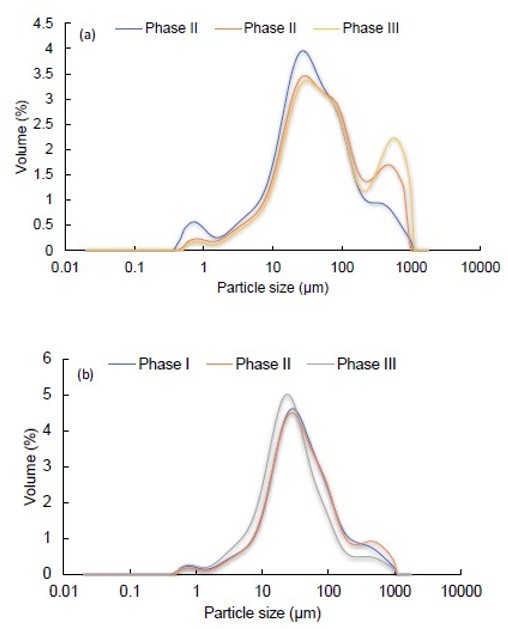
Particle size distributions of the reactor mixed liquor and the membrane loose gel layer under the tested SRTs (Chapter V, Figure 5.8). No contact angle data are shown.
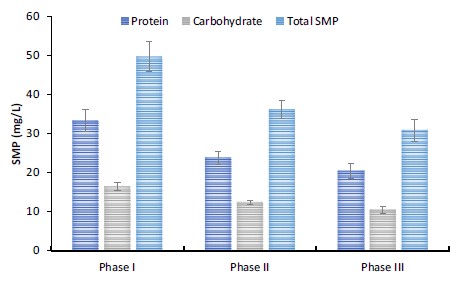
Protein, carbohydrate and total soluble microbial product (SMP) concentrations under the tested SRTs (Chapter V, Figure 5.9). No contact angle data are shown.
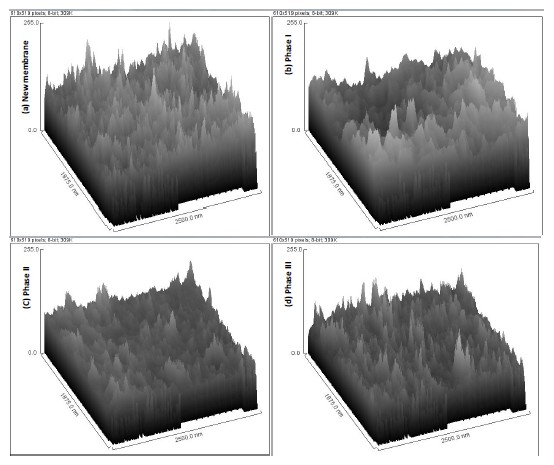
ImageJ 3D surface plots, based on SEM images, of the virgin membrane and membranes used in Phases I to III at different OLRs (Chapter VII, Figure 7.6).
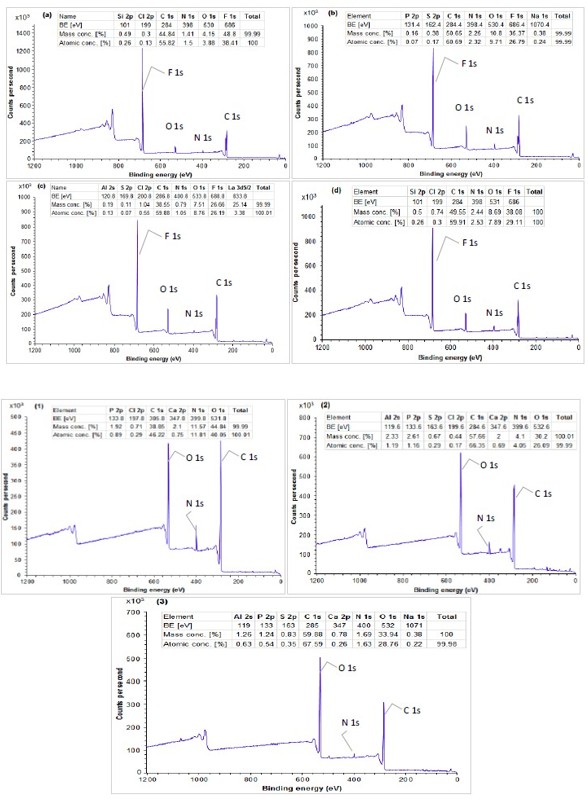
XPS spectra and elemental composition of the new and used membranes and of MLSS in Phases I to III (Chapter VII, Figure 7.10). No contact angle data are shown.
Dropometer contact angle measurements provided a quantitative record of how MLSS surface hydrophobicity changed with SRT, OLR and HRT during thermophilic anaerobic membrane treatment of pulp and paper mill primary sludge. They were reported alongside zeta potential and dewaterability as part of the sludge characterization, while the operating recommendations in the thesis rest mainly on biogas yield, transmembrane pressure and membrane resistance data.
In this thesis, gel layer formation and transmembrane pressure rise tracked MLSS concentration and loading rate; MLSS contact angle was reported as a supporting sludge property.
Adjusting SRT and OLR influences MLSS surface hydrophobicity and membrane performance.
MLSS contact angle and dewaterability (capillary suction time) were reported side by side, and both changed with SRT and operating time (Tables 5.2 and 7.2).
Cleaning effectiveness was assessed through permeability recovery after physical, NaClO and citric acid cleaning, with FTIR and XPS showing foulants that remained after cleaning.
It measured water contact angle on mixed liquor suspended solids (MLSS) from a thermophilic submerged anaerobic membrane bioreactor treating pulp and paper primary sludge, using a Dropometer M-3 (Droplet Smart Tech Inc.). About 3 μL of pure water was dispensed by micropipette and an average angle was calculated for each specimen. The Chapter V methods also list membranes, but contact angle values are reported only for MLSS (Tables 5.2 and 7.2).
In Chapter V, MLSS angles fell as solids retention time increased, from 49.3 to 62.4° at 32 days to 28.2 to 42.3° at 45 days and 19.1 to 26.7° at 55 days. In Chapter VII, the angle was 64.3 ± 3.2° at an organic loading rate of 2.2 kg MLSS/m³ d, dropped to 24.6 ± 3.04° at 3.9 kg MLSS/m³ d, and recovered to 43.5 ± 5.8° at 1.5 kg MLSS/m³ d.
The author reports the angles as a measure of sludge surface hydrophobicity, alongside zeta potential and dewaterability, and notes that lower hydrophobicity at longer retention times matches trends reported by other researchers. The membrane fouling conclusions rest mainly on MLSS concentration and resistance data, with a loose gel layer identified as the predominant fouling mechanism.