Primary surface measurement reported
Static contact angles (water, glycerol, diiodomethane) on PSe films, used to calculate surface energy (dispersive and polar components) via the Owens–Wendt–Rabel–Kaelbel (OWRK) model.

Client Citation Analysis
Static contact angles (water, glycerol, diiodomethane) on PSe films, used to calculate surface energy (dispersive and polar components) via the Owens–Wendt–Rabel–Kaelbel (OWRK) model.
Contact angles are attributed to “Droplet Smart Tech (Markham, ON, Canada)”, with droplets imaged using a 0.3 Mp camera, angles extracted using an in-house written program, and surface energy calculated using OWRK.
The static contact angles were used to compute surface energy of PSe film-coated glass and compare how film coatings synthesized in different buffers change wetting behavior and surface-energy components.
9.2
4.3
4.7
Static contact angles on PSe films using three probe liquids (milli-Q water, glycerol, diiodomethane), with surface energy (including dispersive and polar components) calculated using the OWRK model.
Film thickness was determined via AFM scratch tests, and film adhesion-related interaction metrics were obtained from AFM force–distance curves under defined buffer conditions. The study also reports particle growth/structure and related characterization via UV–Vis, TEM, DLS, zeta potential (PALS), EPR, and DFT calculations.
Static contact angles were measured using Droplet Smart Tech (Markham, ON, Canada) by manually placing 20 µL droplets of milli-Q water, glycerol, and diiodomethane onto PSe films, imaging each droplet with a 0.3 Mp camera, and estimating contact angles using an in-house written program; the resulting angles were then used to calculate surface energy using the OWRK model.
These contact-angle-derived surface-energy results were used to compare how PSe film coatings synthesized in different buffers alter glass wettability and shift the balance of dispersive vs polar surface-energy contributions.
Across the buffer systems summarized, the PSe film coating makes glass more hydrophilic, reported as decreasing the water contact angle by over 15°.
The study reports that surface energy of glass increases from approximately ~47 to ~61 mJ/m² when coated with PSe films (as summarized in Table S1).
The reported increase in overall surface energy is described as having a higher contribution from the dispersive component than from the polar component (Table S1).
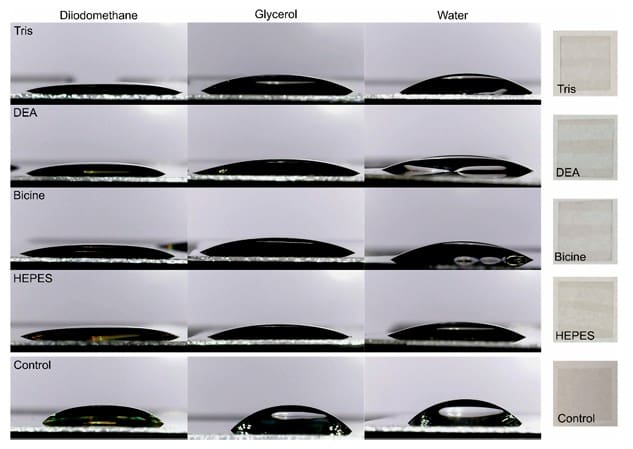
Shows the static contact angle images on PSe films for the three probe liquids used in the OWRK surface-energy analysis.
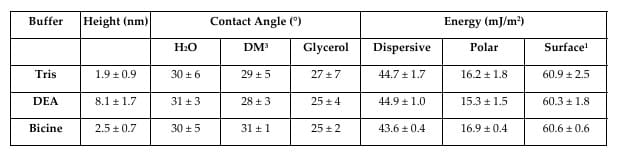
Summarizes film properties used in the discussion of contact-angle changes and the resulting surface energy (including dispersive and polar components).
Within the study’s buffer-dependent synthesis framework, the contact angle measurements provide a quantitative comparison of how PSe films modify glass wetting behavior across buffer conditions, and they enable calculation of surface energy components rather than relying on a single contact-angle value alone.
The resulting surface-energy decomposition (dispersive vs polar) supports the paper’s interpretation of how PSe film coating changes surface interactions, alongside the study’s broader nanoparticle/film characterization dataset.
Static contact angles were collected using 20 µL drops of milli-Q water, glycerol, and diiodomethane, with camera-based imaging and in-house angle extraction feeding an OWRK surface-energy calculation.
The reported outcome for PSe film-coated glass is a reduction in water contact angle by over 15° across the buffer systems summarized.
The reported total surface energy increases from ~47 to ~61 mJ/m² when glass is coated with PSe films (Table S1).
The study attributes more of the surface-energy increase to the dispersive component than to the polar component (Table S1).