Contents

Client Citation Analysis

Combinational regenerative inductive effect of bio-adhesive hybrid hydrogels conjugated with hiPSC-derived myofibers and its derived EVs for volumetric muscle regeneration

This study develops bio-adhesive hybrid hydrogels for volumetric muscle regeneration and uses water contact angle to characterize hydrogel surface wettability.

At-a-Glance Summary

Primary surface measurement reported

Water contact angle (hydrogel wettability) was measured on GelMA and GelTA hydrogels prepared with and without EV incorporation.

Dropometer attribution in the paper

The Dropometer is cited as a “Droplet Lab Tensiometer (Droplet Lab, Ontario, Canada)” used to inject 16 μl water droplets for contact angle measurement, with contact angles after 1 s analyzed by ImageJ software.

How the surface-tension / contact-angle data were used in the study

Contact angle was used to describe hydrogel hydrophilicity and to compare wettability between GelTA and GelTA‑EVs hydrogels. The text also references contact angle comparisons for GelMA and GelMA‑EVs in supplementary figures.

Replication / reliability statement

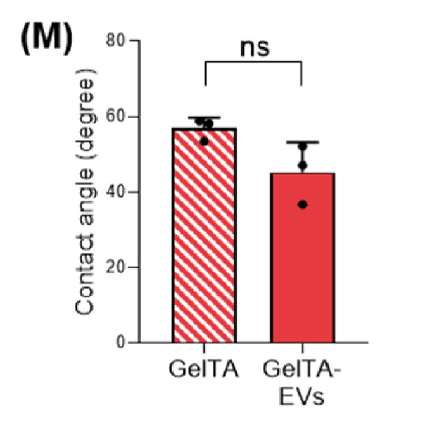
Contact angle in Fig. 5M was quantified by ImageJ (n = 3).

Paper Details

Title
Combinational regenerative inductive effect of bio-adhesive hybrid hydrogels conjugated with hiPSC-derived myofibers and its derived EVs for volumetric muscle regeneration
Authors
Jiseong Kim; Myung Chul Lee; Jieun Jeon; et al.; Indranil Sinha; Su Ryon Shin
Journal
Bioactive Materials
Year
2025
Volume
43
Pages / Article
579–602
License
CC BY-NC-ND 4.0

Journal context

What it is
Journal-level metrics for the publication venue (not a rating of this specific article).
How to read it
Compare metrics within category; updates are annual and lag current-year publications.

Scopus metrics (Elsevier / Scopus rating 2024)

CiteScore 2024

36.2

CiteScore subject ranks (CiteScore 2024)
  • Q1 - Materials Science, Biomaterials (3/140)
  • Q1 - Engineering, Biomedical Engineering (5/323)
  • Q1 - Biochemistry, Genetics and Molecular Biology, Biotechnology (4/314)
SNIP 2024

2.833

SJR 2024

4.075

Journal Impact Factor (Clarivate JCR)

Journal Impact Factor (JCR 2025)

20.3

  • Q1 - Materials Science, Biomaterials (2/55)
  • Q1 - Engineering, Biomedical (3/124)

What Was Measured

Primary surface / interfacial measurement

Water contact angle was measured after 1 s following deposition of a 16 μl water droplet on the hydrogel surface to characterize wettability.

Supporting measurements

Hydrogel microstructure and surface/topography context was reported using scanning electron microscopy (SEM) and atomic force microscopy (AFM) outputs presented alongside contact angle within the hydrogel characterization set.

Role of the Dropometer

In the contact angle assay, hydrogels (GelMA or GelTA, prepared with or without EVs) were formed on glass using a 500 μm high and 10 mm diameter PDMS mold, swelled in DPBS for 3 h, and then dried with Kimwipes. A constant-volume water droplet (16 μl) was injected onto the gel surface using a Droplet Lab Tensiometer (Droplet Lab, Ontario, Canada), and the contact angle after 1 s was analyzed using ImageJ software.

These contact angle measurements were used to compare hydrogel wettability across formulations (including GelTA vs GelTA‑EVs) as part of the study’s hydrogel surface characterization.

Method Snapshot

Method Snapshot Table

Surface-measurement series Hydrogel formulation (as described) EV incorporation (as described) Sample format & mounting Pre-test conditioning Dropometer step Output & analysis Instruments Conditions Data location
GelTA wettability comparison 7.5% (w/v) GelTA in DPBS 2 × 10^9 EVs mixed with 30 μL of 7.5% (w/v) GelTA in DPBS Solution placed on a 500 μm high and 10 mm diameter PDMS mold; glass slide placed on top to fix gels on glass Swelled in DPBS for 3 h; dried sufficiently and carefully with Kimwipes 16 μl water droplet injected onto gel surface Contact angle after 1 s; analyzed by ImageJ Droplet Lab Tensiometer (Droplet Lab, Ontario, Canada); ImageJ 16 μl droplet; 1 s timepoint Figure 5M
GelMA wettability comparison 7.5% (w/v) GelMA in DPBS 2 × 10^9 EVs mixed with 30 μL of 7.5% (w/v) GelMA in DPBS Solution placed on a 500 μm high and 10 mm diameter PDMS mold; glass slide placed on top to fix gels on glass Swelled in DPBS for 3 h; dried sufficiently and carefully with Kimwipes 16 μl water droplet injected onto gel surface Contact angle after 1 s; analyzed by ImageJ Droplet Lab Tensiometer (Droplet Lab, Ontario, Canada); ImageJ 16 μl droplet; 1 s timepoint Figures S6K–S6L

Key Findings

Hydrophilic wettability range reported for GelTA-based hydrogels

GelTA and GelTA‑EVs hydrogels are described as having good hydrophilicity, with a contact angle around 50–70°, which the authors link to maximizing cell adhesion.

GelTA and GelTA‑EVs showed similar contact angle

In Fig. 5M, GelTA and GelTA‑EVs hydrogels displayed similar contact angle, quantified by ImageJ (n = 3).

GelMA and GelMA‑EVs contact angle comparison was referenced in supplementary figures

The text describes GelMA‑EVs as showing similar contact angle compared with pristine GelMA hydrogel and points to Figs. S6K and S6L.
Figures & Visuals

Figure 5M — GelTA vs GelTA‑EVs wettability comparison

What it shows

Shows GelTA and GelTA‑EVs hydrogels with similar contact angle, quantified by ImageJ (n = 3).
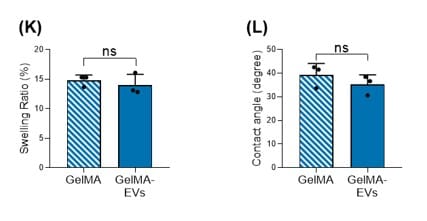
Figures S6K–S6L — GelMA vs GelMA‑EVs wettability comparison

What it shows

Referenced in the text for contact angle comparison between GelMA‑EVs and pristine GelMA hydrogels.

Why It Matters

Within the hydrogel characterization workflow in this study, the contact angle assay provides a direct wettability readout used to describe surface hydrophilicity and to compare formulations with and without EV incorporation. The authors explicitly connect the reported contact angle range to cell adhesion considerations while presenting contact angle as part of the broader surface/structure characterization set for these biomaterial scaffolds.

Practical Takeaways

Use fixed droplet volume and a defined timepoint

The assay uses 16 μl water droplets and evaluates contact angle after 1 s, with angle analysis performed in ImageJ.

Standardize hydrogel pre-conditioning before wetting tests

Hydrogels are swelled in DPBS for 3 h and then dried carefully with Kimwipes prior to droplet deposition.

Document casting and mounting geometry for surface measurements

Hydrogels are formed using a 500 μm high and 10 mm diameter PDMS mold and fixed on glass by placing a glass slide on top during preparation.

Use contact angle to compare EV-loaded vs pristine hydrogels

The study reports contact angle comparisons for GelTA vs GelTA‑EVs (Fig. 5M) and references GelMA vs GelMA‑EVs comparisons in supplementary figures.

Report replication when presenting contact angle comparisons

The contact angle result in Fig. 5M is reported with n = 3.

Download Experiment