Primary surface measurement reported
The study reports water contact angle (WCA) on the optimized corncob cellulosic residue (CCR) film as a wettability indicator.

Client Citation Analysis
The study reports water contact angle (WCA) on the optimized corncob cellulosic residue (CCR) film as a wettability indicator.
WCA is measured using a “0.05 µL precise dropper from the Dropometer (Droplet Lab)”, with a smartphone image analyzed in sessile drop software to calculate the contact angle.
The WCA output is used to classify the CCR film as hydrophilic based on the authors’ stated <90° wettability criterion, and to motivate discussion of hydrophobicity targets for food packaging.
Three sample measurements were used to calculate the average WCA value.
18.3
2.153
1.952
9.8
Water contact angle (WCA, in degrees) was measured on the optimized CCR film using a sessile-drop approach with image-based analysis.
The study also reports film performance and characterization measurements including water vapor permeability (WVP), tensile strength (TS) and elongation at break (EB), hydration-property tests (e.g., water absorption behavior), and spectroscopic characterization (UV–Vis transmittance and FTIR).
The authors measure water contact angle by placing the film sample on the mount, dispensing a water droplet using a “0.05 µL precise dropper from the Dropometer (Droplet Lab)”, capturing a smartphone picture of the droplet, and analyzing the image using sessile drop software to calculate WCA (protocol cited to Chen et al., 2018). The reported WCA value is based on three measurements averaged.
In the results discussion, the WCA output is used as a wettability classifier (hydrophilic vs hydrophobic) for the optimized CCR packaging film and is discussed in the context of hydrophobicity targets for food packaging.
The methods specify a sessile-drop WCA workflow using a 0.05 µL Dropometer dropper, smartphone imaging, and sessile drop software to calculate contact angle.
In the WCA results section, the CCR film is reported to display a contact angle of 63.4°, with the value linked to Fig. 4c.
The authors state that angles less than 90° denote hydrophilicity and use the measured WCA to stress the film’s hydrophilic character.
Hydrophobicity is framed as a food-packaging goal in the discussion
The paper notes that hydrophobic packaging films are generally desired for food packaging and discusses additive approaches reported in prior work as strategies to improve WCA.
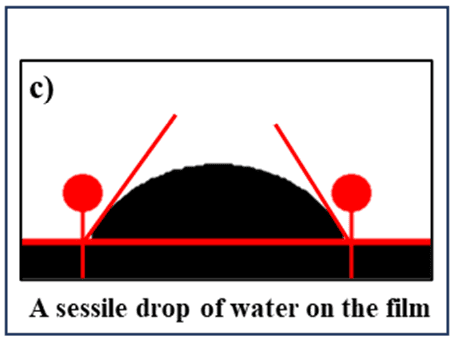
Panel (c) presents the water contact angle measurement image associated with the optimized CCR film.
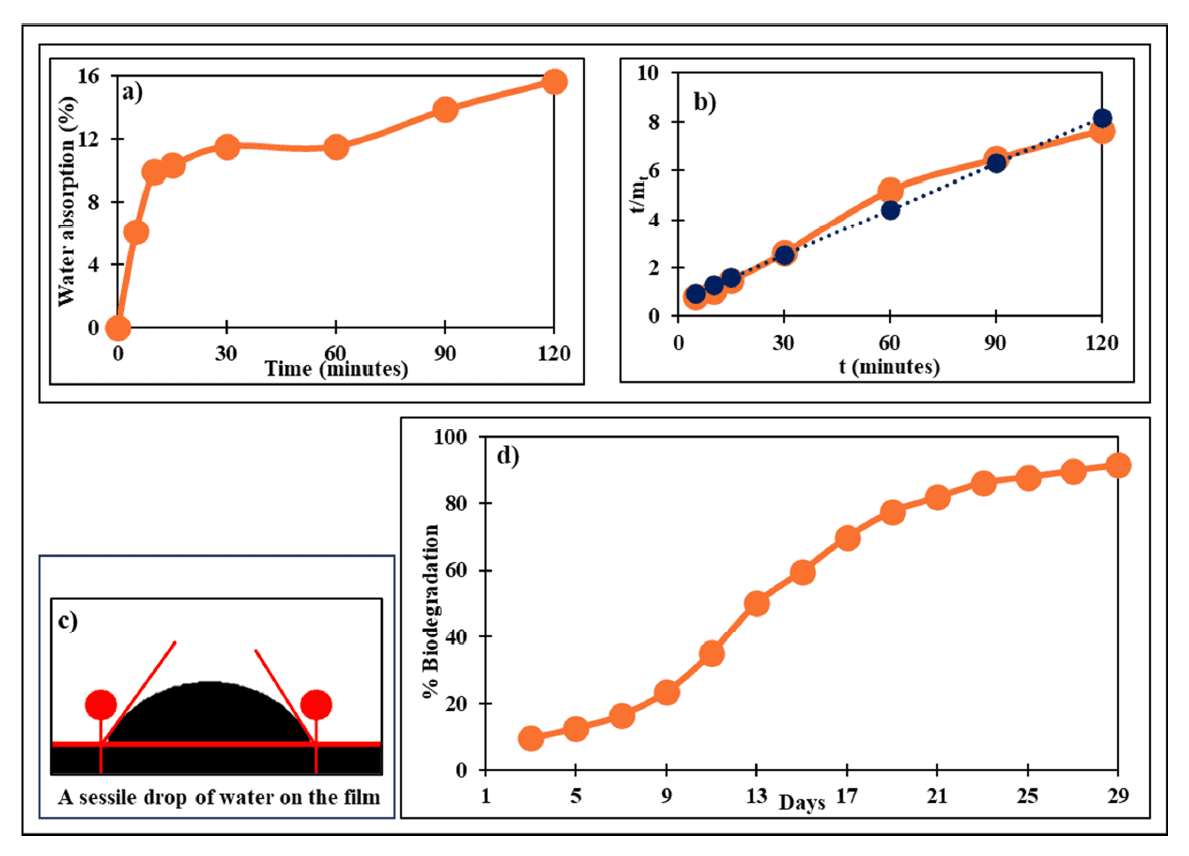
Figure 4 groups hydration-related visuals and includes the WCA measurement as panel (c), which is referenced directly in the WCA discussion.
Within this work, WCA is treated as a core wettability parameter for packaging films, used to distinguish hydrophilic versus hydrophobic surface behavior using a stated 90° criterion. The Dropometer-enabled sessile-drop workflow provides the paper’s quantitative wettability value for the optimized CCR film.
In the results discussion, the authors connect the measured WCA to hydrophilicity classification and use it to frame hydrophobicity as a desirable target for food-packaging materials, motivating further exploration of approaches to improve CCR film hydrophobicity.
The WCA method attributes droplet dispensing to a “0.05 µL precise dropper from the Dropometer (Droplet Lab)”, paired with smartphone imaging and sessile drop software analysis.
The procedure is described as mounting the film, placing a water droplet, capturing a smartphone image, and calculating WCA from the droplet image.
The reported WCA value is an average of three measurements.
The CCR film’s WCA (63.4°) is interpreted using the paper’s <90° hydrophilicity criterion.
The WCA visualization is presented in Fig. 4c, which is cited directly in the WCA results text.