Primary surface measurement reported
DI water surface tension, receding contact angle, and advancing contact angle were measured under controlled temperature and relative humidity inside the chamber.

Client Citation Analysis
DI water surface tension, receding contact angle, and advancing contact angle were measured under controlled temperature and relative humidity inside the chamber.
This thesis is in-house work. Its author, Gurdeep Saini, is Droplet Lab's Chief of Operations; his supervisor, Alidad Amirfazli, is a Droplet Lab co-founder and Scientific Advisor. The thesis credits Droplet Lab designs as the basis for its imaging fixtures. It is presented here as technology background, not as independent third-party validation.
The thesis states that a phone was used for image acquisition and image processing using the “DropletLab© sessile and pendent apps,” with ADSA-P used for surface tension and ADSA-P plus polynomial used for contact angle.
The surface-tension and contact-angle outputs were used to benchmark the chamber against literature experiments performed at defined temperature and humidity conditions. The study used them to compare trend agreement for humidity-dependent surface tension, evaporative receding contact angle on glass, and advancing contact angle on Teflon.
Operating range: 10 °C to 70 °C, ambient to 80% RH, and only "near the center of volume of the controlled environment inside the chamber, not the inner corners or edges." The device tested is a reduced-scope prototype. Supply chain disruption during the pandemic forced a redesign, and the thesis states that "it cannot be run to its maximum settings without failure." In a test at 90 °C and 100% RH, the silicone holding the chamber together began to fail at the 1200 second mark. Temperature overshoot at setpoint is 1.2 °C ± 0.45; steady-state error under 1 °C. Cooling to 15 °C without a fan takes 70 minutes for the air to reach setpoint because the heat sink works against natural convection. Humidity readings fluctuate significantly in tests above and below ambient temperature, mainly because of the lag between humid air injection and its dissipation; during cooling, constant condensation on the cooling block adds further fluctuation. All readings come from a single sensor per variable; the thesis recommends future work use "an average of multiple sensors distributed inside the chamber."
The thesis reports DI water surface tension by the pendent drop method and DI water contact angle by sessile-drop tests. Surface-tension benchmarking was performed at constant temperature with varied humidity, and contact-angle benchmarking covered receding behavior on glass and advancing behavior on Teflon.
Supporting measurements included chamber air temperature, Peltier temperature, ITO glass temperature, and relative humidity inside the chamber. The receding-contact-angle benchmark also tracked initial contact angle, contact angle radius, and initial volume.
DropletLab© sessile and pendent apps
smart phone
LED back light
RTD sensors (PT100 / PT1000)
SHT-30 Temperature/Humidity sensor
Laird ETX6-12-F1-4040-TA-RT-W6 (Peltier) · Delta FHS-A9025S19 (heat sink/fan) · Elegoo MEGA 2560 (microcontroller) · Cytron MDD10A (motor driver) · Adafruit 3290/3984/3328/3648/4099 (RTDs, amplifiers, SHT-30) · SainSmart 2-channel relay · DFRobot DFR0009 (display) · AGPTEK atomizer · Dewin air pump · McMaster-Carr (heat sinks, fan, pipe) · custom PEEK, PTFE, ITO glass and acrylic parts per Appendix B drawings 1–14
Krüss TC40 · DataPhysics TFC 100Pro · DataPhysics TPC 160 · Ramé-hart Peltier chamber · Ramé-hart Advanced chamber (thesis Table 2-B)
The thesis states that a phone was used for image acquisition and image processing, using the DropletLab© sessile and pendent apps. An LED back light was used to increase contrast so the droplet outline could be extracted accurately by the imaging software; in the surface-tension benchmark, an image of a DI water droplet sufficiently deformed by gravity was analyzed by ADSA-P, while the sessile-drop studies used ADSA-P and polynomial fits for contact-angle measurements.
The thesis used a smartphone running Droplet Lab's apps for image capture and analysis: "A phone was used for image acquisition and image processing, using the DropletLab© sessile and pendent apps." No product model is named; the string "Dropometer" does not appear in the thesis. The imaging fixtures around it (base plate, phone holder, syringe holder, LED backlight) are documented in the author's drawings in Appendix B, with designs "adapted from the commercial product from Droplet SmartTech company in Toronto." Droplet Lab's contribution to this work is the analysis software plus the fixture designs; the chamber itself and all its control electronics are the author's.
If temperature and humidity matter for your surface tension or contact angle work, we can walk you through the smartphone drop shape workflow used here.
At 40°C, DI water surface tension decreased as relative humidity increased. The thesis states that this matched the literature trend used for benchmarking.
The thesis states: "The results were not the same for 15°C where the trend reported by literature could not be replicated with the chamber," and its conclusion states "measurements taken at 15°C showed significant deviation from the literature." The recorded surface-tension values were between about 71 and 73 mN/m across the tested humidity conditions. The author notes the IAPWS accepted value of 73.5 mN/m ± 0.4 at 15°C and that 78 mN/m is reached by water supercooled to −16.5 °C, and concludes that the literature values should be further investigated to find the source of the discrepancy.
For DI water on glass at 27.5°C and 61%RH, the contact angle decreased almost linearly with time while the contact radius remained constant. The thesis interprets this behavior as evaporation on a high-energy surface that keeps the drop pinned.
On spin coated Teflon, the advancing contact angle was around 127° for temperatures between 50°C and 70°C at humidity levels between 53% and 65%RH. Within that range, temperature did not significantly change the measured advancing angle.
Comparing 53-65%RH with 94-100%RH, the average advancing contact-angle difference was 5.1°, regardless of temperature. The thesis links this trend to increased effective surface energy of the flat Teflon coating with vapor deposition. The literature benchmark being reproduced (Weisensee et al.) reported approximately 9° over the same temperature range against the chamber's 5.1°. The thesis notes its values are offset from the literature "due to the nature of a prepared Teflon surface having high contact angle hysteresis" and adds that "it is difficult to fabricate a surface with identical contact angles."
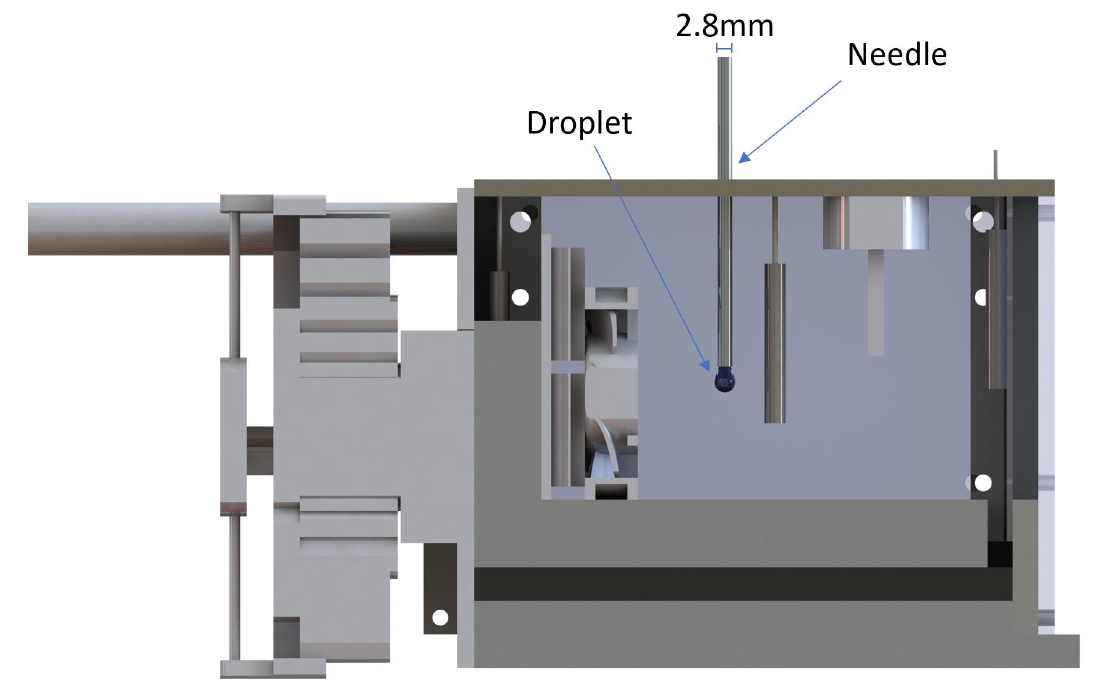
Shows the pendent droplet centered in the chamber for surface-tension testing, with the needle position and reported droplet volume of 39 µL.
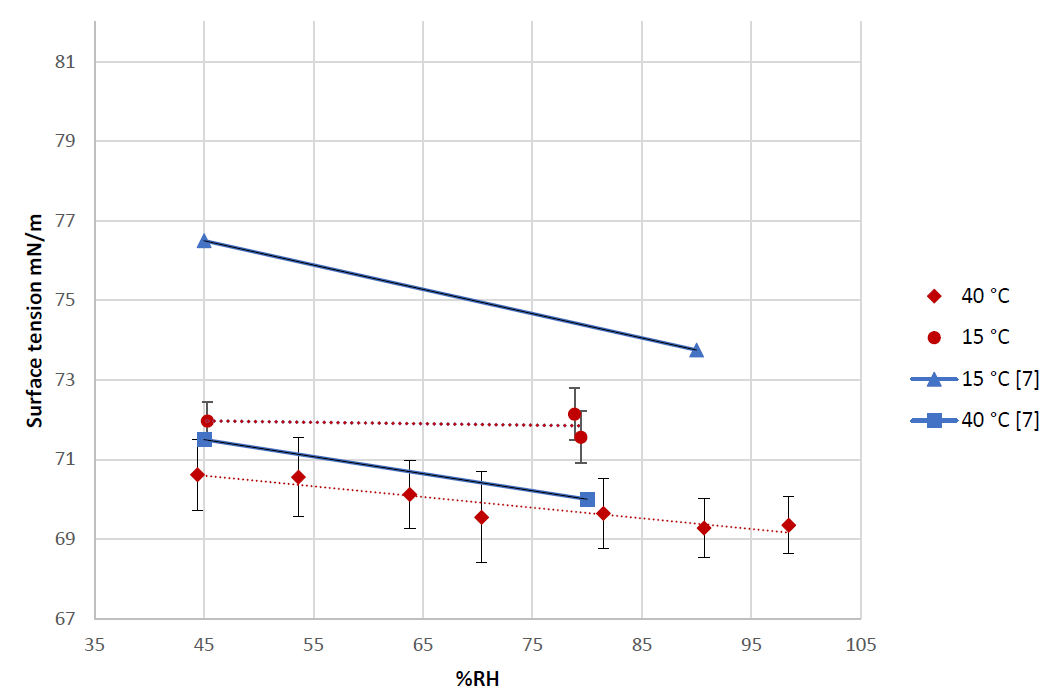
Surface tension of DI water at constant temperature and varied humidity; the thesis reports it falls as humidity rises.
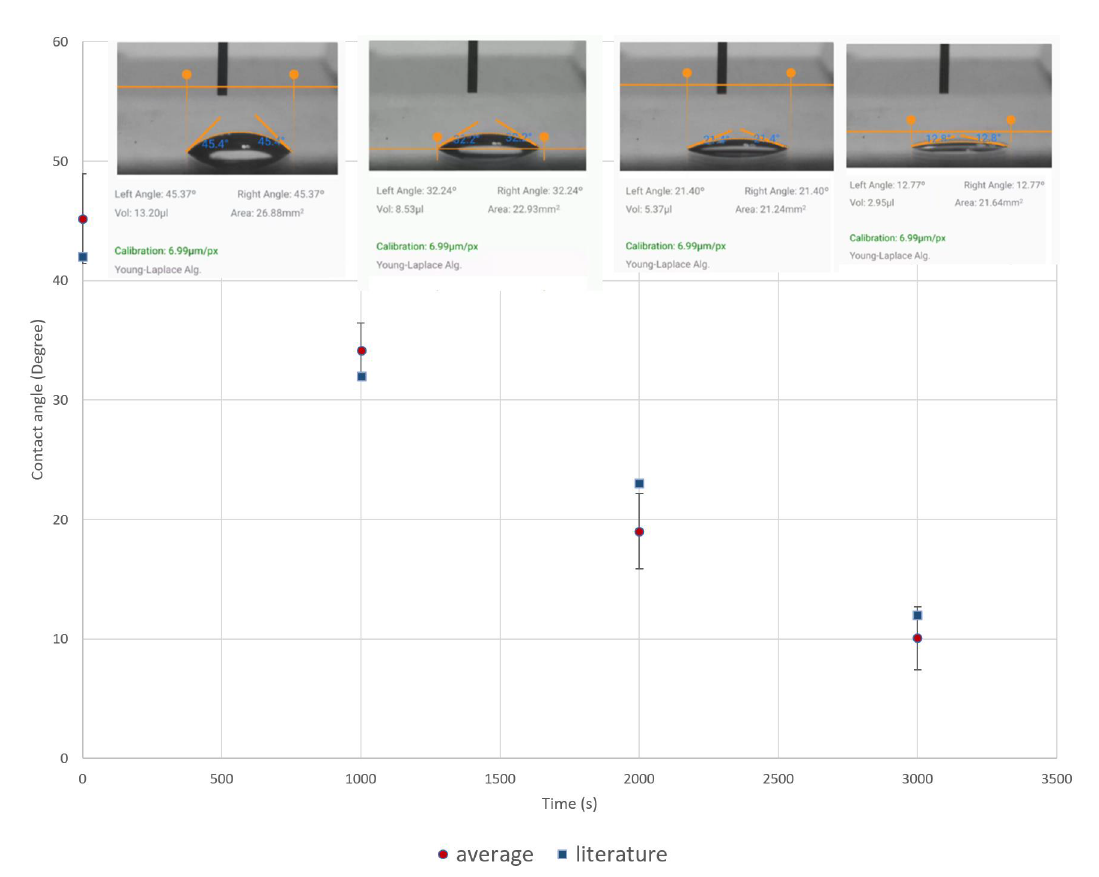
Shows time-resolved sessile-drop images and the drop-angle decline at 27.5°C and 61%RH alongside literature values.
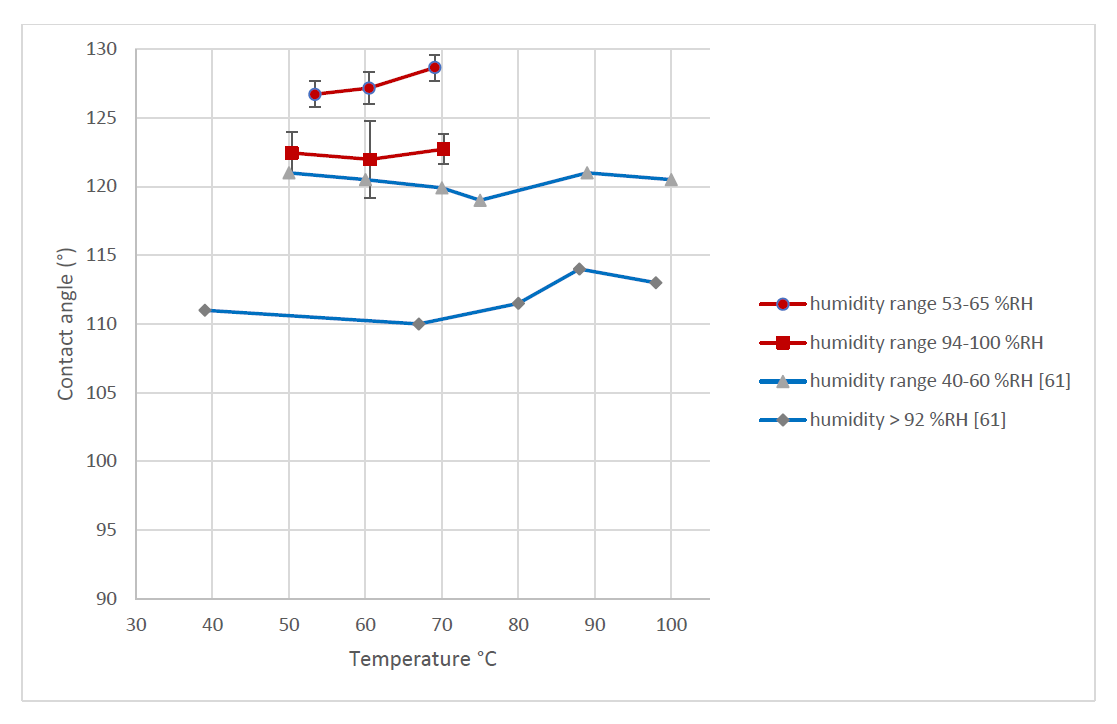
Plots advancing contact angle against temperature for two humidity bands, making the humidity-driven offset easy to see.
The thesis was motivated by interfacial phenomena involving temperature and humidity, and surface tension plus contact angle were the main measurements used to verify that the chamber could recreate literature-like droplet behavior under controlled conditions. In practice, those outputs connected the chamber design to actual droplet benchmarking on DI water.
Their value in the study was comparative: they showed agreement with literature for the glass and Teflon contact-angle benchmarks and for the 40°C surface-tension trend, while also exposing a lower-temperature surface-tension discrepancy that the author singled out for further investigation.
The thesis validated the chamber with pendent-drop surface tension and sessile-drop contact-angle measurements, so the performance check covered both liquid-air and liquid-solid behavior.
At 40°C, surface tension changed with relative humidity, and on flat Teflon the advancing angle shifted between mid-range and near-saturation humidity bands.
On glass, the receding-angle benchmark captured the nearly linear angle decline with constant contact radius used as the literature comparison.
The 15°C surface-tension benchmark is where the author flagged a discrepancy, making that region important for verification.
The author used the DropletLab© sessile and pendent apps with chamber-window imaging and LED backlighting for the surface-tension and contact-angle measurements reported here.
The thesis used a smartphone running the DropletLab sessile and pendent apps to image and analyze DI water drops inside the environment chamber. Surface tension was measured by the pendent drop method with ADSA-P, and advancing and receding contact angles were measured on sessile drops with ADSA-P and polynomial fitting. The thesis does not name the Dropometer; the phone, syringe and backlight fixtures were adapted from Droplet SmartTech designs.
At 40 °C, DI water surface tension decreased as relative humidity increased, matching the trend reported in the literature benchmark. At 15 °C that published trend was not reproduced: the largest values recorded were between 71 and 73 mN/m, and the author notes the accepted value at 15 °C is 73.5 ± 0.4 mN/m. The thesis concludes that the literature values should be investigated further to find the source of the discrepancy.
On glass at 27.5 °C and 61% RH, the contact angle of an evaporating drop fell almost linearly while the contact radius stayed constant, in line with the literature. On spin coated Teflon, the advancing angle was around 127° between 50 and 70 °C at 53 to 65% RH, and on average 5.1° lower at 94 to 100% RH, compared with about 9° in the literature study. The author links the offset to the high contact angle hysteresis of the prepared Teflon surface.
No. This is in-house work: the author, Gurdeep Saini, is part of the Droplet Lab team, the thesis acknowledges Droplet Lab co-founder Alidad Amirfazli for taking him as a student, and the imaging fixtures were adapted from Droplet SmartTech designs. The benchmarks were designed to test the chamber using DI water only, and the thesis leaves other liquids, such as 3D printing resins and multicomponent drops, to future work.