Primary surface measurement reported
Water contact angle (WCA) of the optimized film, evaluated at 0, 10, 20, and 30 seconds to observe wetting behavior over time.

Client Citation Analysis
Water contact angle (WCA) of the optimized film, evaluated at 0, 10, 20, and 30 seconds to observe wetting behavior over time.
The water contact angle was measured using a Dropometer (Droplet Lab, Markham, ON, Canada) with smartphone image capture and sessile drop software analysis.
The authors use WCA as a quantitative indicator of surface wetting (hydrophilicity/hydrophobicity) and interpret the time-dependent decrease in WCA as increased hydrophilicity of the optimized film.
Water contact angle (WCA) measured on the optimized soyhull lignocellulosic residue extract (SHE) film using a sessile water droplet, tracked at 0, 10, 20, and 30 seconds to evaluate changes in hydrophobicity over time.
The film formulation was optimized using tensile strength (TS), elongation at break (EB), and water vapor permeability (WVP), and the optimized film was characterized for additional properties including color, spectroscopic properties, hydration-related behavior (e.g., water absorption), and soil biodegradability.
The water contact angle was measured using a Dropometer (Droplet Lab, Markham, ON, Canada) with a 0.05 µL precision dropper. A sessile water droplet was placed on the film surface, imaged using a smartphone, and analyzed using sessile drop software to calculate the water contact angle; measurements were taken at 0, 10, 20, and 30 seconds to evaluate changes in hydrophobicity over time.
In the results, the authors use the WCA time series to characterize the optimized film’s wetting behavior and to interpret the surface as hydrophilic based on their stated 90° criterion.
The authors describe contact angle as a quantitative measurement of wetting and use it to assess surface hydrophilicity/hydrophobicity of the film.
A WCA below 90° is stated to indicate a hydrophilic surface, while a WCA above 90° indicates a hydrophobic surface.
The optimized SHE film’s WCA decreases from 76.9 ± 1.8° (0 s) to 58.3 ± 1.3° (10 s), 52.7 ± 1° (20 s), and 49.2 ± 1.3° (30 s) (Figure 3d).
The authors interpret the gradual decline in WCA over time as an increase in the film’s hydrophilicity, and they note that improving hydrophobicity would require further research (e.g., incorporating hydrophobic materials such as lignin and waxes).

Shows the optimized film’s water contact angle at 0, 10, 20, and 30 seconds, supporting the reported decrease in WCA over time.
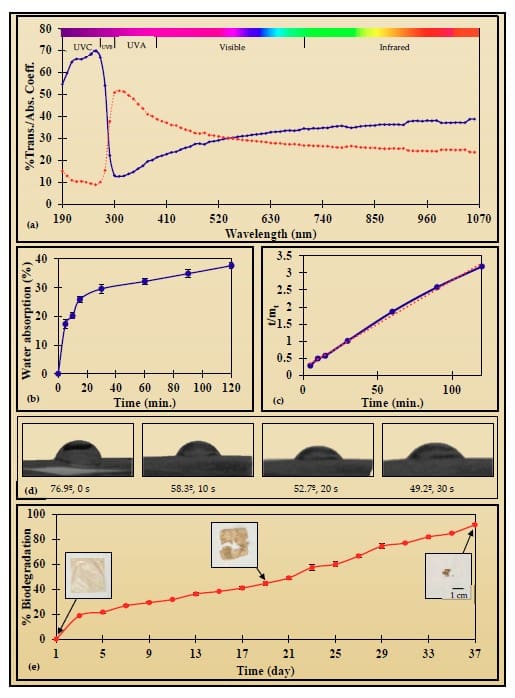
Presents multiple optimized-film characteristics in one place, with panel (d) providing the Dropometer-derived WCA time series alongside other film property plots.
In the authors’ film characterization workflow, water contact angle is used as a quantitative surface-wetting metric to describe hydrophilicity versus hydrophobicity. By measuring WCA at multiple short time intervals, the study reports how the optimized soyhull-derived film’s wettability changes over 30 seconds.
This time-dependent contact-angle result is part of the broader characterization supporting the authors’ development of biodegradable packaging films from soyhull lignocellulosic residue.
The study measures WCA at 0, 10, 20, and 30 seconds, enabling a time-resolved view of wetting behavior on the optimized film surface.
The authors interpret WCA values below 90° as hydrophilic and above 90° as hydrophobic.
WCA drops from 76.9° at 0 s to 49.2° at 30 s, and the authors interpret this as increased hydrophilicity over time.
The paper notes that incorporating hydrophobic materials such as lignin and waxes is a potential approach, while emphasizing that further research is needed.