Primary surface measurement reported
The contact angle of mixed liquor suspended solids (MLSS) was measured as part of the study’s MLSS surface-property characterization across operating phases.

Client Citation Analysis
The contact angle of mixed liquor suspended solids (MLSS) was measured as part of the study’s MLSS surface-property characterization across operating phases.
The Methods state that “contact angle of MLSS was measured by using Dropometer M-3 (Droplet Smart Tech Inc. Canada),” using pure water as a probe fluid for the contact angle measurement.
Contact angle values are reported by operating phase and discussed in the MLSS “surface properties and dewaterability” results, where the authors interpret changes in contact angle in terms of hydrophobicity trends across different OLR/HRT operating conditions.
The study reports MLSS contact angle measured using pure water as the probe fluid, with values summarized by operating phase.
In the same MLSS “surface properties and dewaterability” dataset, the authors report zeta potential, dewaterability (capillary suction time), soluble microbial products (SMP), and MLSS concentration by phase, alongside discussion of operating-condition effects.
The paper reports that the contact angle of MLSS was measured using Dropometer M-3 (Droplet Smart Tech Inc. Canada), with pure water used as the probe fluid for the contact angle measurement.
These contact angle values are used to compare MLSS surface-property behavior across the study’s three operating phases (defined by different OLR/HRT conditions) and are interpreted by the authors as hydrophobicity trends.
The reported MLSS contact angle is 64.3 ± 3.2° in Phase I (OLR 2.2 ± 0.16), 24.6 ± 3.04° in Phase II (OLR 3.9 ± 0.19), and 43.5 ± 5.8° in Phase III (OLR 1.5 ± 0.10), as listed in Table 2.
The authors state that the contact angle of the mixed liquors ranged between 24° and 64° and decreased as operating time increased.
In the MLSS surface-properties discussion, the authors describe a “hydrophobicity” recovery when OLR decreased to 1.5 ± 0.10 kg‑TSS/m³·d, corresponding to the Phase III contact angle value reported in Table 2.
The authors report that soluble microbial products (SMP) followed the same “hydrophobic trend,” with the highest SMP concentration observed at the lower OLR and vice versa.
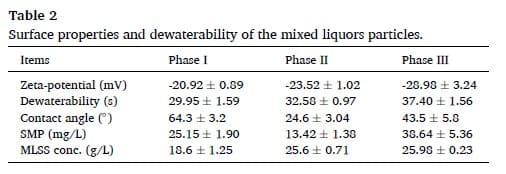
Summarizes zeta potential, dewaterability, contact angle, SMP, and MLSS concentration for Phases I–III.
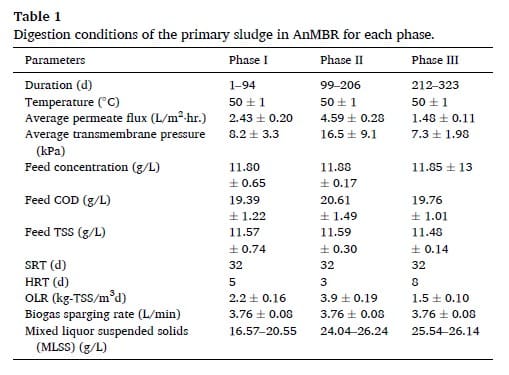
Lists the digestion conditions used to define Phases I–III (including HRT and OLR) that frame the contact-angle comparison
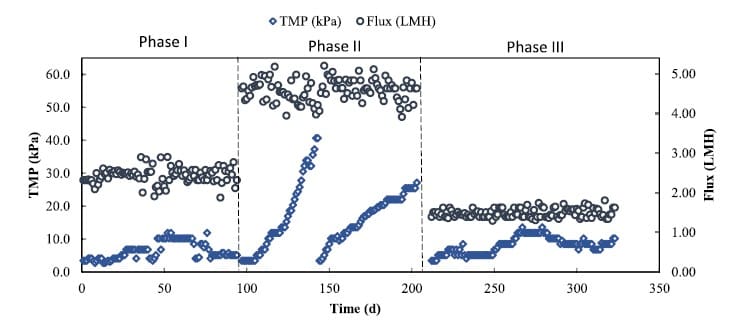
Shows membrane flux versus operating time with phase labels, providing the operating timeline context for the phase-based MLSS property reporting.
Within the study’s stated scope, MLSS properties are evaluated alongside membrane performance to understand how operating conditions (OLR/HRT) relate to sludge characteristics under thermophilic submerged anaerobic membrane bioreactor operation treating primary sludge from a pulp and paper mill.
The Dropometer-derived MLSS contact angle is one of the reported MLSS “surface properties,” and the authors use the phase-by-phase contact angle results to describe changes in hydrophobicity trends across operating conditions, discussing these trends in parallel with SMP behavior.
For MLSS wettability characterization in this study, contact angle is measured using Dropometer M-3 (Droplet Smart Tech Inc. Canada) with pure water as the probe fluid.
MLSS contact angle is presented by operating phase in Table 2, enabling direct comparison across the study’s three OLR/HRT conditions.
Across Phases I–III, the reported MLSS contact angle values shift from 64.3 ± 3.2° to 24.6 ± 3.04° to 43.5 ± 5.8°.
The authors discuss the contact-angle changes in terms of a hydrophobicity trend across operating phases and relate SMP behavior to the same trend.