Primary surface measurement reported
Surface tension of surfactant solutions and surfactant–polymer solutions, measured across CHEC concentrations of 1000–4000 ppm and surfactant concentrations of 0–500 ppm.

Client Citation Analysis
Primary surface measurement reported
Surface tension of surfactant solutions and surfactant–polymer solutions, measured across CHEC concentrations of 1000–4000 ppm and surfactant concentrations of 0–500 ppm.
Dropometer attribution in the paper
The paper attributes surface-tension measurements to a “pendant drop tensiometer” manufactured by Droplet Lab, Markham, ON, Canada, with droplet profiles fit to the Young–Laplace equation.
How the surface-tension / contact-angle data were used in the study
The surface-tension data were used to compare pure polymer, pure surfactant, and polymer–surfactant mixtures, to locate minima versus surfactant concentration, and to track how those minima shifted as polymer concentration increased. The paper also compares the surface-tension minima with maxima in consistency index to interpret coupled changes in surface activity and rheology.
Replication / reliability statement
Surface tension was measured twelve times for each fluid and averaged; for the 2000 ppm CHEC series, the paper reports small standard deviations across the surfactant concentration sweep.
Primary surface / interfacial measurement
Surface tension was measured for surfactant solutions and surfactant–polymer solutions at room temperature using the pendant droplet method. The study uses these measurements as its direct readout of surface activity across the CHEC/Stepwet composition sweep.
Supporting measurements
Steady rheological properties were measured and described with the power-law model through the consistency index K and the flow behavior index n. Electrical conductivity was also measured to compare ionic changes alongside rheology and surface activity.
Surface tension
pendant drop tensiometer manufactured by Droplet Lab, Markham, ON, Canada
Steady rheology
Fann 35A/SR-12 viscometer
Steady rheology
Haake Roto-visco RV 12 with MV I viscometer
Electrical conductivity
Thermo Orion 3 Star conductivity meter
Sample preparation
Gifford-Wood homogenizer
For surface-tension measurements, the paper describes a pendant drop tensiometer manufactured by Droplet Lab, Markham, ON, Canada. A pendant droplet was generated, imaged at high resolution using a smartphone camera, and analyzed in specialized software by fitting the droplet profile with the Young–Laplace equation to estimate surface tension.
These measurements were used to show how surface activity changed with surfactant concentration, how that response depended on CHEC concentration, and where the surface-tension curves aligned with maxima in consistency index.
If you need surface tension tracked across polymer and surfactant concentration sweeps, we can show you the same pendant drop workflow on your formulations.
CHEC alone changed surface tension very little
For polymer-only CHEC solutions, surface tension was almost independent of polymer concentration and only slightly less than that of water. In the same series, conductivity increased with polymer concentration.
Polymer–surfactant mixtures were markedly more surface active
The surface tension of polymer–surfactant mixtures was substantially lower than that of the surfactant solution without polymer. The paper states that, at the same surfactant concentration, this indicates polymer–surfactant complexes were more surface active than surfactant molecules.
Surface-tension minima shifted with polymer concentration
At a given polymer concentration, surface tension dropped and passed through a minimum at intermediate surfactant concentration, most clearly at 1000 and 2000 ppm CHEC; at 3000 and 4000 ppm, the paper reports that the minimum either shifted to high surfactant concentration or surface tension leveled off. The paper concludes that this minimum generally shifted to higher surfactant concentration as polymer concentration increased; for the 2000 ppm CHEC series, Table 3 shows a minimum mean surface tension of 27.058 mN/m at 250 ppm surfactant.
Surface and rheology extrema tracked together
The surface-tension plots were consistent with the rheological data in that the consistency index exhibited a maximum where surface tension was minimum. The consistency-index maximum shifted from 100–200 ppm surfactant at 1000 ppm CHEC to 400–500 ppm surfactant at 4000 ppm CHEC.
Higher polymer loading strengthened the mixture response
At any given surfactant concentration, increasing polymer concentration raised the consistency index and generally lowered the flow behavior index, making the mixtures more shear-thinning. In the same fixed-surfactant comparison, surface tension decreased substantially and conductivity increased with increasing polymer concentration.
Surface-tension measurements were repeatable
Surface tension was measured twelve times per fluid and averaged. For the 2000 ppm CHEC series, the paper reports small variability around the mean across the full surfactant concentration sweep, and Figure 11 shows correspondingly small error bars.
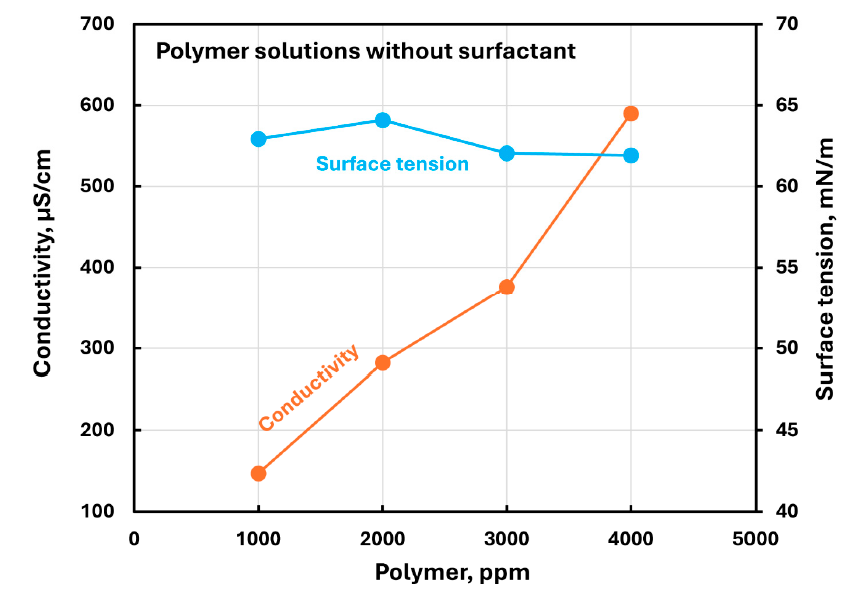
What it shows
Shows conductivity and surface tension for polymer-only CHEC solutions, establishing that surface tension changes little with polymer concentration before surfactant is added.
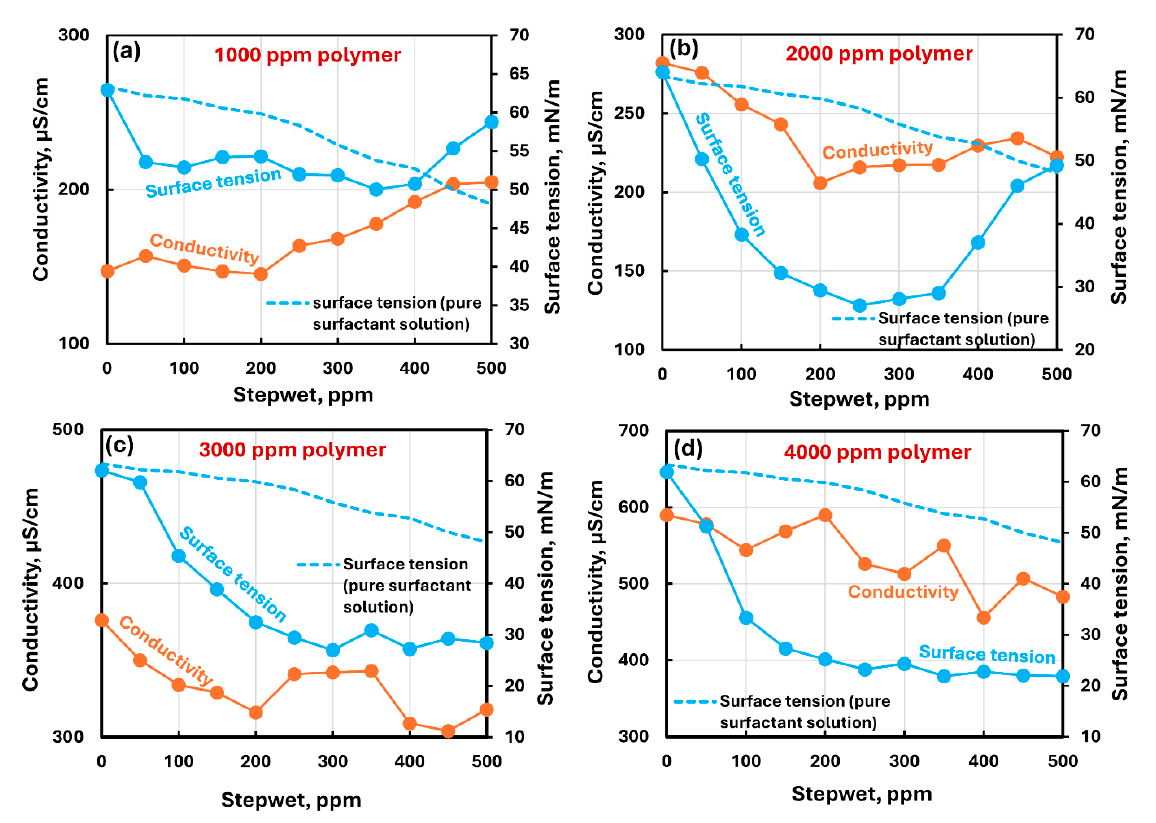
What it shows
Electrical conductivity and surface tension of polymer and surfactant mixtures at different CHEC polymer concentrations.
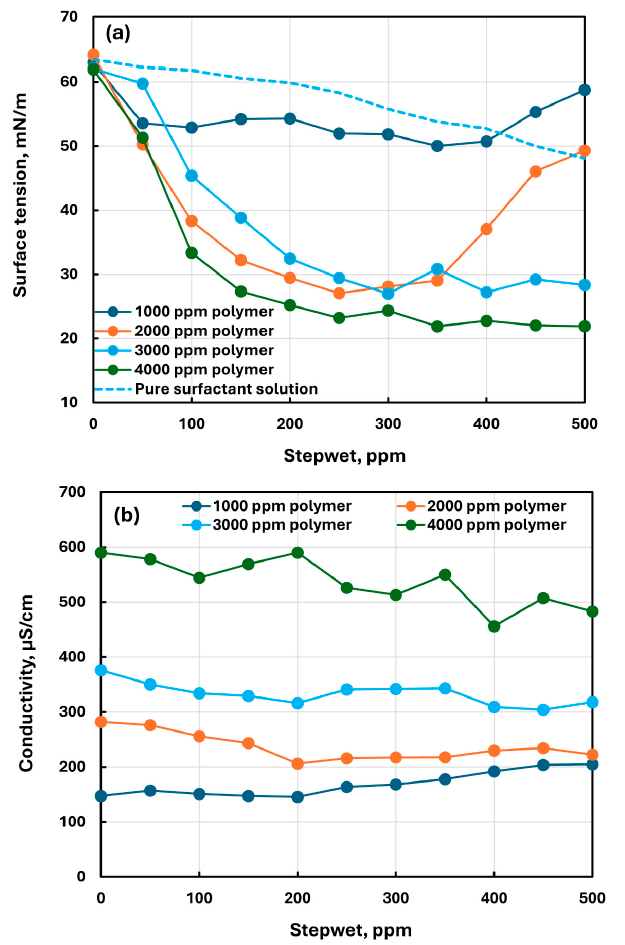
What it shows
Shows that, at a given surfactant concentration, surface tension decreases substantially as polymer concentration increases.
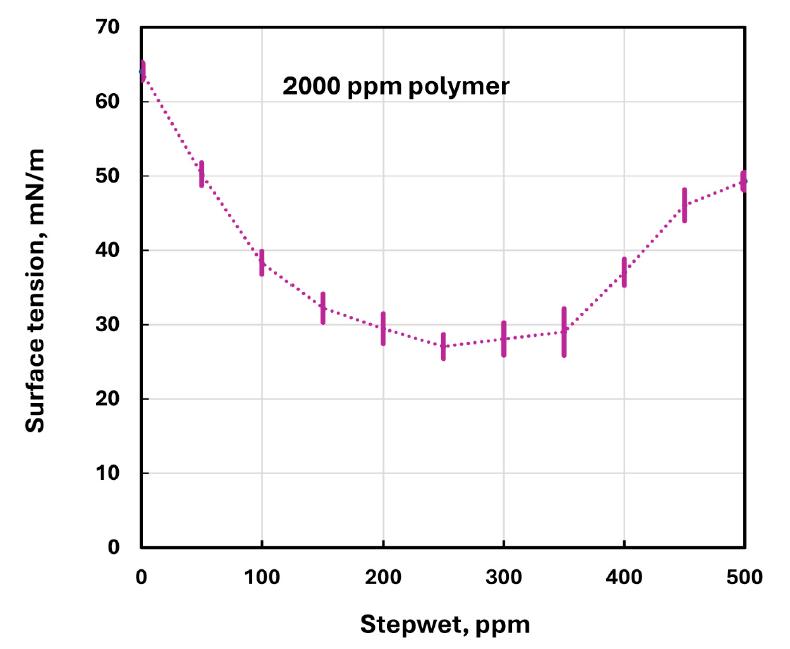
What it shows
Shows error bars on the 2000 ppm CHEC surface-tension data, matching the mean and standard deviation values reported in Table 3.
The paper frames polymer–surfactant interactions as important to applications such as enhanced oil recovery, hydraulic fracturing and drilling fluids, and formulated products. In that context, surface tension served as the study’s direct measure of surface activity alongside rheology and conductivity.
Here, the pendant-drop data showed how much the mixtures lowered surface tension, showed that the low-surface-tension response moved as CHEC concentration changed, and were reported by the authors as consistent with the rheological data, with surface-tension minima where the consistency index reached a maximum. The authors discuss charge neutralization and entanglement at lower surfactant addition, and recharging and disentanglement at higher surfactant addition, as a possible explanation for these coordinated trends.
Use surface tension to locate composition windows
In this study, surface-tension minima marked the same composition region where the consistency index reached a maximum.
Expect the surfactant window to move with polymer loading
As CHEC concentration increased from 1000 to 4000 ppm, the response shifted to higher sodium lauryl sulfate concentrations.
Keep polymer-only and surfactant-only baselines in view
The paper used both baselines to show that CHEC alone had little effect on surface tension, while polymer–surfactant mixtures were much more surface active.
Read surface tension together with rheology and conductivity
The authors used all three measurements to interpret how mixture behavior changed across composition.
Build repeat measurements into the workflow
Each fluid was measured twelve times for surface tension and averaged, and the 2000 ppm series showed small standard deviations across the sweep.
The authors measured the surface tension of cationic hydroxyethyl cellulose (CHEC) solutions, sodium lauryl sulfate (Stepwet) solutions and their mixtures at room temperature with a pendant drop tensiometer manufactured by Droplet Lab. Each drop was imaged with a smartphone camera and its profile fitted with the Young–Laplace equation, and every fluid was measured twelve times and averaged. CHEC concentration ranged from 1000 to 4000 ppm and surfactant concentration from 0 to 500 ppm.
At 2000 ppm CHEC, mean surface tension fell from 64.09 mN/m with no surfactant to a minimum of 27.058 mN/m at 250 ppm surfactant, then rose to 49.3 mN/m at 500 ppm, with standard deviations between 0.97 and 3.14 mN/m (Table 3). The authors report that the mixtures were much more surface active than surfactant solution alone at the same concentration. They also report that the surface tension minimum generally shifted to higher surfactant concentration as polymer concentration increased, matching where the consistency index peaked.
Surface tension was measured at room temperature only, and replicate statistics are tabulated for the 2000 ppm CHEC series, with the other polymer concentrations shown graphically. The authors state that the mechanisms behind the trends are not yet clear and suggest dynamic light scattering, dynamic rheology and intrinsic viscosity measurements for future work.