Primary surface measurement reported
Water contact angle of sessile Milli-Q water droplets on Shrilk film surfaces, including untreated chitosan and silk surfaces and wax-coated Shrilk.

Client Citation Analysis
Water contact angle of sessile Milli-Q water droplets on Shrilk film surfaces, including untreated chitosan and silk surfaces and wax-coated Shrilk.
The methods state that contact angle images were taken using the “Droplet Lab Tensiometer (Droplet Lab, Canada)” and analyzed in ImageJ with the DropSnake plugin.
The contact-angle data were used to compare hydrophobic coatings applied to Shrilk films, specifically Wax-It-All and Otter Wax, against untreated chitosan and silk surfaces. The authors then interpreted those wettability results alongside dry and wet tensile testing to assess whether coating improved water resistance.
Figure 4.3 reports mean values with error bars as ± standard deviations for n = 4–6 samples per group, with pairwise p-values calculated using two-tailed Student’s T-tests.
The thesis reports water contact angle measurements on film surfaces using sessile droplets of Milli-Q water. These measurements were used to compare untreated Shrilk surfaces with hydrophobic-coating treatments.
The contact-angle data were interpreted alongside dry and wet tensile strength, toughness, and elongation at break for untreated and wax-coated Shrilk films. Elsewhere in the thesis, SEM, FTIR, Raman spectroscopy, and compost burial testing were used to characterize laminate structure, chemistry, mechanics, and biodegradability.
Droplet Lab Tensiometer (Droplet Lab, Canada)
Tescan Vega GMU scanning electron microscope (Tescan, Czech Republic)
Nicolet iS50 FTIR Spectrometer on the mid-IR ATR setting (Thermo Fisher, USA)
XploRA Plus Raman Spectrometer (Horiba, Japan)
Instron 68TM-10 instrument (Instron, USA)
digital calipers
For contact angle measurement, the authors created a sessile droplet by dispensing 0.2 mL of Milli-Q water from a 1 mL syringe onto the film surface. Contact angle images were then taken using the Droplet Lab Tensiometer (Droplet Lab, Canada), loaded into ImageJ, and analyzed with the DropSnake plugin.
In the study workflow, these contact-angle comparisons were used to evaluate whether hydrophobic wax coatings changed Shrilk surface wetting before the same treatment groups were examined by wet tensile testing.
Applying Wax-It-All increased the contact angle of the Shrilk film by 35% relative to the untreated chitosan layer (p = 0.005) and 50% relative to the untreated silk layer (p = 0.001). Otter Wax increased contact angle by 21% relative to the untreated chitosan layer (p = 0.051) and 34% relative to the untreated silk layer (p = 0.014), and the reported mean contact angles for Wax-It-All- and Otter Wax-treated films were 81° and 73°, respectively.
Untreated Shrilk films lost more than a factor of 10 in tensile strength when wet (p < 0.001). Wax-It-All- and Otter Wax-treated films dropped by factors of 2.46 (p = 0.024) and 2.89 (p = 0.008), respectively.
Untreated films showed no significant change in toughness when wet (p = 0.324), whereas treated films more than doubled in toughness when wet, with statistical significance reported for Otter Wax (p = 0.013). All three groups experienced a 4–6x increase in elongation at break when wet, with p = 0.008 for untreated Shrilk, p = 0.046 for Wax-It-All, and p = 0.040 for Otter Wax.
In the discussion, the authors note that both Wax-It-All- and Otter Wax-treated films remained under 90° contact angle and therefore were still technically hydrophilic surfaces. The contact-angle results were presented as proof-of-concept evidence that surface treatment could improve water resistance.
Earlier in the thesis, dry Shrilk films reached a mean tensile strength of 76.7 MPa, compared with 44.3 MPa for chitosan controls, 11.6 MPa for silk fibroin controls, and 18.0 MPa for chitosan-silk fibroin blends. The contact-angle work in Chapter 4 was used to test whether that laminate performance could be better maintained after water exposure.
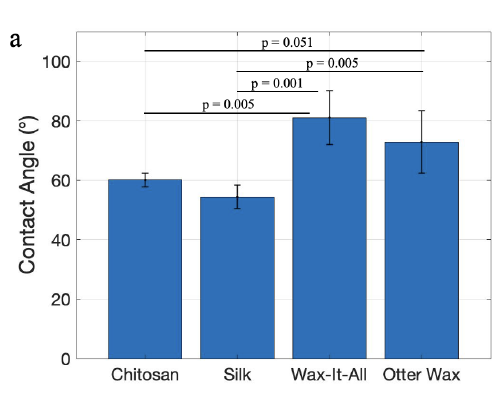
This panel compares contact angle across untreated chitosan, untreated silk, Wax-It-All-treated, and Otter Wax-treated surfaces.
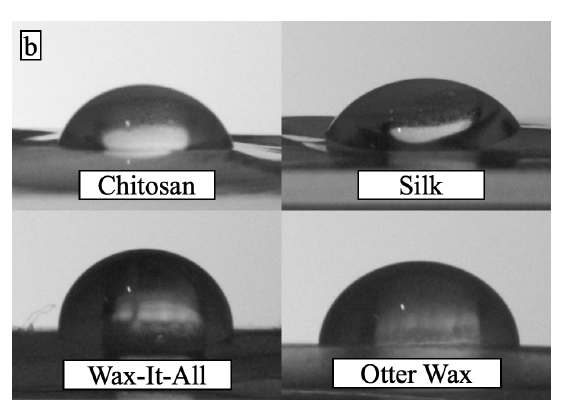
Representative droplet images on chitosan, silk, Wax-It-All, and Otter Wax surfaces provide a visual comparison of how coating changed wetting behavior.
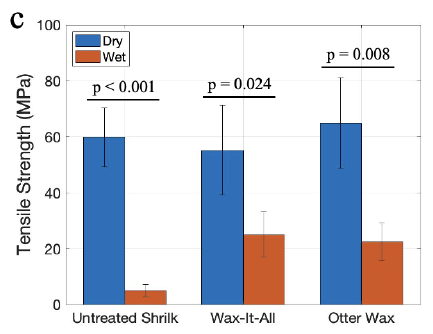
This panel shows that the coating groups associated with higher contact angles retained more dry tensile strength after wetting than untreated Shrilk.
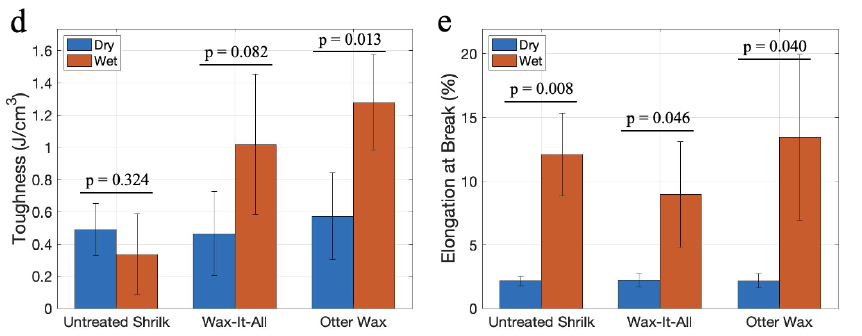
These panels show higher wet-state toughness and elongation at break, especially for coated films, which the authors discuss in terms of moderate water plasticization.
Within this thesis, contact angle served as a direct surface-level readout for whether wax treatments changed how water interacted with Shrilk. That mattered because the broader packaging goal was not only to make a strong laminate, but to improve its behavior after exposure to water.
The authors used contact angle together with wet tensile testing, not as a standalone endpoint. In that combined workflow, the treatments that increased contact angle also reduced the loss of wet tensile strength, while coated wet films showed higher toughness and elongation at break, supporting the paper’s interpretation that hydrophobic surface treatment can reduce Shrilk’s water vulnerability and that moderate water uptake may plasticize the film.
In this study, the Droplet Lab Tensiometer was used to separate untreated Shrilk surfaces from wax-coated Shrilk before wet mechanical testing.
The authors used contact angle alongside one-minute water immersion and tensile testing to judge whether a coating changed packaging-relevant performance.
Both coated films remained under 90°, yet they still retained more tensile strength when wet than untreated Shrilk.
Wax-It-All reached 81°, compared with 73° for Otter Wax, although the difference between the two coated groups was not statistically significant.
The coated films became tougher and more extensible when wet, which the authors interpreted as evidence that water could act as a plasticizer at intermediate hydration levels.