Primary surface measurement reported
The paper reports water contact angle on the optimized alfalfa lignocellulosic extract film as part of its hydration-property characterization.

Client Citation Analysis
The paper reports water contact angle on the optimized alfalfa lignocellulosic extract film as part of its hydration-property characterization.
The authors state that water contact angle was determined using “a Dropometer (Droplet Lab, Markham, ON, Canada)” by placing a water droplet on the film surface and recording the angle immediately.
The contact-angle data were used to describe the film’s hydrophobicity and time-dependent wetting behavior within the hydration-properties section. The authors interpreted these results together with moisture content, water solubility, and water absorption to discuss packaging suitability for moisture-insensitive foods such as fresh fruits and vegetables.
The primary surface measurement reported with the Dropometer is water contact angle on the optimized ALE film. The paper reports 78.9 ± 2.3° at 0 s, decreasing to 69.9 ± 0.5° at 10 s, 60.9 ± 1.5° at 20 s, and 54.5 ± 0.4° at 30 s.
The study also reports tensile strength, elongation at break, water vapor permeability, color, transparency, UV–Vis–IR transmittance, absorbance coefficient, FTIR spectra, antioxidant activity, moisture content, water solubility, water absorption with kinetic-model fitting, and soil biodegradation. These measurements were used to build the overall packaging-performance profile of the optimized film.
Dropometer (Droplet Lab, Markham, ON, Canada)
Texture Analyzer (Stable Micro Systems, TA-HD Plus, Serial No. 5529, Surrey, UK)
Nix Pro 2 color sensor (Model no: NIXPRO002, Nix Sensor Ltd., Hamilton, ON, Canada)
UV–Visible spectrophotometer (Model UV-1600PC, 10037-436, VWR International, Radnor, PA, USA)
Fourier-transform infrared spectroscopy (FTIR)
The Dropometer was used for sessile-drop water contact angle measurement on the optimized alfalfa lignocellulosic extract film. In the methods section, the authors describe placing a water droplet on the film surface and recording the angle immediately; in the hydration-results section, the resulting contact-angle profile is presented at 0, 10, 20, and 30 s.
In this study, the Dropometer output was part of the hydration-property package the authors used to interpret how the optimized film wets over time and how that surface behavior aligns with packaging use for moisture-insensitive foods.
If you need water contact angle tracked over time on biopolymer packaging films, we can show you the same drop measurement workflow on your samples.
The study optimized the film formulation at 0.5 g ALE, 453.8 mM CaCl2, and 1.5% sorbitol. That optimized film delivered 11.2 ± 0.7 MPa tensile strength, 5.8 ± 0.9% elongation at break, and 1.2 ± 0.2 × 10⁻¹⁰ g m−1 s−1 Pa−1 water vapor permeability.
The optimized ALE film showed a water contact angle of 78.9 ± 2.3° at 0 s. The authors discuss this as part of the film’s hydrophobicity profile within the hydration-properties section.
The contact angle declined steadily over 30 s, from 78.9° to 54.5°. The authors attribute this decrease to the inherent absorption, spreading, and swelling behavior of biopolymers.
The paper links the film’s hydration behavior to the retained lignin fraction, stating that lignin hinders water penetration and increases hydrophobicity. In the same hydration section, water absorption rose from 45.3 ± 1.5% at 5 min to 69.3 ± 1.0% at 120 min, with the Peleg model giving the best kinetic fit (R² = 0.9990; RMSE = 0.0179).
The optimized film combined hydration behavior with UV–Vis–IR light blocking, antioxidant activity, and rapid soil biodegradation, reaching over 90% biodegradation within 29 days at 24% soil moisture. The authors position this overall profile for sustainable packaging applications.
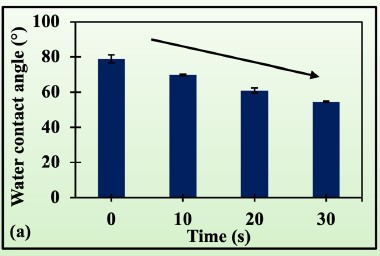
This panel shows the optimized ALE film’s water contact angle decreasing from 78.9 ± 2.3° at 0 s to 54.5 ± 0.4° at 30 s.
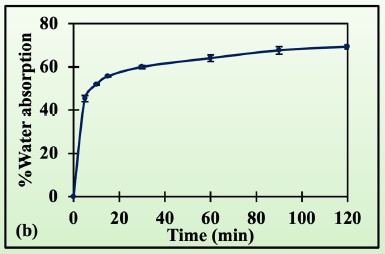
This panel shows water absorption increasing over time to 69.3 ± 1.0% at 120 min, providing hydration context alongside the Dropometer-derived wetting data.
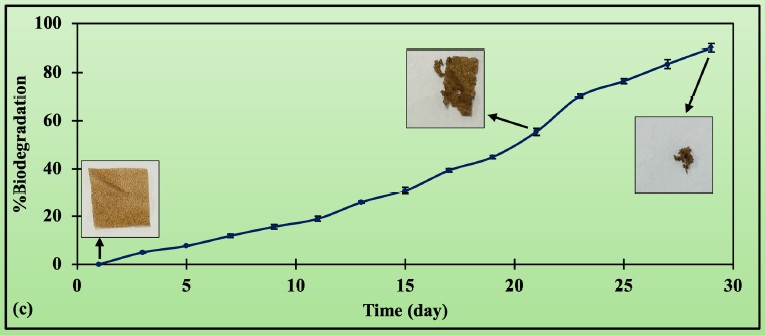
This panel shows soil biodegradation progressing beyond 90% by day 29.
In this paper, the Dropometer data give a direct readout of how the optimized alfalfa film surface interacts with water over time. That matters because the study frames hydration behavior as part of packaging suitability, and the contact-angle results sit alongside moisture content, water solubility, and water absorption in the authors’ interpretation of film performance.
The broader value in the paper is application fit: the authors combine the contact-angle profile with barrier, optical, antioxidant, and biodegradation data to support alfalfa-derived lignocellulosic films as a sustainable packaging material, particularly for moisture-insensitive products and for foods that benefit from light protection.
The optimized ALE film begins with a water contact angle of 78.9 ± 2.3°, giving a clear baseline for how the surface initially presents to water.
The measured decline to 54.5 ± 0.4° by 30 s shows that this is a dynamic wetting system rather than a static single-point surface result.
The contact-angle output was most informative in combination with moisture content, solubility, and water-absorption behavior, rather than as a stand-alone number.
The reported Dropometer values belong to the optimized film made with 0.5 g ALE, 453.8 mM CaCl2, and 1.5% sorbitol, which is the formulation the paper carries forward into detailed characterization.
The authors use the surface and hydration results to support packaging for moisture-insensitive foods, while the film’s light-blocking and antioxidant properties broaden its relevance to light-sensitive and oxidation-sensitive products.
The authors used a Dropometer (Droplet Lab, Markham, ON, Canada) to measure the water contact angle on the optimized alfalfa lignocellulosic extract (ALE) film. A water droplet was placed on the film surface and the angle was recorded immediately, with readings reported at 0, 10, 20 and 30 s. These results sit in the paper's hydration properties section alongside moisture content, water solubility and water absorption.
The film showed 78.9 ± 2.3° at 0 s, decreasing to 69.9 ± 0.5° at 10 s, 60.9 ± 1.5° at 20 s and 54.5 ± 0.4° at 30 s (Figure 3a). The authors attribute the gradual decrease to the absorption, spreading and swelling behavior of biopolymers, and link the retained lignin to reduced water penetration. They describe the film as moderately hydrophilic and suggest it suits packaging for moisture-insensitive products such as fresh fruits and vegetables.
Contact angle was reported for the optimized film only, not for each of the fifteen formulations screened during optimization. Water was the only test liquid reported, so surface free energy and advancing or receding angles were outside the scope of this paper.