Primary surface measurement reported
Water contact angle on the outer and inner layers of disposable facemasks and the N95 respirator, measured by sessile drop using deionized water.

Client Citation Analysis
Water contact angle on the outer and inner layers of disposable facemasks and the N95 respirator, measured by sessile drop using deionized water.
The paper states that water contact angle measurements were performed using a “Droplet Lab Dropometer” to determine the wettability of the outer and inner layer of the disposable facemasks and respirators, using 10 µL deionized-water droplets by the sessile drop method.
The contact-angle results were used to compare hydrophobic and hydrophilic behavior across mask layers and mask types. In the discussion, the authors connect hydrophobic outer layers with resistance to macroscopic fluid droplet penetration and the hydrophilic Level 3 inner layer with ready absorption and limiting the spread of liquid droplets from the user.
Water contact angle (WCA) measurements were conducted on the outer and inner layers of disposable masks and the N95 respirator. The reported WCA values span from 78 ± 13° for the Level 3 inner layer to 120 ± 5° for the N95 inner layer.
The chapter also reports optical microscopy and low-vacuum SEM for mask-layer morphology, including fiber diameter and pore size; FTIR for polymer identification and moisture-retention analysis; and EDS mapping for copper in the reusable antimicrobial mask. These measurements were used together to interpret differences among commercially available mask designs.
Leica EZ4D stereoscope
environmental field-emission Hitachi SU5000 SEM equipped with a Bruker X-Flash 6160 energy dispersive X-ray spectrometer
Droplet Lab Dropometer
Bruker ALPHA system
Bruker X-Flash 6160 energy dispersive X-ray spectrometer
The Dropometer was used to measure water contact angle on the outer and inner layers of disposable facemasks and respirators. The chapter specifies a sessile-drop workflow using deionized water with a droplet size of 10 µL, and the output reported is WCA in degrees for each mask layer pair.
Within the study, these wettability values serve as a direct comparison tool across mask constructions and support interpretation of how different layer materials and surfaces relate to fluid handling behavior.
If you compare water contact angle on mask layers or other nonwoven fabrics, we can show you the same sessile drop workflow on your samples.
The chapter reports that mask and respirator layers made of polypropylene showed hydrophobic behavior, with WCA values between 107° and 120°. This includes the outer and inner layers of the non-medical 3-ply mask, Level 1 mask, and N95 respirator, as well as the outer layer of the Level 3 mask.
The Level 3 medical mask paired a hydrophobic outer layer at 114 ± 6° with a hydrophilic inner layer at 78 ± 13°. The authors relate the hydrophilic inner layer to readily absorbing and limiting the spread of liquid droplets from the mask user.
The authors state that the measured WCAs on mask layers were higher than a flat polypropylene surface value of 96°. They interpret this through surface topography and roughness, citing Wenzel in the discussion of enhanced hydrophobicity on rough hydrophobic surfaces.
In the chapter summary, wettability is presented alongside morphology, chemistry, and moisture-retention measurements as part of a characterization protocol for explaining key mask properties. The authors explicitly connect this combined dataset to interpretation of particulate filtration efficiency, resistance to fluid penetration, and differential pressure.
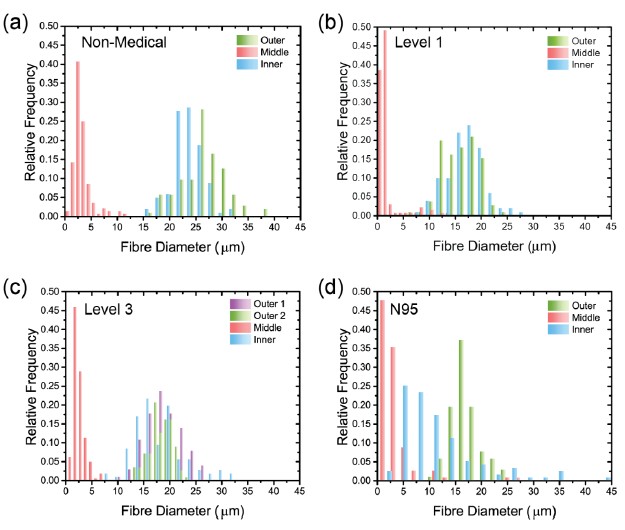
This figure shows the fiber-diameter distributions used to compare structural differences among non-medical, Level 1, Level 3, and N95 layers, providing context for the wettability results.
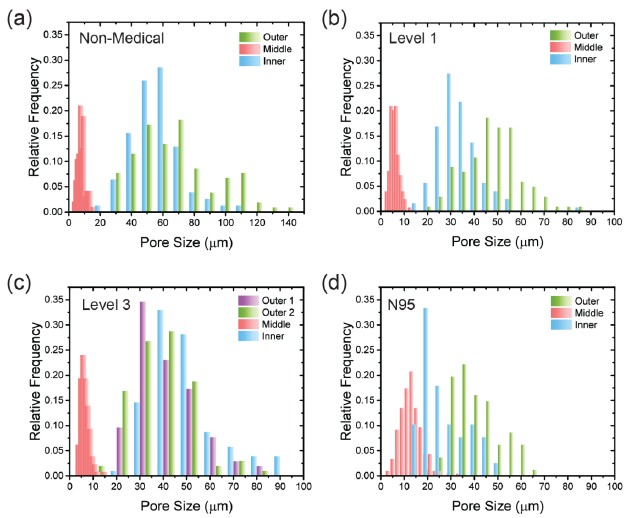
This figure shows pore-size distributions across the same mask families, supporting the chapter’s broader interpretation of surface and filtration behavior.
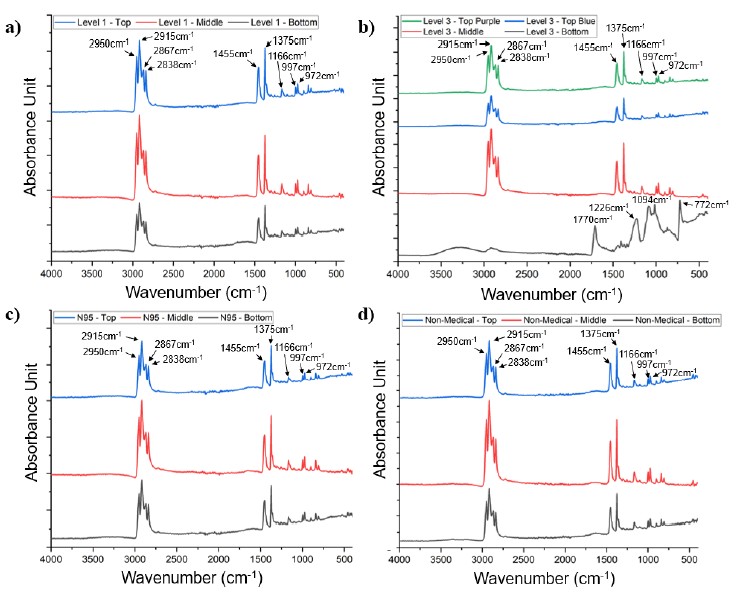
This figure presents FTIR spectra identifying polypropylene across most layers and PETE in the Level 3 inner layer, directly supporting interpretation of the contact-angle contrast.
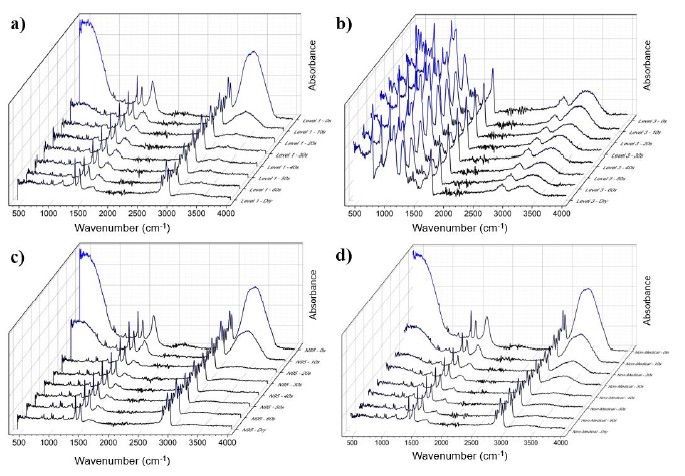
Time lapse FTIR spectra of moist mask samples over 60 s at 10 s intervals, showing drying under ambient conditions for Level 1, Level 3, N95 and non medical masks.
For this PPE-focused study, the Dropometer data provide a direct readout of whether commercial mask layers behave as water-repellent or water-accepting surfaces. That layer-by-layer comparison helps separate designs that keep both sides hydrophobic from the Level 3 configuration, where the wearer-facing inner layer is associated with hydrophilic behavior.
Because the chapter combines Dropometer wettability data with SEM structure, FTIR chemistry, and moisture-retention measurements, the contact-angle results become part of a broader explanation of how mask construction relates to performance-relevant properties identified by the authors, including resistance to fluid penetration and particulate filtration behavior.
The study uses one consistent sessile-drop protocol across mask types, making the Dropometer outputs useful for direct comparison of outer and inner layer behavior.
The clearest wettability contrast in the dataset is the Level 3 mask, where the PETE inner layer reports 78 ± 13° while the outer layer reports 114 ± 6°.
The chapter explicitly notes that mask-layer WCAs exceed the flat polypropylene reference, linking apparent hydrophobicity to surface topography and roughness.
In this work, contact-angle data are most informative when interpreted together with SEM-derived morphology, FTIR-based polymer identification, and moisture-retention behavior.
It measured water contact angle on the outer and inner layers of four disposable products: a non-medical 3-ply mask, Level 1 and Level 3 medical masks, and an N95 respirator. The chapter used a Droplet Lab Dropometer with the sessile drop method and 10 μL deionized water drops, with results in Table 3-2. The reusable cotton and antimicrobial masks examined elsewhere in the chapter were not part of the contact angle set.
Polypropylene layers measured between 107° and 120°, from 107 ± 7° on the non-medical mask outer layer to 120 ± 5° on the N95 inner layer. The Level 3 mask was the exception, with a 114 ± 6° outer layer and a 78 ± 13° inner layer, which the chapter identifies as PETE.
The chapter reports that the polypropylene layers read higher than flat polypropylene (96°) and attributes this to surface topography, citing Wenzel. It describes a hydrophobic outer layer as desirable to keep fluid droplets from penetrating the mask, and the hydrophilic Level 3 inner layer as desirable to absorb droplets from the wearer and limit their spread.