Primary surface measurement reported
The paper measured contact angle of mixed liquor suspended solids (MLSS) and membranes, using pure water as the probe fluid under different solids retention time conditions.

Client Citation Analysis
The paper measured contact angle of mixed liquor suspended solids (MLSS) and membranes, using pure water as the probe fluid under different solids retention time conditions.
The authors state that “The contact angle of MLSS and membranes was measured by Dropometer M-3 (Droplet Smart Tech Inc. Canada).”
The contact-angle data were used alongside zeta potential, dewaterability, particle-size distribution, membrane resistance and permeability, SEM-EDX, FTIR, and XPS to interpret how sludge surface properties shifted with solids retention time and how those changes related to membrane fouling behavior.
15.1
1.383
1.697
8.2
8.1
The paper measured contact angle of MLSS and membranes. Reported phase-wise contact-angle values are given for MLSS, with ranges of 49.3–62.4° at 32 d SRT, 28.2–42.3° at 45 d SRT, and 19.1–26.7° at 55 d SRT.
The contact-angle results were interpreted with zeta potential, dewaterability, particle size distributions of reactor mixed liquor and loose gel layer, soluble microbial products, and membrane resistance and permeability. Broader fouling characterization also included SEM-EDX, FTIR, and XPS analyses of virgin and used PVDF membranes.
The Dropometer was used to measure the contact angle of MLSS and membranes during thermophilic submerged AnMBR treatment of pulp-and-paper primary sludge. Pure water was used as the probe fluid, about 3 μL of water was dispensed with a micropipette onto the specimen surface, and an average contact angle value was calculated for each tested specimen.
In the study workflow, the contact-angle data served as a comparative surface-property readout that the authors used together with zeta potential, dewaterability, solids concentration, particle-size distribution, and residual fouling characterization to interpret SRT-dependent changes in membrane fouling behavior.
The MLSS contact-angle range decreased from 49.3–62.4° at 32 d SRT to 28.2–42.3° at 45 d and 19.1–26.7° at 55 d. The authors interpreted sludge at higher SRT as less hydrophobic than sludge at lower SRT.
MLSS concentration increased across the SRT phases from 16.55–23.02 g/L to 26.36–28.96 g/L. The paper identifies MLSS concentration as the predominant factor affecting membrane performance, with higher solids levels accompanying higher hydraulic resistance and more foulant deposition.
Resistance analysis showed gel-layer resistance accounted for about 98.6–98.8% of total resistance during primary-sludge treatment. The authors therefore identified loose gel-layer formation as the predominant membrane-fouling mechanism in this operating window.
The paper reports that most MLSS and loose-gel-layer particles were larger than membrane pores, while smaller particles showed the greater tendency to deposit on the membrane surface. This supported the broader fouling interpretation used alongside the surface-property data.
EDX, FTIR, and XPS all indicated that used membranes still carried foulant signatures after cleaning. The authors linked these residuals to both organic and inorganic materials and to increased solids accumulation at longer SRT.
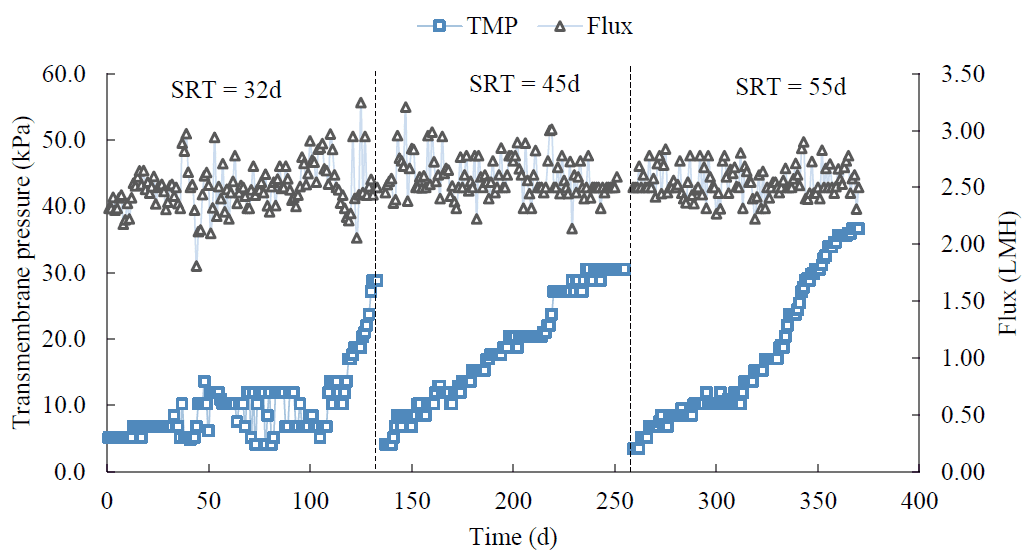
This figure shows permeate flux and transmembrane pressure over time across the 32, 45, and 55 d SRT phases.
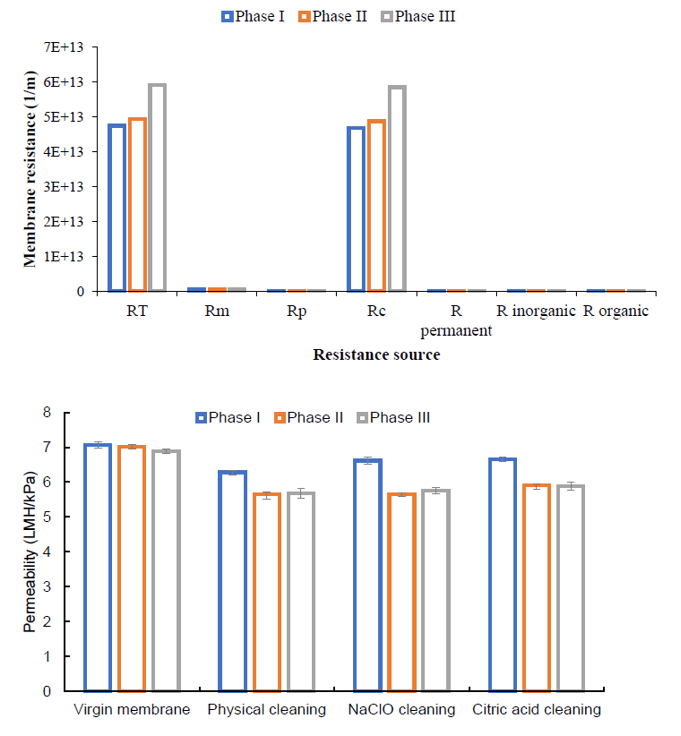
This figure breaks membrane resistance into components and shows the dominance of gel-layer resistance during treatment.
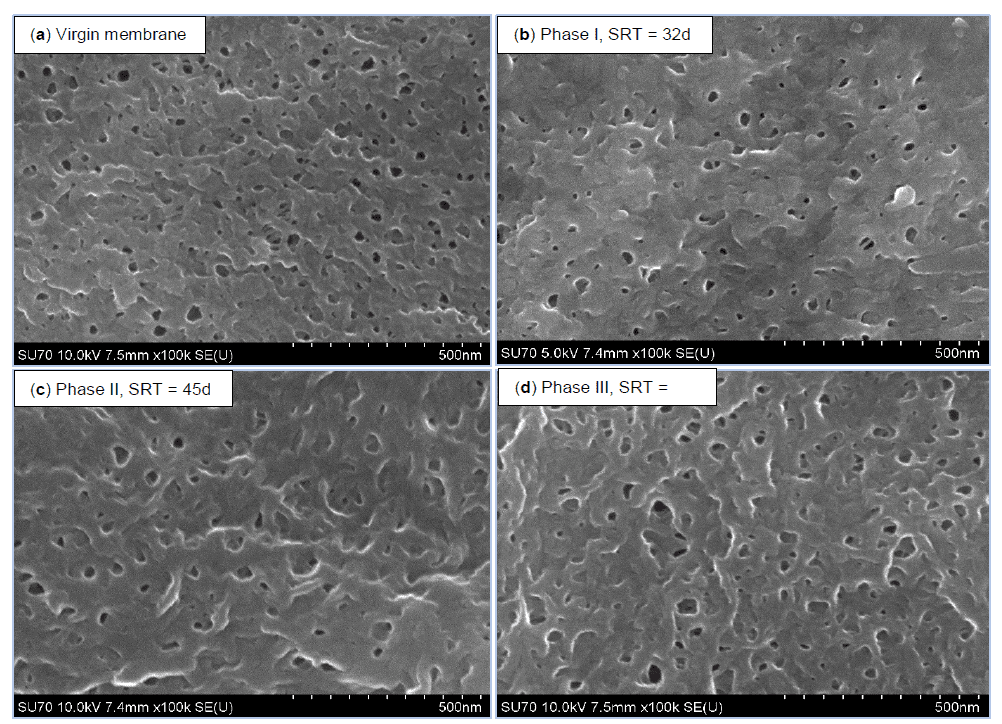
SEM images compare virgin and used PVDF membranes after operation at the three tested solids retention times.
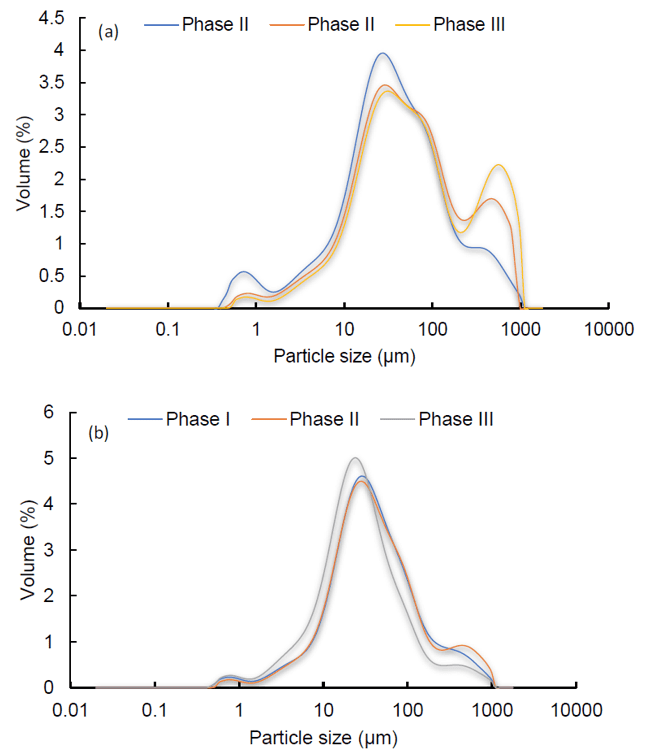
This figure shows the particle-size distributions of reactor mixed liquor and membrane loose gel layer used to interpret fouling behavior alongside the contact-angle data.
This paper sits in a membrane-performance context where stable sludge treatment and stable methane-generating operation depend on how solids behave at the membrane surface. In that workflow, the Dropometer-derived contact-angle measurements gave the authors a direct way to compare surface-property changes in the mixed liquor as SRT increased.
By combining contact angle with zeta potential, dewaterability, particle-size distributions, and post-run foulant characterization, the study used surface-property data as part of a broader fouling diagnosis rather than as a standalone metric. That made the contact-angle results practically useful for understanding why longer SRT operation coincided with higher MLSS concentration, stronger fouling signatures, and gel-layer-dominated resistance.
The authors used Dropometer contact-angle measurements to compare how MLSS surface behavior changed across 32, 45, and 55 d SRT operation, giving a direct surface-property readout within the fouling study.
In this paper, contact angle was interpreted together with zeta potential, dewaterability, PSD, SMP, and membrane-resistance data, which is how the authors turned a wetting measurement into a fouling interpretation.
Lower contact-angle ranges at longer SRT coincided with higher MLSS concentrations and more severe fouling indicators, making the Dropometer data useful for phase-to-phase comparison rather than a single-point measurement.
The Dropometer results supported the paper’s broader conclusion that gel-layer formation, rather than pore blocking, was the dominant fouling pathway under the tested conditions.