Primary surface measurement reported
The study reports water contact angle measurements on resin disk specimens and contact angle measurements of uncured UV resin-based coating droplets to evaluate hydrophilicity/wettability.

Client Citation Analysis
The study reports water contact angle measurements on resin disk specimens and contact angle measurements of uncured UV resin-based coating droplets to evaluate hydrophilicity/wettability.
Contact angles were measured using the contact angle measurement apparatus (Dropometer, Droplet Lab, Markham, ON, Canada), and uncured droplet contact angles were obtained using the Droplet Lab’s Sessile software (version 1.0.5.1) via the Young–Laplace equation.
Water contact angle results are used for wettability assessment across the Commercial Control, Experimental Control, and UV resin-coated groups with different DMADDM concentrations (Figure 2). Contact angle results for uncured UV resin-based samples are used to compare the hydrophilicity of uncured coating droplets across the experimental UV resin groups (Figure 3).
A total of 15 measurements were taken for the water contact angle assay, and uncured UV resin-based coating contact angles were analyzed with n = 15.
5.4
2.8
3.0
Contact angle (degrees) was measured to assess hydrophilicity: (1) water contact angle on resin disk specimens and (2) contact angle of uncured UV resin-based coating droplets applied onto a TEMPSMART resin disk surface.
The study also reports surface roughness (Ra) of specimens, SEM evaluation of resin-based coating thickness, and multiple biofilm/cell-based assays (e.g., CFU, metabolic activity via MTT, lactic acid production, live/dead staining, and SEM visualization of biofilms).
The Dropometer is used as a contact angle measurement apparatus to quantify surface hydrophilicity via sessile-drop testing in air. Water contact angle measurements were made by applying 5 µL deionized (DI) water droplets onto resin disks and evaluating the contact angle during a 10 s timeframe (15 measurements). For uncured UV resin-based coatings, a standard 3 µL droplet of each experimental UV resin group was applied onto the surface of the TEMPSMART resin disk and imaged after 10 s; contact angle values were obtained using Droplet Lab’s Sessile software (version 1.0.5.1) via the Young–Laplace equation.
In the study, the contact angle outputs are used to compare wettability/hydrophilicity between control and DMADDM-modified coating groups (cured disks) and to compare wetting behavior across uncured UV resin formulations.
For wettability assessment (Figure 2; mean ± sd; n = 15), Commercial Control (70.5 ± 4.6°), Experimental Control (70 ± 6.8°), and UV+ 2.5% DMADDM (69.1 ± 7.6°) showed no significant differences among these three groups (p > 0.01). UV+ 5% DMADDM (54.7 ± 5.9°), UV+ 7.5% DMADDM (51.7 ± 7.6°), and UV+ 10% DMADDM (50.7 ± 8°) showed no significant differences among these three groups (p > 0.01), and there was a significant difference between the lower-concentration set and the higher-concentration set (p < 0.01).
In Figure 3 (mean ± sd; n = 15), the uncured UV resin-based samples had contact angles of 26.84 ± 3.8° (Experimental Control), 26.48 ± 1.9° (UV+ 2.5% DMADDM), 26.70 ± 2.1° (UV+ 5% DMADDM), 27.95 ± 2.1° (UV+ 7.5% DMADDM), and 27.84 ± 1.5° (UV+ 10% DMADDM), with no significant difference between all groups (p > 0.01).
Water contact angles are described as a qualitative measure of surface hydrophobicity, with an angle below 65° demonstrating a surface that is more hydrophilic.
The discussion states that while there was a significant difference in hydrophilicity between lower and higher concentrations of DMADDM, the overall hydrophilicity did not adversely impact the coating’s performance, and the antibacterial properties of DMADDM “seem to outweigh” potential increases in bacterial adhesion due to hydrophilicity. For uncured UV resin-based coatings, the paper states all coatings showed “excellent hydrophilicity,” and that increased wetting ability allows for “faster and easier application.”
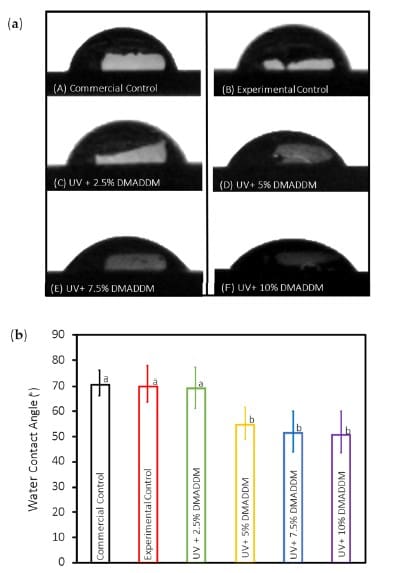
Shows representative water droplet images on samples and statistical comparisons of water contact angle (mean ± sd; n = 15) across Commercial Control, Experimental Control, and DMADDM-containing coating groups.
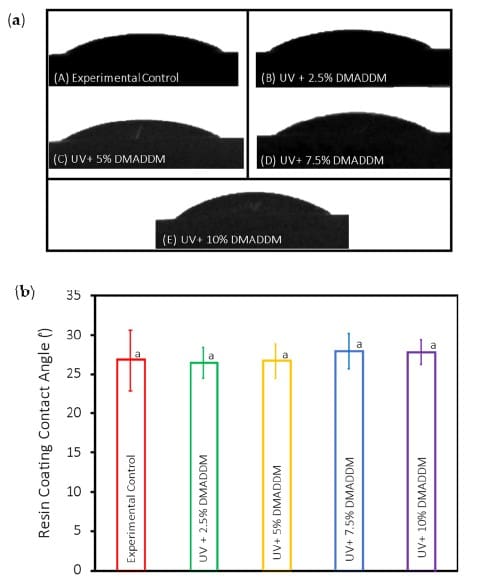
Shows representative images and statistical analysis (mean ± sd; n = 15) of uncured resin coating droplet contact angles across the experimental UV resin groups.
In the paper’s discussion, surface hydrophilicity (via water contact angle) is treated as a surface property that can influence bacterial adhesion and biofilm formation, which is central to the study’s goal of suppressing biofilms and inhibiting secondary caries on provisional crown materials.
Within that context, the Dropometer-generated contact angle data support the paper’s interpretation of how DMADDM concentration changes wettability of cured coated disks, and how uncured coating droplets wet the TEMPSMART resin disk surface in a way the authors describe as favorable for application.
Water contact angles were measured via the sessile-drop technique in air using 5 µL DI water droplets evaluated over a 10 s timeframe, with 15 measurements taken.
The paper reports higher-DMADDM coating groups with lower water contact angles (UV+ 5%, 7.5%, and 10% DMADDM) compared with Commercial Control / Experimental Control / UV+ 2.5% DMADDM, with a significant difference between these sets (p < 0.01).
Uncured UV resin droplet contact angles were obtained from droplet images captured after 10 s and analyzed using Droplet Lab’s Sessile software (version 1.0.5.1) via the Young–Laplace equation.
The uncured UV resin droplet contact angles across Experimental Control and DMADDM-containing UV resin groups showed no significant difference between all groups (p > 0.01).
The paper notes that a water contact angle below 65° demonstrates a surface that is more hydrophilic, providing a criterion for qualitative interpretation of wettability.