Primary surface measurement reported
Saline contact angle on titanium discs before and after vacuum plasma treatment, used to evaluate surface hydrophilicity on machined and rough surfaces.

Client Citation Analysis
Saline contact angle on titanium discs before and after vacuum plasma treatment, used to evaluate surface hydrophilicity on machined and rough surfaces.
The wettability test was conducted using “a tensiometer (Droplet Lab, Droplet Biosciences, Cambridge, MA, USA)” to measure the contact angle of a saline droplet on titanium surfaces.
The contact-angle data were used to compare titanium surface hydrophilicity before and after plasma treatment on machined and rough discs. The authors interpreted the lower post-treatment contact angles together with reduced carbon contamination and improved early fibroblast and osteoblast attachment.
Five machined and five rough-surfaced titanium discs were used for wettability testing, with the same discs measured before and after treatment to ensure consistency.
The paper reports titanium-surface hydrophilicity by measuring the contact angle of a saline droplet before and after plasma treatment. Reported values decreased from 83.1° to 24.1° on machined discs and from 77.3° to 15.7° on rough discs.
Supporting measurements included SEM surface-topography imaging, EDS-based carbon analysis, cell viability assays for fibroblast and osteoblast adherence, immunohistochemistry staining of actin cytoskeleton and nuclei, SEM imaging of cell morphology, and RNA sequencing for differential gene expression.
tensiometer (Droplet Lab, Droplet Biosciences, Cambridge, MA, USA)
Zeiss Gemini 360 FE-SEM SEC; ZEISS, Oberkochen, Germany
EDS via the Zeiss Gemini 360 FE-SEM SEC
CellTiter-Glo Luminescent Cell Viability Assay, Promega
TRITC-conjugated phalloidin and DAPI stain
Zymo-Seq RiboFree Total RNA Library Kit
ACTILINK (Plasmapp Co., Ltd., Seoul, Republic of Korea) — vacuum plasma device, capacitively coupled plasma discharged through vacuum pumping; each titanium disc treated 30 s in an enclosed plasma-filled chamber. Donated by the manufacturer.
GraphPad Prism 10.4.1 (GraphPad Software Inc., La Jolla, CA, USA). Paired Student's t-test for before/after disc comparisons; unpaired Student's t-test for between-group analyses.
Grade 4 titanium discs, 10 mm diameter × 2 mm thickness (BioHorizons, Birmingham, AL, USA) for topography, hydrocarbon and hydrophilicity testing; Grade 4 discs 10 mm × 5 mm (Hoowon, EDI Co., Ltd., Busan, Republic of Korea) for cell viability, IHC and RNA sequencing. Both sets donated by the suppliers.
The paper reports the liquid (saline), the substrate (Grade 4 titanium discs, 10 mm × 2 mm), the sample size (five machined and five rough discs, the same discs measured before and after treatment) and the statistical test (paired Student's t-test). Droplet volume, temperature, humidity, the interval between plasma treatment and measurement, and the number of droplets per disc are not stated in the paper. The mean contact angles are given in Section 3.3, with the before and after comparisons plotted in Figures 5C and 5F.
The paper credits "a tensiometer (Droplet Lab, Droplet Biosciences, Cambridge, MA, USA)" in Section 2.5, used for a wettability test on titanium discs. It does not name a product or model. The authors placed a saline droplet on the surface and measured contact angle before and after 30 s vacuum plasma treatment on both machined and rough-surfaced Grade 4 titanium discs, using the same discs for paired before/after comparison.
In the study workflow, the tensiometer supplied the hydrophilicity readout that the authors used to quantify the plasma-induced change in surface wettability, which they report alongside the carbon, cell-response and gene-expression findings.
If you check how plasma treatment changes titanium wettability, we can show you the same saline contact angle workflow on your samples.
Plasma treatment produced a strong reduction in saline contact angle on both titanium surface types. Machined discs shifted from 83.1° to 24.1°, and rough discs shifted from 77.3° to 15.7°, with both reductions reported as statistically significant at p < 0.0001.
EDS analysis showed carbon content decreasing from 2.60% to 1.87%, a 28.1% reduction after plasma treatment. SEM imaging at 10,000× showed the titanium surface architecture was preserved during treatment.
Fibroblast adherence on machined titanium discs was higher at the 1, 2, and 6 h time points after plasma treatment. Immunohistochemistry and SEM also showed broader cytoskeletal spread and more spread-out pseudopodia morphology at early time points.
Osteoblast adherence on rough titanium discs was higher at the 1 and 2 h time points after plasma treatment. IHC and SEM images showed more spread-out morphology, and by 24 h osteoblasts in the plasma group displayed a long, spindle-shaped, well-attached morphology.
RNA sequencing identified two genes as significantly upregulated in plasma-treated fibroblasts at 6 h versus the no-plasma group: Apln (log2 fold change = 1.90, FDR = 3.9 × 10⁻²) and Crabp2 (log2 fold change = 3.13, FDR = 1.4 × 10⁻⁴). The paper links these genes to angiogenesis and cell growth differentiation.
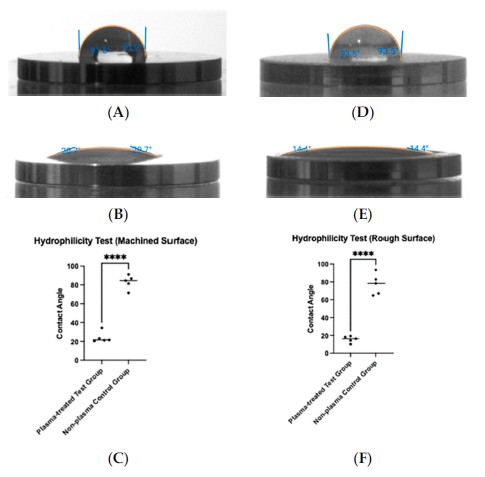
This figure shows the saline-droplet contact-angle images and before/after distributions for machined and rough titanium surfaces, making it the central visual for the Droplet Lab tensiometer's hydrophilicity result
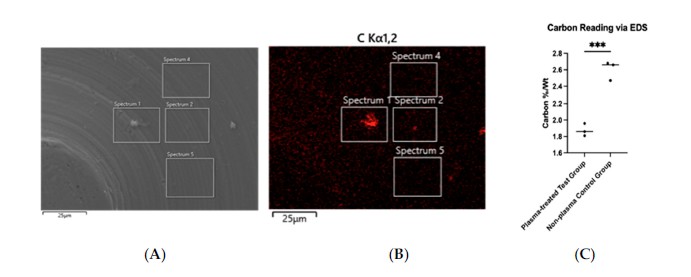
This figure shows EDS-based carbon mapping and the reduction in carbon percentage by weight after plasma treatment, reported alongside the hydrophilicity change seen in Figure 5.
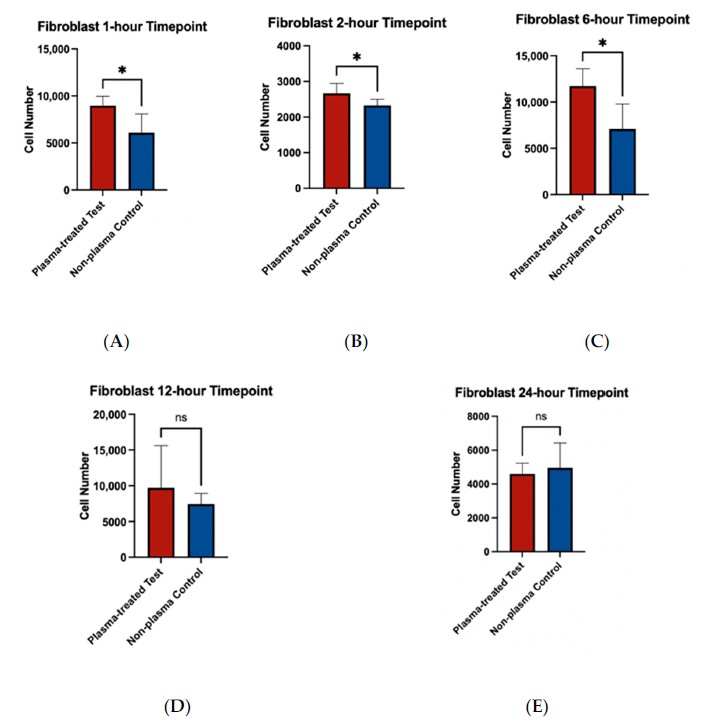
This figure shows that the plasma-treated machined surfaces had higher fibroblast adherence at early time points in the soft-tissue-facing cell model used in the study.
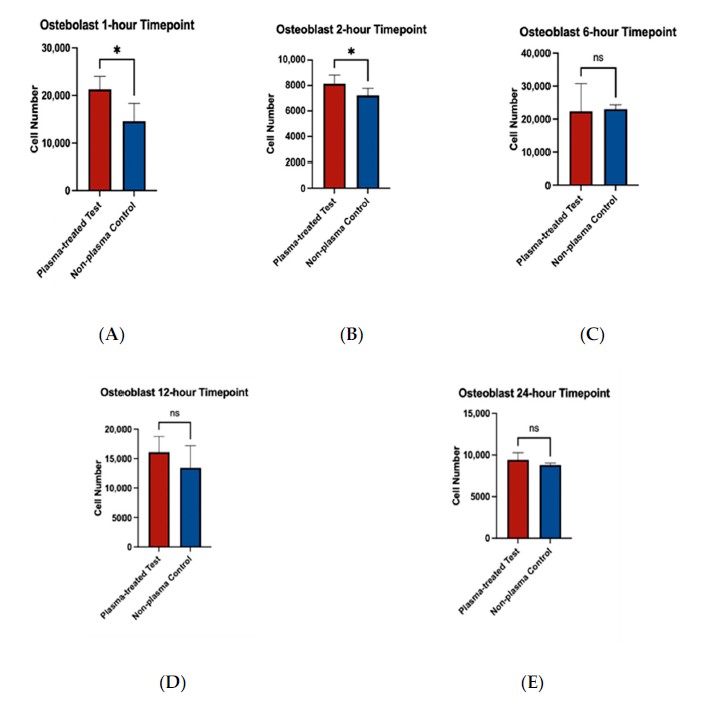
This figure shows higher early osteoblast adherence on plasma-treated rough surfaces in the implant-body-facing cell model used in the study.
In this paper, the contact-angle data, measured with the tensiometer the paper credits as "(Droplet Lab, Droplet Biosciences, Cambridge, MA, USA)", are the study's direct surface-level evidence that vacuum plasma treatment shifts titanium toward a more hydrophilic state. The authors treat hydrophilicity as one of several markers alongside carbon contamination removal, cell attachment, cytoskeletal morphology and gene expression, and their Discussion cites prior literature (Wennerberg et al., reference 24) for the link between hydrophilicity and bone response.
Within the paper's implant-biomaterials context, the wettability and cell-attachment datasets are reported as separate outputs of the same treatment, and its hydrophilicity-to-bone-response argument cites prior in vivo and in vitro work: "Improved hydrophilicity has been shown to have a stronger short-term bone response in existing in vivo and in vitro experiments [24]." The authors frame these results around improved implant biocompatibility and early healing-related interactions on implant and abutment surfaces.
They state it "remains unclear whether the hydrophilic state induced by plasma treatment persists over time or whether it requires additional surface modifications to maintain its bioactive properties," and call for studies assessing long-term stability. The paper also notes it was "conducted in an in vitro setting" that "does not replicate the complex biological environment present in vivo," acknowledges "the limitations of the disc model used in this study," and calls for in vivo validation and direct comparison against alternative surface modification technologies such as UV irradiation.
The Droplet Lab tensiometer provided the quantitative wettability readout used to compare untreated and plasma-treated titanium in this study. The contact-angle shift was large on both machined and rough discs.
The same discs were measured before and after treatment, which made the wettability comparison tightly matched to the plasma intervention. That design strengthens the study’s surface-level comparison.
The authors used the tensiometer on both machined and rough titanium surfaces, aligning the wettability test with abutment-like and implant-body-like use cases inside the study design.
In this paper, the contact-angle result gains value when read together with EDS carbon reduction, cell-attachment assays, morphology imaging, and RNA sequencing. The study uses that combined workflow to interpret plasma treatment as a surface-bioactivation step.
The most prominent biological differences appeared at early time points. The tensiometer readout characterizes surface wettability after treatment and is reported alongside those early cell results.
The authors used a tensiometer credited to Droplet Lab to measure the contact angle of a saline droplet on Grade 4 titanium discs before and after 30 s of vacuum plasma treatment. Five machined and five rough surfaced discs were tested, with the same discs measured before and after treatment.
On machined discs, the contact angle decreased from 83.1° before treatment to 24.1° after treatment, and on rough discs it decreased from 77.3° to 15.7°. The authors report both reductions as statistically significant (p < 0.0001) and use them as evidence that plasma treatment increased titanium surface hydrophilicity.
The authors report the contact angle change alongside a 28.1% reduction in surface carbon content, preserved surface microtopography and earlier fibroblast and osteoblast attachment after plasma treatment. The paper does not state the droplet volume or the time between treatment and measurement, and it does not follow how the contact angle changes during storage after treatment.