Primary surface measurement reported
Hydrophobicity was evaluated from the contact angle of a water drop resting on the waxed surface.

Client Citation Analysis
Hydrophobicity was evaluated from the contact angle of a water drop resting on the waxed surface.
The hydrophobicity measurements were taken with a “Dropometer Surface Analysis System,” and the contact angle measurements were found using the included software.
The contact-angle results in Figure 6 were used to compare hydrophobicity across four waxes at two test temperatures and to assess whether hydrophobicity followed the marketed optimal performance temperature ranges. These results were discussed alongside hardness and friction data in the paper’s interpretation of wax performance.
For each test method, at least 3 samples of each wax and temperature were tested, and averages were used for analysis.
Hydrophobicity was evaluated from the contact angle of a drop of water resting on the waxed surface. Contact angle measurements were obtained with the included software.
The study also measured Shore-A hardness on waxed samples and directly on the wax block, and coefficient of friction using Stribeck testing and a temperature-dependent steady-speed tribometer test. These measurements were interpreted together with contact angle in the results and conclusion.
The study evaluates hydrophobicity from the contact angle of a drop of water when resting on the waxed surface. This was measured using a Dropometer Surface Analysis System, and the contact angle measurements were found using the included software. The measurements were performed on waxed circular sintered UHMWPE base samples, with water applied at room temperature.
In this study, the Dropometer contact-angle results were used to compare hydrophobicity across the four waxes at cold and room-temperature conditions and to judge whether hydrophobicity followed the marketed temperature ranges.
The hydrophobicity discussion is based on contact angle, with the paper stating that a higher contact angle corresponds to higher hydrophobicity.
The Universal wax is described as having similar contact angle at both temperatures tested. The paper interprets this as aligning with the expectation that Universal would perform similarly across temperatures.
The paper states that hydrophobicity should be maximized at the optimal usage temperature if hydrophobicity is an influential performance mechanism. In the discussion, the temperature-specific waxes are reported to show the opposite pattern.
Together with hardness and friction testing, the Dropometer-derived contact-angle results contributed to the paper’s conclusion that the measured properties did not correlate with the marketed performance temperatures of the waxes tested.
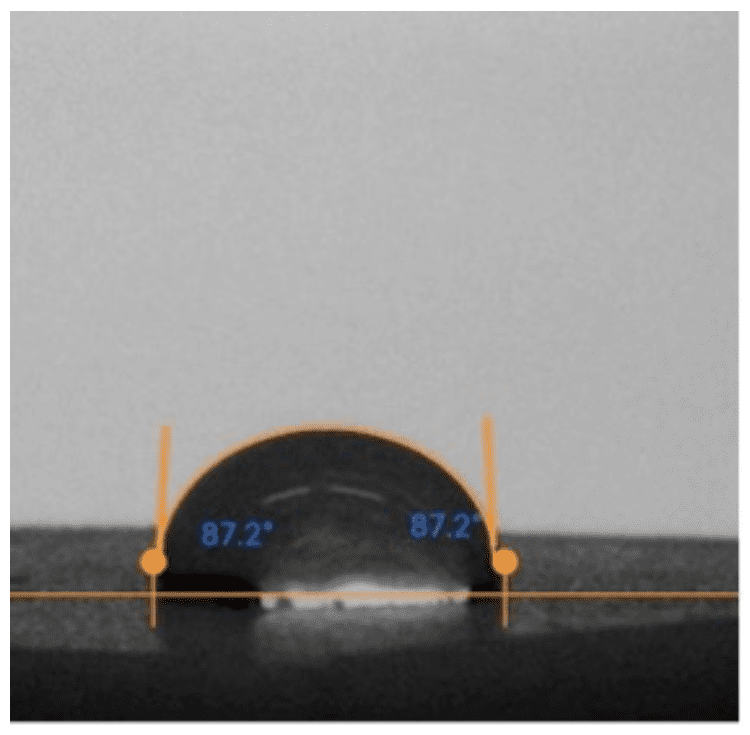
Referenced in the hydrophobicity methods as the included software used to obtain the contact angle measurements.
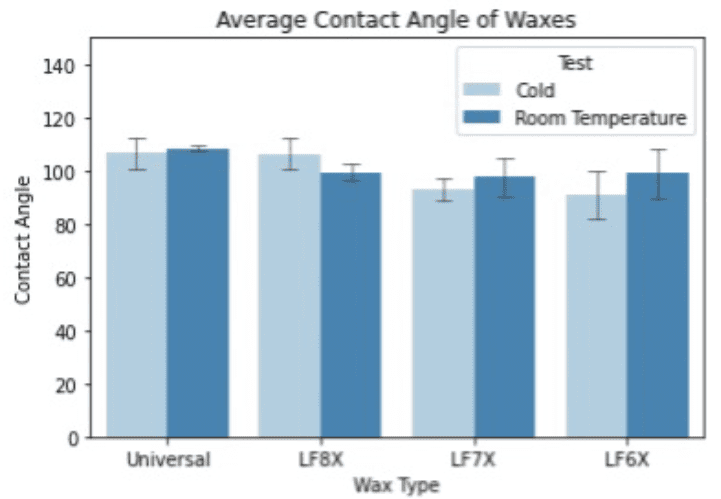
Shows the average contact angle readings taken with the Dropometer contact angle measurement system for the four waxes under two test temperatures.
The paper addresses an applied question in ski-surface science: whether marketed low-fluorinated waxes show temperature-dependent behavior consistent with proposed performance mechanisms. Within that framework, the Dropometer contact-angle measurements provide the study’s hydrophobicity readout.
Those contact-angle results were interpreted alongside hardness and friction testing to compare the four waxes against their marketed temperature ranges. In the authors’ conclusion, the measured properties did not track the advertised performance temperatures, and future hydrophobicity testing closer to use temperatures was identified as a useful next step.
The study uses the Dropometer Surface Analysis System to measure the contact angle of a water drop resting on waxed UHMWPE samples, with values obtained in the included software.
Figure 6 compares averaged contact-angle readings for LF6X, LF7X, LF8X, and Universal under cold and room-temperature conditions.
Universal is discussed as showing similar contact angle at both tested temperatures.
The temperature-specific waxes are discussed as not showing higher hydrophobicity closer to their marketed optimal performance temperatures.
At least 3 samples of each wax and temperature were tested, and averages were used in the analysis.