Contents
PFAS-Free Reformulation & Repellency Screening

PFAS-Free Reformulation: Water and Oil Repellency Screening for Non-Fluorinated Alternatives

Rank candidate PFAS-free formulations on water and oil repellency side by side, before committing to durability testing, so you find out early whether a non-fluorinated chemistry actually closes the performance gap, not after a failed field trial.

Who this is for: Formulation chemists reformulating away from PFAS in textiles, food packaging and paper coatings, and industrial water/oil repellent treatments; regulatory and compliance teams needing performance substantiation for PFAS-free claims; QA teams verifying finished PFAS-free treated goods.

Positioning: Dropometer verifies water and oil repellency performance, it does not verify the chemical absence of PFAS. A regulatory or marketing "PFAS-free" claim requires dedicated analytical testing (targeted LC-MS/MS or total organic fluorine methods), not a wetting measurement. It also does not replace full durability testing (wash and abrasion cycling, AATCC spray and oil-repellency ratings).

Last updated
July 13, 2026
Gurdeep-Saini-Photo
Written by
Gurdeep Singh Saini
Holds a BASc in Mechanical Engineering (Ryerson) and an MASc from York University. He focuses on the custom AI behind the instrument.
COO at Droplet Lab
Read More

Droplet-Lab logo
Technical Review by
Droplet Lab Team
Droplet Lab builds precision instruments and software for surface science measurement, specialising in contact angle analysis and surface tension characterisation. Used by researchers across materials science, pharmaceuticals, coatings, and advanced manufacturing, Droplet Lab's Dropometer has contributed to studies published in peer-reviewed journals including Advanced Functional Materials (Impact Factor 19). The team combines instrument engineering with deep domain knowledge in wettability science with a focus on practical accuracy.

Read More
Gurdeep-Saini-Photo
Written By

Gurdeep Singh Saini

COO at Droplet Lab

Holds a BASc in Mechanical Engineering (Ryerson) and an MASc from York University. He focuses on the custom AI behind the instrument.

Droplet-Lab logo
Reviewed By

Droplet Lab Team

Droplet Lab builds precision instruments and software for surface science measurement, specialising in contact angle analysis and surface tension characterisation. Used by researchers across materials science, pharmaceuticals, coatings, and advanced manufacturing, Droplet Lab's Dropometer has contributed to studies published in peer-reviewed journals including Advanced Functional Materials (Impact Factor 19). The team combines instrument engineering with deep domain knowledge in wettability science with a focus on practical accuracy.


The Cost Of Getting It Wrong

15–20%

of annual revenue consumed by Cost of Poor Quality in typical manufacturing operations

American Society for Quality

10×

higher hidden cost vs. visible scrap cost: rework, re-inspection, downtime, and warranty claims are rarely captured

Lean Six Sigma research consensus

$1 → $10

upstream prevention typically saves $10 in internal rework and up to $100 in external warranty and recall costs, for the specific failure modes an upstream screen actually catches

COPQ prevention-to-failure ratio

ASQ, Learn Lean Sigma, Fabrico COPQ Guide 2026. Figures are industry-wide benchmarks, not Droplet Lab claims. PFAS restrictions are expanding across the EU and multiple U.S. states, making early, defensible reformulation data a real competitive advantage. This screen measures water and oil repellency performance; verifying the chemical absence of PFAS requires separate analytical testing.

QC-Ready Summary

What this workflow does and what it does not

Quick technical reference for formulation chemists and regulatory/QA teams evaluating fit before reading further.

Evidence Box (QC-Ready)

Problem this solves

A non-fluorinated reformulation candidate needs to match PFAS's simultaneous water and oil repellency, historically the hardest part of PFAS-free reformulation. Many candidates that pass a quick water-repellency check still underperform on oil or grease repellency, or lose performance faster under washing and abrasion.

Dropometer role in workflow

An R&D screening tool ranking candidate PFAS-free formulations on water and oil-probe contact angle side by side, before committing to full durability and analytical testing. Not a replacement for AATCC-style repellency rating tests, durability cycling, or PFAS analytical testing.

Primary outputs

Water contact angle
Oil/grease-probe contact angle, using a defined hydrocarbon test-liquid series
Surface energy trend across candidate formulations
Contact angle after a defined wash or abrasion cycle count, as a durability proxy

Calibration requirement

Correlate PASS/MONITOR/FAIL thresholds against your own AATCC 118 oil-repellency rating, AATCC water-repellency rating, or application-specific durability data, not a generic published contact angle number.

Protocol defaults

A standardized probe-liquid series: DI water plus a hydrocarbon test-liquid set analogous to AATCC 118's graded liquids
Fixed droplet volume and timepoint
Minimum 5 replicates per sample
Record wash or abrasion cycle count whenever testing durability

Key limitation

This workflow verifies repellency performance, it does not verify the chemical absence of PFAS. A "PFAS-free" regulatory or marketing claim always needs its own dedicated analytical verification.

Who this is for

What are you trying to solve?

The Dropometer serves four roles across a PFAS-free reformulation program. Each has a different primary risk.

Formulation R&D Chemist

Screening non-fluorinated candidate chemistries for water and oil repellency before committing to full durability trials or a production run.

R&D iteration and trial-batch cost

QA / QC Manager

Needing a numeric release gate on finished PFAS-free treated goods before shipment, rather than relying on a single water-repellency spot check.

Batch inconsistency and customer complaint cost

Regulatory / Compliance Officer

Needing documented performance evidence to support a PFAS-free claim, understanding clearly that this evidence supports but does not substitute for required analytical PFAS testing.

Claim substantiation risk

Sourcing / Supplier Qualification

Comparing competing PFAS-free chemistry suppliers on a level, numeric basis, rather than relying on each supplier's own reported figures.

Supplier switching risk
workflow fit

Is this the right screen for your process?

This is not a universal solution. Check the conditions below before investing further time.

Good fit if

You're screening non-fluorinated candidate formulations and need a numeric way to compare water and oil repellency side by side before a full durability trial
You need to characterize how quickly a candidate's repellency degrades under washing or abrasion, relative to the PFAS product it's replacing
You need a numeric release gate on finished PFAS-free treated goods rather than a single water-repellency spot check
You're comparing PFAS-free chemistry suppliers and want an independent, apples-to-apples performance comparison
You want performance evidence to support a PFAS-free claim, understanding that it must be paired with separate analytical PFAS testing, not substituted for it

Less relevant if

You need to prove or disprove the chemical absence of PFAS, that requires targeted analytical testing (LC-MS/MS or total organic fluorine methods), not a wetting measurement, see Honest Scope for why this instrument can't answer that question at all
You need a final oil- or water-repellency rating for a spec sheet, an accredited AATCC 118 or AATCC 22 test result remains the acceptance method
Your reformulation is already qualified and stable with no new candidate chemistries, suppliers, or durability questions to investigate
Your application doesn't require oil or grease repellency at all, in that case a simpler water-repellency-only screen may be sufficient and this workflow's oil-probe testing is unnecessary overhead
Root Cause Context

The Hard Part of PFAS-Free Reformulation Isn't Water Repellency. It's Oil Repellency.

Most non-fluorinated chemistries can approach PFAS's water repellency. Matching its oil and grease repellency is a different, harder problem.

PFAS achieves its uniquely low surface energy, roughly 10 to 20 mN/m, through fluorocarbon chemistry that repels both water and oil simultaneously. That dual repellency is exactly what makes PFAS-free reformulation hard: peer-reviewed literature on non-fluorine oil repellency is consistent that most non-fluorinated chemistries, silicone-based, hydrocarbon or wax-based, and emerging bio-based systems, can approach reasonable water repellency, but oil and grease repellency remains the harder property to replicate without fluorine.

That gap matters most in applications where oil or grease contact is part of the product's actual use case, food packaging and food-contact paper being the clearest example, where a candidate that looks fine on a water-repellency spray test can still fail in the field the first time it touches grease. It's compounded by a separate, real durability problem: several non-fluorinated repellent treatments, particularly non-crosslinked silicone or wax-based systems, lose repellency performance faster under washing or abrasion than the fluorinated products they're replacing.

This workflow screens candidate formulations on both water and oil-probe contact angle, and tracks that performance across a wash or abrasion cycle series, so a reformulation gap gets caught in R&D screening rather than in a field trial or a customer complaint. The one thing this workflow cannot do, and this needs to be said plainly: it does not verify the chemical absence of PFAS. A repellency screen that passes tells you the candidate performs well; it says nothing about whether trace PFAS or PFAS precursors are still present. That question always needs its own analytical testing.

Recognition

What Does a Failed PFAS-Free Reformulation Actually Look Like?

A candidate reformulation passes an initial water-repellency check but underperforms on oil or grease repellency in actual use, loses repellency faster than expected after washing or handling, or produces inconsistent results across batches, without a quantitative way to catch the gap before a field failure or a substantiation challenge.

A candidate passes water-repellency testing but fails oil or grease repellency in application.
Repellency performance degrades faster than the PFAS product being replaced, after washing, abrasion, or normal handling.
Inconsistent repellency performance across batches of the same nominal PFAS-free formulation.
Customer or regulatory pushback questioning whether a "PFAS-free" claim is adequately substantiated.
A supplier's PFAS-free chemistry performs differently on your specific substrate than in the supplier's own published data.
Repellency performance that looks acceptable in lab trials but underperforms once scaled to production application conditions.
Diagnosis

Root Causes

Why:

  • Non-fluorinated chemistries generally can't reach the very low surface energy that gives PFAS its simultaneous water and oil repellency, so oil-probe repellency lags water repellency even in an otherwise well-performing candidate.

How to detect:

  • Oil or hydrocarbon-probe contact angle is low, or the candidate fails a graded oil-repellency series, even when water contact angle looks acceptable

Corrective action:

  • Screen every candidate against an oil-repellency test-liquid series specifically, not water repellency alone

Why:

  • Several non-fluorinated repellent systems, particularly non-crosslinked silicone or wax-based chemistries, lose repellency faster than fluorinated alternatives under repeated washing or abrasion.

How to detect:

  • A larger contact-angle drop after a defined wash or abrasion cycle count than your baseline or the incumbent PFAS product shows

Corrective action:

  • Reformulate the crosslink chemistry or binder system, then re-test the full durability curve, not just a single post-cycle reading

Why:

  • A chemistry that performs well at lab-bench scale can underperform once applied at production coverage and cure conditions.

How to detect:

  • Contact angle on production-line samples differs meaningfully from lab-bench candidate screening results

Corrective action:

  • Re-optimize application and cure parameters specifically for the new chemistry rather than assuming lab-bench results transfer directly

Why:

  • Some "PFAS-free" formulations still contain trace PFAS from shared processing equipment or from precursor breakdown, an analytical and supply-chain issue, not a wetting-performance issue.

How to detect:

  • Repellency performance looks acceptable, but analytical PFAS testing still detects PFAS or PFAS precursors, this cannot be detected by contact angle measurement

Corrective action:

  • Audit equipment and supply chain for cross-contamination, and verify with dedicated analytical PFAS testing, not a wetting measurement

Why:

  • Contact angle and surface energy verify repellency performance, they do not and cannot verify chemical identity or the presence or absence of PFAS.

How to detect:

  • Not detectable by this instrument at all; requires targeted analytical methods (for example, LC-MS/MS-based targeted PFAS analysis or total organic fluorine testing)

Corrective action:

  • Pair this workflow's performance screening with dedicated analytical PFAS testing before making or relying on any regulatory or marketing PFAS-free claim

Not sure which root cause applies to your process?

A surface science specialist can review your reformulation performance data and help you identify whether a repellency screen would add a useful upstream gate.

For Compliance Officers and QA Managers

Building a defensible PFAS-free reformulation record

Surface readiness measurement produces the type of numeric, traceable output that a subjective "it feels water-repellent" impression cannot. This record documents repellency performance, it supports but does not by itself substantiate a PFAS-free chemical claim, which needs its own analytical verification. If your quality or regulatory process requires documented evidence of performance for NCR responses, CAPA files, incoming inspection records, or customer or regulatory audits, water and oil-probe contact angle data provide that performance evidence in a format your QA documentation already requires.

Audit trail

Numeric water contact angle, oil-probe contact angle, and surface energy values with replicate spread, timestamps, and formulation or batch identification; replacing subjective repellency impressions with defensible numeric logs.

CAPA evidence

When an oil-repellency failure or a durability complaint triggers a Corrective and Preventive Action file, water and oil-probe data from before and after a formulation change provide quantitative evidence of the mechanism involved, not anecdotal description.

NCR documentation

Non-conformance reports that include numeric repellency data allow you to assign root cause to oil-repellency gap, durability degradation, or application mismatch with evidence, not inference.

Supplier qualification

Incoming PFAS-free chemistry or pre-treated substrate inspection using water and oil-probe contact angle provides a numeric acceptance criterion for supplier qualification, independent of the supplier's own reported figures.

Process control records

Water and oil-probe contact angle trend logs across formulation batches demonstrate statistical process control at the reformulation step; relevant to Six Sigma, SPC, and DMAIC programs targeting reformulation-driven COPQ.

Reformulation screening record

A concentration-series or candidate-chemistry comparison gives R&D a numeric basis for gating which non-fluorinated formulation advances to full durability and analytical testing, instead of finding out about a performance gap only after a field failure.

What to Measure

Primary screen

Water contact angle

Why it matters: A baseline hydrophobic repellency indicator, and the easier of the two properties to replicate without fluorine.

How to interpret: Higher angle indicates better water repellency; correlate against your own AATCC-style water-repellency rating.

When it is not enough: Doesn't predict oil or grease repellency at all, the two properties are governed by different surface energy regimes.

Primary screen

Oil / grease-probe contact angle (hydrocarbon test-liquid series)

Why it matters: A direct indicator of oleophobic performance, the property most non-fluorinated chemistries struggle to match.

How to interpret: Correlate against your own AATCC 118-style oil-repellency rating; a candidate with strong water repellency but poor oil-probe performance will likely underperform in food-contact or grease-exposure applications.

When it is not enough: A single reading doesn't capture durability under repeated use or washing.

Primary screen

Contact angle after wash or abrasion cycling

Why it matters: Many non-fluorinated repellent treatments degrade faster under repeated washing or abrasion than fluorinated ones.

How to interpret: Track the decline curve against your own durability requirement, not a single-point pass/fail.

When it is not enough: Lab-scale cycling is a proxy for real-world use and wash conditions, not a substitute for them.

QC

Surface energy trend

Why it matters: Quantifies overall treatment effectiveness across candidates on a comparable, numeric scale.

How to interpret: Compare across candidate chemistries at matched application and cure conditions.

When it is not enough: A performance metric only; says nothing about chemical composition or PFAS content.

Validated Measurement Approach

Independent benchmarking and publication-based validation references.

Benchmark Validation

Dropometer contact angle and pendant-drop surface tension methods have been benchmarked against KRÜSS DSA100E reference measurements. The instrument is referenced in peer-reviewed journals including Bioactive Materials (Impact Factor 20) and Advanced Functional Materials (Impact Factor 19).

See peer-reviewed validation

Publication Evidence

Our instruments are referenced in peer-reviewed journals, theses, and conference publications.

Browse citations
QC Protocol

How Dropometer Fits Your Workflow

Dropometer is best used to screen candidate PFAS-free chemistries head-to-head on both water and oil repellency, then track durability before committing to full analytical and field validation.

1

Screen candidates head-to-head

Measure water and oil-probe contact angle across candidate PFAS-free chemistries at matched application conditions: Rank candidates on both properties together, not water repellency alone

2

Characterize durability

Track contact angle across a wash or abrasion cycle series for your leading candidates: This is where several non-fluorinated systems separate from a fluorinated incumbent, catch it here, not in the field

3

Set a finished-goods release gate

Verify production samples against your validated candidate baseline before shipment: PASS: within baseline band → release MONITOR: borderline result → re-verify or hold FAIL: out of band → investigate application, cure, or formulation drift

4

Pair with analytical verification before any PFAS-free claim

Route to targeted LC-MS/MS or total organic fluorine analytical testing to substantiate a regulatory or marketing claim: This wetting screen never substitutes for that analytical step, no matter how good the repellency performance looks

We completed our gage R&R study on the unit and it performed very well.

Brandon Barbee

Corporate Quality Engineer - Zeus Industries - Polymer Manufacturing

Download the PFAS-Free Reformulation Screening SOP Template

An editable SOP template your team can adapt for your substrate, candidate chemistries, and application process. Includes measurement protocol, oil-probe test-liquid guidance, gate-setting guidance, and a QC log format ready for your documentation system.

Example Outputs

Sample Candidate Screening: Water vs. Oil Repellency Across Chemistry Types

Representative output format. Values are illustrative, not a universal specification.

Actual measurement output
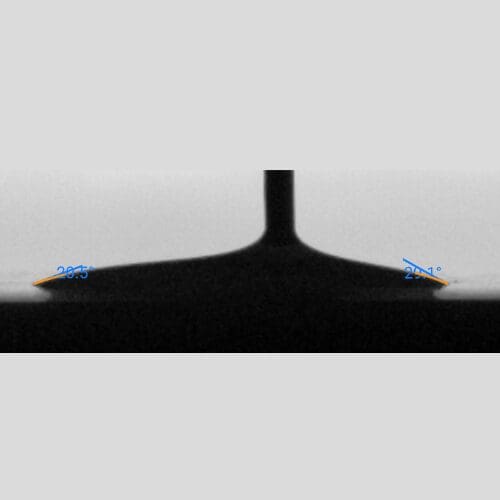
Dropometer silicon oil on teflon probe contact angle measurement. This is the type of output used to decide which candidate advances to durability and analytical testing.

Actual measurement output

Sample Candidate Screening: Water vs. Oil Repellency Across Chemistry Types

Candidate Water Contact Angle (°) Oil-Probe Contact Angle (°) Contact Angle After 20 Wash Cycles Fit
Incumbent PFAS-based treatment (benchmark) 118° 92° 108° Reference benchmark
Candidate A, silicone-based 112° 41° 79° Strong water repellency, weak oil repellency
Candidate B, wax/hydrocarbon-based 104° 35° 61° Moderate on both, fastest durability decline
Candidate C, bio-based (chitosan-derived) 98° 58° 90° Best oil-repellency and durability balance of the three, still below PFAS benchmark on all three metrics

The incumbent PFAS treatment sets the benchmark on all three metrics, this is the performance bar every candidate is being measured against. Candidate A shows the pattern the literature predicts most often: water repellency close to the benchmark, but oil-probe contact angle well below it, this candidate would likely underperform in any grease-contact application despite looking strong on a water-only check. Candidate B is weaker across the board and shows the steepest post-wash decline, a durability concern independent of its initial performance. Candidate C doesn't match the PFAS benchmark on any single metric, but it's the most balanced candidate of the three and the strongest on oil repellency specifically, worth advancing to a full durability and analytical PFAS-verification trial even though no candidate here fully closes the gap. This output would be included in the reformulation screening record used to decide which candidate advances.

Troubleshooting

PFAS-free reformulation troubleshooting guide

Start condition: a candidate is underperforming, losing repellency too fast, or producing inconsistent batches. Use the signal pattern to identify the most likely cause.

Signal A

Water contact angle looks fine, oil-probe contact angle is low

Likely cause: Oil and grease repellency gap, common across non-fluorinated chemistries.
Action: Screen the candidate against a full oil-repellency test-liquid series, and treat oil repellency as a separate gate from water repellency.

Signal B

Larger-than-expected contact-angle drop after wash or abrasion cycling

Likely cause: Durability and wash-cycle degradation, particularly common in non-crosslinked silicone or wax-based systems.
Action: Reformulate the crosslink chemistry or binder system and re-test the full durability curve.

Signal C

Production-line samples underperform lab-bench candidate results

Likely cause: Application or cure process mismatch at production scale.
Action: Re-optimize application and cure parameters specifically for the new chemistry.

Signal D

Repellency performance looks acceptable but analytical testing still detects PFAS

Likely cause: Cross-contamination from shared equipment or precursor carryover, not a wetting-performance issue.
Action: Audit equipment and supply chain, and rely on analytical PFAS testing, not repellency data, to resolve this.

FAQ

Common questions before adoption

No, and this is the most important limitation on this page. Contact angle measures repellency performance, not chemical identity. A PFAS-free regulatory or marketing claim always requires separate analytical testing, targeted LC-MS/MS or total organic fluorine methods.

PFAS's fluorocarbon chemistry achieves an unusually low surface energy that repels both water and oil at once. Most non-fluorinated alternatives can approach water repellency reasonably well, but matching oil and grease repellency without fluorine remains a harder, less-solved problem, this is well documented in the peer-reviewed literature, not a marketing talking point.

Yes. Comparing water and oil-probe contact angle across candidates at matched conditions, plus tracking a wash or abrasion durability curve, is one of the more direct uses of this protocol.

No. It's a fast screening tool for R&D and QC. Confirm final repellency ratings with accredited AATCC-style acceptance testing.

Verify it independently on your own substrate and application conditions. Supplier-reported figures often don't transfer directly once applied at your production coverage and cure conditions.

It depends entirely on the application. If the product never contacts oil or grease in use, the oil-repellency gap may not matter. If it's a food-contact or grease-exposure application, it almost certainly does.

It can be used as supporting performance evidence alongside required analytical PFAS testing, not as a substitute for it. Check with your regulatory team on exactly what documentation your specific claim or jurisdiction requires.

Business Impact

What Changes When You Screen Reformulation Candidates Before a Field Trial, Not After

Before and with Dropometer; operational outcomes

Metric Before Dropometer With Dropometer Indicative Benchmark
Failure discovery point A field trial or customer complaint, after committing a candidate to production Water and oil-probe contact angle screening across candidates before a field trial "COPQ from late-discovered defects typically 15–20% of revenue for manufacturers without upstream gates"
Candidate ranking Full field trials across each candidate chemistry Water and oil-probe comparison in a single screening run "Structured data-driven ranking vs. full-trial trial-and-error"
Durability assessment Assumed durability parity with the PFAS incumbent Measured wash/abrasion decline curve per candidate "Catches a durability gap before it reaches the field"
Supplier claims Taken at face value from supplier-reported data Verified independently on your own substrate and conditions "Reduces reliance on supplier-reported values alone"
Claim substantiation Performance-only or absent documentation Numeric repellency records paired explicitly with required analytical PFAS testing "Supports, without ever replacing, a defensible PFAS-free claim"

Instant ROI Snapshot

PFAS-Free Reformulation ROI Snapshot

Estimate saved iterations and lab cost.

Each Dropometer unit is $5,000 — default models 1 unit.
Candidate chemistry plus substrate cost per formulation trial.
Application, water and oil-probe contact angle capture, and analysis.
Conservative range: 25-40%.

Result

~0
Iterations saved / month
~0
Monthly savings
~0
Payback period
~0
Year-1 net benefit

Monthly savings = materials saved + technician time saved from reduced iterations.

Honest scope

What Repellency Screening Cannot Tell You About PFAS-Free Reformulation

Knowing the limits of any measurement tool is part of using it responsibly.

This instrument verifies repellency performance, it cannot verify the chemical absence of PFAS. Never treat a good contact angle result as evidence for a regulatory or marketing PFAS-free claim on its own.
No universal contact angle threshold applies across all substrates, applications, and repellency requirements; validate your own threshold against AATCC-style acceptance ratings and your application's real use conditions.
Oil and grease repellency and water repellency are governed by different surface energy regimes; a strong water-repellency result says nothing about oil-repellency performance.
Durability under washing or abrasion must be measured directly, don't assume a candidate's initial contact angle predicts its performance after repeated use.
Lab-bench candidate screening results may not transfer directly to production-scale application and cure conditions; re-verify at production scale before final qualification.
Use repellency metrics as an upstream R&D and QC gate, then confirm final suitability with accredited AATCC-style testing and dedicated analytical PFAS testing before any regulatory claim.

Use this page to improve candidate screening and durability characterization, not to replace accredited repellency testing or analytical PFAS verification. The Dropometer is one layer in a reformulation program, not a substitute for the whole program.

How this page was created

Editorial and technical transparency notes for this page.

Transparency Details 4 checklist items
01

Drafting assistance

Initial draft created with AI assistance (Claude Opus 4.8), then rewritten for technical clarity.

02

Technical review

Reviewed and edited for technical accuracy by a surface-science specialist.

03

Verification steps

Identifiers, units, thresholds, and key claims checked against cited sources before publication.

04

Updates

Reviewed every 12 months or when the underlying standard changes.

Report a correction

Spotted an issue in this summary? Send a correction request and our team will review it.

Correction Request

We work hard to keep this standards summary accurate and up to date. If you spot an error (wrong revision/year, missing requirement, incorrect interpretation, or broken link), tell us and we'll review it.

Contact us to report a correction
References

Sources

1.
Non-fluorine oil repellency: To what extent can it substitute perfluoroalkyl substances? Progress in Organic Coatings (ScienceDirect). https://www.sciencedirect.com/science/article/abs/pii/S0300944023003223
2.
AATCC TM118-2020, Test Method for Oil Repellency: Hydrocarbon Resistance. https://members.aatcc.org/store/tm118/528/
3.
PFAS-free superhydrophobic chitosan coating for fabrics. Carbohydrate Polymers (ScienceDirect). https://www.sciencedirect.com/science/article/pii/S0144861724002078
4.
Chen, X. et al. Contact angle measurement with a smartphone. Review of Scientific Instruments, 89, 035117 (2018). https://pubs.aip.org/aip/rsi/article-abstract/89/3/035117/368179/Contact-angle-measurement-with-a-smartphone
5.
Fabrico. The Cost of Poor Quality (COPQ) in Manufacturing: 2026 Guide. https://www.fabrico.io/blog/cost-of-poor-quality-copq-manufacturing-guide/
6.
Making Strategy Happen. The Cost of Quality: The 1-10-100 Rule. https://www.makingstrategyhappen.com/the-cost-of-quality-the-1-10-100-rule/