
Surfactants, CMC, Emulsions and Foams
Critical Micelle Concentration (CMC) Determination: Measure Surfactant Concentration by Surface Tension for Anionic, Cationic and Detergent Formulations
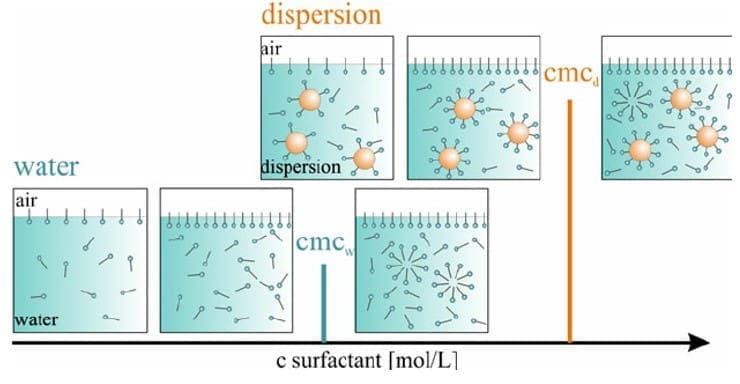
The CMC is the surfactant concentration at which micelles start to form and surface tension stops falling. Measure surface tension across a dilution series, fit the two parts of the curve, and you obtain the CMC of your own formulation, in your own medium, rather than a value copied from a datasheet.

Written by
Gurdeep Singh Saini
Holds a BASc in Mechanical Engineering from Ryerson University (now Toronto Metropolitan University) and an MASc from York University. He develops the automatic edge and baseline detection behind the Dropometer's analysis.
COO at Droplet Lab
Read More

Technical Review by
Droplet Lab Team
Droplet Lab builds precision instruments and software for surface science measurement, specialising in contact angle analysis and surface tension characterisation. Used by researchers across materials science, pharmaceuticals, coatings, and advanced manufacturing, Droplet Lab's Dropometer has contributed to studies published in peer-reviewed journals including Advanced Functional Materials (Impact Factor 19). The team combines instrument engineering with deep domain knowledge in wettability science with a focus on practical accuracy.
Read More
Reviewed By
Droplet Lab Team
Droplet Lab builds precision instruments and software for surface science measurement, specialising in contact angle analysis and surface tension characterisation. Used by researchers across materials science, pharmaceuticals, coatings, and advanced manufacturing, Droplet Lab's Dropometer has contributed to studies published in peer-reviewed journals including Advanced Functional Materials (Impact Factor 19). The team combines instrument engineering with deep domain knowledge in wettability science with a focus on practical accuracy.



Validated measurement approach for CMC by surface tension
How the Dropometer itself has been validated, and where customers have published with it.
Peer reviewed method
The Dropometer pendant drop surface tension method is published in Colloids and Surfaces A, and its contact angle method in Review of Scientific Instruments.
See the validation papersCustomer evidence on surfactant systems
Prof. Rajinder Pal's group at the University of Waterloo measured surfactant and polymer solutions with the Dropometer in seven publications. Their own data gave an HTAB CMC of 300 ppm, against about 332 ppm in the literature.
Read the Waterloo case studyExample CMC determination: surface tension at different surfactant concentrations
Example data only. Your values will differ with surfactant, medium and temperature.
How to read this table
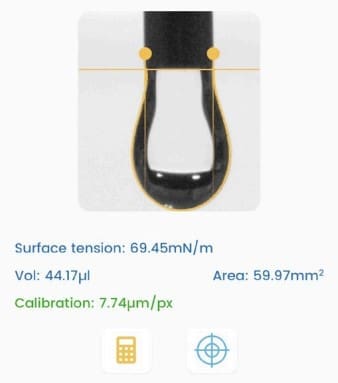
Grey rows fall steeply below the CMC; green rows sit on the plateau. Fitting a line to each group gives a calculated CMC of about 6.5 mM for this example. Your fitting rule should be fixed in your SOP before you run samples.
Example data, not customer data. Pendant drop surface tension of an anionic surfactant in water at 25 °C, read at a fixed drop age.
Report a correction
Spotted an issue in this summary? Send a correction request and our team will review it.
Correction Request
We work hard to keep this page accurate and up to date. If you spot an error (wrong revision/year, missing requirement, incorrect interpretation, or broken link), tell us and we'll review it.
Contact us to report a correctionReferences
1.
Mukerjee, P., Mysels, K. J. Critical Micelle Concentrations of Aqueous Surfactant Systems. NSRDS-NBS 36, National Bureau of Standards, 1971. https://nvlpubs.nist.gov/nistpubs/Legacy/NSRDS/nbsnsrds36.pdf
2.
US Food and Drug Administration. Premarket Notification (510(k)) Guidance Document for Contact Lens Care Products, 1997, Appendix B: Determining critical micelle concentration by surface tension. https://www.fda.gov/regulatory-information/search-fda-guidance-documents/premarket-notification-510k-guidance-contact-lens-care-products
3.
Sun, C. C., Pal, R. Effect of polymer concentration on the rheology and surface activity of cationic polymer and anionic surfactant mixtures. Fluids 10:253, 2025. Customer publication that used the Dropometer; the link goes to our analysis. https://dropletlab.com/validation/citations/analysis/effect-of-polymer-concentration-on-the-rheology-and-surface-activity-of-cationic-polymer-and-anionic-surfactant-mixtures/
4.
Pal, R., Sun, C. C. Influence of added surfactants on the rheology and surface activity of polymer solutions. ChemEngineering 9:105, 2025. Customer publication that used the Dropometer; the link goes to our analysis. https://dropletlab.com/validation/citations/analysis/influence-of-added-surfactants-on-the-rheology-and-surface-activity-of-polymer-solutions/
5.
Pal, A., Pal, R. Influence of surfactants on the rheological behavior of nanocrystal suspension. Preprints.org, 2025. Customer preprint that used the Dropometer; the link goes to our analysis. https://dropletlab.com/validation/citations/analysis/influence-of-surfactants-on-the-rheological-behavior-of-nanocrystal-suspension/
6.
ISO 4311. Anionic and non ionic surface active agents: determination of the critical micellization concentration, method by measuring surface tension with a plate, stirrup or ring. https://dropletlab.com/industry-standards/iso-4311/
7.
Surface tension measurement with a smartphone using a pendant drop. Colloids and Surfaces A: Physicochemical and Engineering Aspects.
https://www.sciencedirect.com/science/article/abs/pii/S0927775717307744