
Battery Wetting and Electrolyte Spreading
Electrolyte Wetting and Electrolyte Additive Selection for Lithium-Ion Batteries: Optimization of Electrolyte Filling and Wetting on the Separator and Positive Electrode in Battery Production
Electrolyte filling and wetting is one of the slowest steps in battery production, and a cell that is not fully wet before formation can plate lithium. Measure electrolyte surface tension and contact angle on separators and electrodes to rank each electrolyte additive, separator and electrode treatment before you build cells.

Written by
Gurdeep Singh Saini
Holds a BASc in Mechanical Engineering from Ryerson University (now Toronto Metropolitan University) and an MASc from York University. He develops the automatic edge and baseline detection behind the Dropometer's analysis.
COO at Droplet Lab
Read More

Technical Review by
Droplet Lab Team
Droplet Lab builds precision instruments and software for surface science measurement, specialising in contact angle analysis and surface tension characterisation. Used by researchers across materials science, pharmaceuticals, coatings, and advanced manufacturing, Droplet Lab's Dropometer has contributed to studies published in peer-reviewed journals including Advanced Functional Materials (Impact Factor 19). The team combines instrument engineering with deep domain knowledge in wettability science with a focus on practical accuracy.
Read More
Reviewed By
Droplet Lab Team
Droplet Lab builds precision instruments and software for surface science measurement, specialising in contact angle analysis and surface tension characterisation. Used by researchers across materials science, pharmaceuticals, coatings, and advanced manufacturing, Droplet Lab's Dropometer has contributed to studies published in peer-reviewed journals including Advanced Functional Materials (Impact Factor 19). The team combines instrument engineering with deep domain knowledge in wettability science with a focus on practical accuracy.



Validated measurement approach for electrolyte wetting
How the Dropometer itself has been validated, and where customers have used it.
Peer reviewed method
The Dropometer drop shape method is published in Review of Scientific Instruments and Colloids and Surfaces A. Contact angle was validated against a KRUSS DSA100E, with a published accuracy of 0.35°.
See the validation papersCustomer evidence in battery R&D
A North American battery materials R&D team needed to see how ionic liquid and aqueous electrolytes wet cathode and anode materials after surface treatment. Some of its electrolytes attack metal, so Droplet Lab set up an automatic dropper with disposable plastic needles for contact angle, surface tension and surface energy.
Read the case studyExample electrolyte additive and separator screening log
Example data only. Your values and gates will differ and must come from your own references.
How to read this log
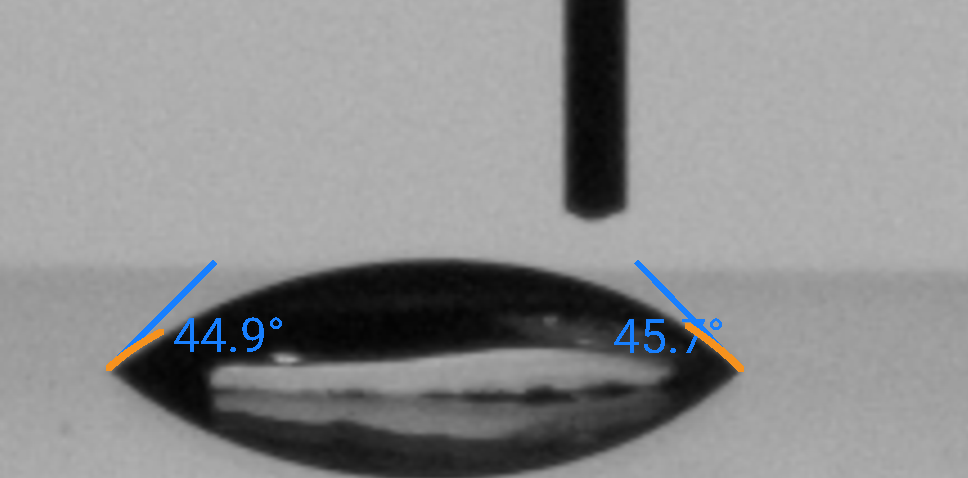
Example gates: contact angle at 10 s at or below 35° and absorption at or below 60 s on the separator. Additive A lowered surface tension and wetting time, so it is shortlisted. Additive B made no difference. A new PE lot wet worse than the reference, so it is held.
Example data, not customer data. LiPF6 carbonate base electrolyte, measured in a dry atmosphere at 25 °C; ranges are in line with Hofmann et al. (2015).
Report a correction
Spotted an issue in this summary? Send a correction request and our team will review it.
Correction Request
We work hard to keep this page accurate and up to date. If you spot an error (wrong revision/year, missing requirement, incorrect interpretation, or broken link), tell us and we'll review it.
Contact us to report a correctionReferences
1.
Wood, D. L. III, Li, J., Daniel, C. Prospects for reducing the processing cost of lithium ion batteries. Journal of Power Sources 275:234 to 242, 2015. https://doi.org/10.1016/j.jpowsour.2014.11.019
2.
Günter, F. J. et al. Influence of pressure and temperature on the electrolyte filling of lithium-ion cells: experiment, model and method. Journal of Power Sources 517:230668, 2022. https://doi.org/10.1016/j.jpowsour.2021.230668
3.
Hofmann, A., Kaufmann, C., Müller, M., Hanemann, T. Interaction of high flash point electrolytes and PE based separators for Li-ion batteries. International Journal of Molecular Sciences 16:20258 to 20276, 2015. https://doi.org/10.3390/ijms160920258
4.
Hagemeister, J. et al. Lean cell finalization in lithium-ion battery production: determining the required electrolyte wetting degree to begin the formation. Energy Technology 11(5):2200686, 2023. https://doi.org/10.1002/ente.202200686
5.
Sheng, Y. et al. Effect of calendering on electrode wettability in lithium-ion batteries. Frontiers in Energy Research 2:56, 2014. https://doi.org/10.3389/fenrg.2014.00056
6.
Davoodabadi, A. et al. Journal of Power Sources 424:193 to 203, 2019 (electrolyte wetting of graphite and NMC532 electrodes). https://doi.org/10.1016/j.jpowsour.2019.03.115
7.
Lux, S. F. et al. The mechanism of HF formation in LiPF6 based organic carbonate electrolytes. Electrochemistry Communications 14:47 to 50, 2012.
https://doi.org/10.1016/j.elecom.2011.10.026
8.
Chen, X. et al. Contact angle measurement with a smartphone. Review of Scientific Instruments 89(3):035117, 2018.
https://pubs.aip.org/aip/rsi/article-abstract/89/3/035117/368179/Contact-angle-measurement-with-a-smartphone
9.
Surface tension measurement with a smartphone using a pendant drop. Colloids and Surfaces A: Physicochemical and Engineering Aspects.
https://www.sciencedirect.com/science/article/abs/pii/S0927775717307744