



Contents
Case Study

The chemistry teaching labs at USF put a working goniometer in front of every undergraduate, at under $1,000 a unit.

Last Updated
July 30, 2026
Sector
Undergraduate Chemistry Education
Deployment
33 units, Tampa, FL
Purpose-built for teaching labs Under $1,000 per unit In continuous use since 2024

Lab-grade goniometers price undergraduate access out of reach, so surface science gets taught from a lecture slide. The undergraduate teaching labs of the chemistry department at USF set a hard cap of $1,000 per unit and asked Droplet Lab to build to it. Thirty-three custom kits went into the ISA and NES teaching labs in 2024, serving roughly 1,000 students per semester in rotation, and are still in continuous use and still receiving software updates.

Droplet Lab educational goniometer
Abhimanyu Photo
Written by
Abhimanyu Bhandankar
Holds an MBA from Schulich School of Business and a BE in IT. He joined Droplet Lab in July 2019 and now leads sales and marketing.
CEO at Droplet Lab
Read More
Gurdeep-Saini-Photo
Technical Review by
Gurdeep Singh Saini
Holds a BASc in Mechanical Engineering (Ryerson) and an MASc from York University. He focuses on the custom AI behind the instrument.
COO at Droplet Lab
Read More
Abhimanyu Photo
Written By

Abhimanyu Bhandankar

CEO at Droplet Lab

Holds an MBA from Schulich School of Business and a BE in IT. He joined Droplet Lab in July 2019 and now leads sales and marketing.

Gurdeep-Saini-Photo
Reviewed By

Gurdeep Singh Saini

COO at Droplet Lab

Holds a BASc in Mechanical Engineering (Ryerson) and an MASc from York University. He focuses on the custom AI behind the instrument.

Primary outcome: instruments per student

undergraduate access to a goniometer

Before demonstration only
After ~1,000 students / semester

Commercial lab-grade goniometers sit at research price points, which in practice restricts them to graduate students. Undergraduates at most institutions meet surface science through a lecture and, at best, a demonstration. The department set a $1,000 per-unit ceiling and Droplet Lab designed to it rather than discounting an existing product. The result was 33 kits for approximately $30,000, rotating roughly 1,000 students through hands-on measurement each semester, at about 30 students per instrument. Every one of them handles the equipment individually rather than watching someone else use it.

33 units

Custom kits delivered to the ISA and NES undergraduate teaching labs.

<$1,000 per unit

Budget ceiling set by the department. The instrument was designed to the price, not discounted to it.

~$30 per student, first semester

A ~$30,000 fleet against ~1,000 students in the first semester alone. The figure falls every term the instruments stay in service.

2+ yrs and counting

Continuous semester use since spring 2024, with software still being updated on request.

Executive Summary

Who

The undergraduate teaching labs of the chemistry department at the University of South Florida in Tampa, led by Dr Jhon J. Figueroa, Assistant Director of Teaching Laboratories.

Problem

Surface science was reaching undergraduates as theory. Lab-grade goniometers cost enough that departments buy one or two and reserve them for graduate research, so the concept that students most need to handle physically is the one they only read about. No commercial instrument existed at a price that would let a department buy thirty of them.

Solution

A goniometer designed from scratch for undergraduate teaching rather than adapted down from the Dropometer. Fixed camera and desktop processing instead of smartphone capture, chosen for classroom robustness. Modular replaceable parts so department staff handle maintenance in house. Thirty-three kits with software licences, delivered inside a $30,000 budget.

Time to Value

First contact in 2020, revived September 2023. Three prototype iterations between September and December 2023, purchase order December 2023, instruments in the teaching labs by spring 2024. Delivery ran through a customs hold and a university IT deployment process.

Results

Thirty-three instruments in continuous semester use for over two years, rotating roughly 1,000 students per semester through hands-on measurement. Students operate the equipment directly, produce their own data, and reach their own conclusions about material wettability. Instructors have moved toward student-led, open-ended lab formats on the strength of it. Assessment data to support those observations quantitatively is being collected now, through a multi-site study to be submitted to the Journal of Chemical Education.

Highlights

~1,000

Students rotating through hands-on measurement each semester

<$1,000

Per-unit ceiling the instrument was designed to meet

2+ years

Continuous semester use with ongoing software support

Quote teaser

"You are a single source purchase since there is no device like that in the market."

The teaching labs, at a glance

Department

Undergraduate teaching labs, Department of Chemistry, University of South Florida, Tampa

Course context

Undergraduate chemistry laboratory curriculum combining classroom instruction with hands-on lab work

Teaching stage

Experiential lab module on surface wettability and contact angle

Users

Roughly 1,000 undergraduates per semester in rotation, supported by teaching assistants, across two teaching lab buildings (ISA and NES)

Deployment

33 custom kits with software licences, approximately $30,000 total

Key constraints

Hard ceiling under $1,000 per unit; survivability under repeated student handling; in-house maintenance; deployment through central university IT

Nothing on the market was built for a room full of undergraduates

A price problem, a durability problem, and a product that did not exist.

Surface science taught without an instrument

For most undergraduates, surface science arrives as a lecture topic. Without an experimental setup, students find the subject either flat or forbiddingly abstract, and the physical intuition that contact angle is meant to build never forms. The department wanted the concept in students' hands, not on a slide.

The access problem is a price problem

Laboratory-grade goniometers carry price tags that let a department buy one, maybe two. Those units go to graduate research, which is the correct allocation of a scarce instrument and also the reason undergraduate cohorts never touch one. Democratising access was not a matter of negotiating a discount. It required a different price class entirely.

The product did not exist

The department's assessment was blunt, and it is worth quoting because it came from the buyer rather than the vendor: Droplet Lab qualified as a single-source purchase because there was no device like it on the market. That is a procurement determination, made by the institution, not a marketing claim.

What success would require

  • Scientific accuracy preserved, not traded away for the price point
  • Survivability under repeated handling by students with no prior instrument experience
  • Maintenance simple enough for department staff to perform without a service contract
  • Software deployable across managed university machines through central IT
  • Thirty-plus units inside a $30,000 budget

Building a lab module around contact angle?

The POGIL-format experiment developed alongside this deployment cover contact angle and surface tension for undergraduate cohorts, including sample preparation, expected value ranges, and the interpretation questions that produce useful student discussion.

Designed to the price, not discounted to it

What Was Deployed

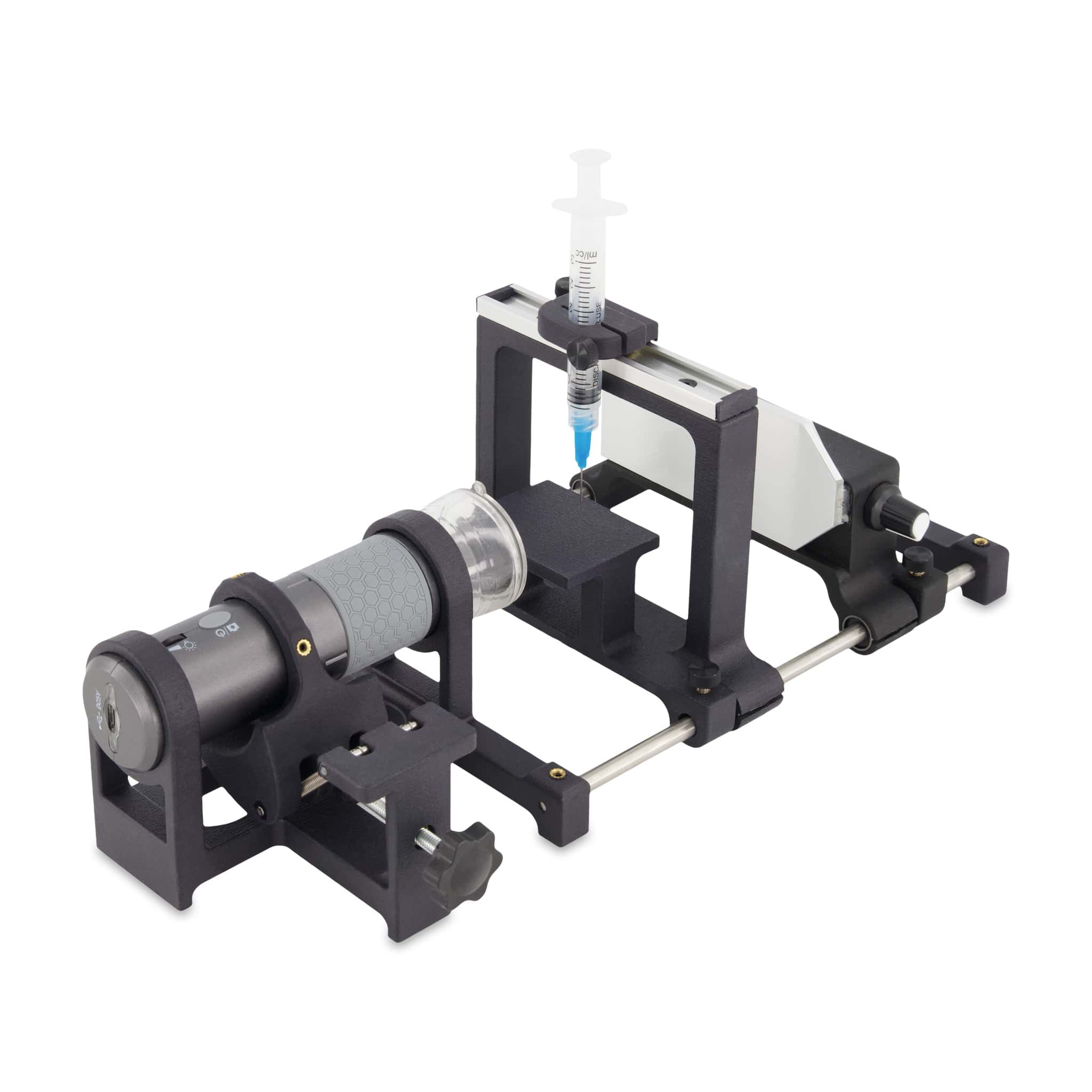
A goniometer built from the ground up for undergraduate teaching, adapted in principle from the Dropometer but not derived from it as a product. Smartphone capture was deliberately rejected: handsets introduce variability across a fleet and add maintenance overhead that a teaching lab cannot absorb, so the design uses a fixed camera with desktop processing and analysis. Housing moved from fully 3D printed to a 3D print and aluminium hybrid across three prototype iterations. Components were selected against the $1,000 per-unit ceiling, and parts were made modular and replaceable so the department services units itself.

The Origin

A three-year gap, then a hard budget number

The conversation started in 2020 and then paused for three years while the project sat on hold at the department's end.

It restarted in September 2023 with a quote request and a call the same day. What made this different from a standard sales cycle was that the department led with a constraint rather than a requirement: thirty-plus units, under $30,000, under $1,000 each. Droplet Lab's assessment was that adapting the flagship Dropometer down to that number would not produce something that survived a teaching lab. The alternative was to design a new instrument.

Three prototype iterations ran between September and December 2023. The second still needed work and a third was ordered before the department saw a demonstration. The housing moved from fully 3D printed toward a 3D print and aluminium hybrid over that period, and the software's calculation logic was rewritten to show users where on the droplet the angle had been measured. A live hardware and software demonstration in early December preceded the purchase request.

Decision Rationale

Why build rather than buy

Three options, and the department documented why two of them failed.

Option 1
$5000+

Buy commercial lab-grade goniometers

Proven instruments with established specifications and vendor support, purchased in the quantity the budget allows.

One or two units, still allocated to graduate research. The undergraduate access problem is unchanged.
Option 2
$0

Keep teaching it from the lecture slide

Continue covering surface science through theory and demonstration, as most undergraduate curricula do.

No capital cost and no change. This was the status quo the department was trying to leave.
Chosen
~$1,000

Commission a purpose-built teaching instrument

Co-develop a new instrument specified to a per-unit ceiling, in a quantity that changes the student-to-instrument ratio.

33 units for the price of one research bench, and a product that did not previously exist.

The department's procurement route tells the story better than any feature comparison. Droplet Lab was processed as a single-source purchase, meaning USF's own determination was that no competing device existed. That is unusual, and it is the reason the build option was available at all: there was nothing to compare against on price, so the constraint became the specification. The trade the department accepted in exchange was co-development risk, three prototype rounds and a delivery that ran through customs and a university IT deployment before a single student used one.

Next Step

Teaching surface science without an instrument?

If your department has a per-student budget rather than a research budget, tell us the number. The USF instrument exists because a chemistry department named a ceiling of $1,000 a unit and we designed to it instead of discounting something else. Dr Figueroa has agreed to act as a reference about how the deployment works in practice.

What changed in the teaching lab

Metric Before After
Undergraduate access Lab-grade goniometers priced for research budgets; access in practice limited to graduate students. 33 units across the ISA and NES teaching labs, rotating ~1,000 students per semester at roughly 30 students per instrument.
How the concept was taught Lecture and textbook, with surface science treated as an abstract topic. Students capture their own droplet images, run their own analysis, and interpret their own wettability results.
Instrument handling Equipment too costly to hand to an undergraduate cohort. Students manipulate the instrument freely without fear of breaking it, which is what produced the engagement gain.
Capture architecture Not applicable. Fixed camera plus desktop processing, chosen over smartphone capture for classroom robustness and lower maintenance.
Maintenance model Vendor-dependent servicing typical of benchtop instruments. Modular, replaceable parts specified so department staff service units in house.
Software Not applicable. Versioned desktop application deployed through USF IT; ML droplet detection and surface tension added after launch.

Rollout timeline

Timeline (high level)

Sept to Nov 2023: Co-development

  • Quote and requirements call, September 2023
  • Working sessions on the contact angle device through September and October
  • Prototype iterations one through three; housing moved toward a 3D print and aluminium hybrid
  • Calculation logic reworked so the analysis screen shows where the angle was measured

Dec 2023 to Jan 2024: Procurement

  • Live hardware and software demonstration, early December
  • Quote for 33 kits and licences inside the $30,000 budget
  • Purchase request submitted 14 December; supplier registration required before a PO could issue
  • Wire verification and Canadian banking format resolved with USF supplier setup through January

Feb to Mar 2024: Delivery and deployment

  • Software installer and licence keys issued February, following EV code signing of the installer
  • Hardware assembly gated on components delayed by Chinese New Year shipping
  • Shipment held at US customs on an inadequate commercial invoice description, then held again on import duty; resolved directly with the carrier
  • Software rollout across all machines in the ISA and NES teaching labs required a university IT ticket, because entering the authorisation code needed administrator rights the department did not hold

May to Jun 2024: First teaching cycle

  • Pre-class testing with two students ahead of the end-of-June cohort
  • Error 10 (droplet profile not found) appeared frequently during testing; traced to lighting and camera focus and resolved by adjusting both. Non-working images from teaching assistants were diagnosed the same way
  • First full undergraduate cohort ran end of June 2024

Nov 2024 onward: Continuous support

  • Fleet found running version 1.0.9 while 1.2.2 was current; update deployed through USF IT
  • Version 1.2.2 added surface tension measurement and a full manual contact angle method
  • ML droplet detection offered for beta and folded into the update at the department's request
  • Further software update requested July 2026, with teaching assistant feedback gathered at the end of the semester

What has been demonstrated, and what is being measured now

Test method

Sessile drop contact angle on solid samples, with surface tension added in a later software version. Students capture droplet images on the instrument and run the analysis themselves.

Sample size and operators

Roughly 1,000 undergraduates per semester in rotation across 33 instruments, sustained for over two years in two teaching lab buildings. This is a usage figure supplied by the department, not an assessed sample.

Repeatability / reproducibility

Instructor observation to date is qualitative. A multi-institution standardisation and reproducibility study covering contact angle and surface tension teaching modules is in progress for the Journal of Chemical Education, with USF participating and Dr Figueroa named as a co-author. That study is designed to produce exactly the multi-site student outcome data this field currently lacks.

Notes / assumptions

Student outcome statements on this page reflect instructor observation rather than formal assessment instruments, and are described as such. Error 10, the most common issue reported in the first teaching cycle, indicates the software cannot locate the droplet profile and is addressed by adjusting illumination and camera focus.

Outcomes to date

Measured Outcomes

~1,000 / semester

Access ratio changed

Thirty-three instruments rotate roughly 1,000 students per semester, about 30 students per unit. Competition for equipment stopped being the limit on how long a student could spend experimenting.

2+ years

Durability in a teaching environment

Continuous semester use since spring 2024, maintained in house through the modular parts design, with no return to vendor servicing.

~$30,000

Budget held

The full fleet, including software licences, landed inside the department's original figure. The per-unit ceiling was a design input from the start rather than a negotiated outcome.

Operational Outcomes

Students produced accurate results, analysed their own findings, and drew their own conclusions about material wettability. Being able to manipulate the instrument without fear of breaking it is what the department identifies as the source of the engagement gain.

Instructors have shifted toward student-led exploration and more open-ended lab formats, with curriculum planning moving away from prescriptive procedures toward independent problem-solving and data interpretation.

The deployment has become a development partnership rather than a completed sale. Software versions, ML droplet detection, surface tension measurement, and a set of POGIL-format experiments have all followed from teaching assistant and instructor feedback.

Financial Context

What $30,000 bought

Figures below are the deployment as purchased, not a modelled return.

Cost per student · ~$30 in semester one

A ~$30,000 fleet against roughly 1,000 students in the first semester works out near $30 a head, and the figure divides down every additional term the instruments stay in service. The same $30,000 buys one research-grade benchtop that undergraduates never touch.

Per-unit ceiling · under $1,000

The department named the number first. Component selection, housing material, and the decision to use a fixed camera rather than a smartphone all followed from it.

Ongoing cost · in-house maintenance

Modular replaceable parts remove the service contract line item. Software updates have been supplied on request across two years at no additional licence cost.

Costs reflect a 2023 build to a department-specified ceiling. Current pricing for the Educational instrument is available on request.

What the department said

"The informal feedback has been positive. Students achieved good results, indicating the instruments are functioning effectively and providing accurate data. More importantly, they were able to independently analyze their findings and draw their own conclusions about material wettability. Allowing them the freedom to manipulate the instrument without fear of breakage fostered a deeper understanding of its operation and likely increased their confidence in experimental techniques."
Dr Jhon J. Figueroa - Assistant Director of Teaching Laboratories, Department of Chemistry University of South Florida

A partnership still in progress

Delivered

33 custom teaching goniometers deployed across two undergraduate teaching lab buildings
Desktop software deployed through university IT, with contact angle and surface tension measurement
ML droplet detection added to the contact angle workflow

In Pilot

Latest software version with expanded surface tension capability, deployment scheduled with USF IT
Teaching assistant feedback from the current semester feeding the next round of fixes

Planned

Multi-institution standardisation and reproducibility study on contact angle and surface tension teaching modules, submitted to the Journal of Chemical Education with Dr Figueroa as a named co-author
Assessed deployment cycle to generate formal student outcome data

Next Step

Teaching surface science without an instrument?

If your department has a per-student budget rather than a research budget, tell us the number. The USF instrument exists because a chemistry department named a ceiling of $1,000 a unit and we designed to it instead of discounting something else. Dr Figueroa has agreed to act as a reference about how the deployment works in practice.