Only the outermost 5–10 angstroms decide wettability.
What lies beneath is largely irrelevant to the immediate wetting response; even monolayer contamination can rewrite the result.

Guest lecture · Surface Ventures keynote · 16 July 2026
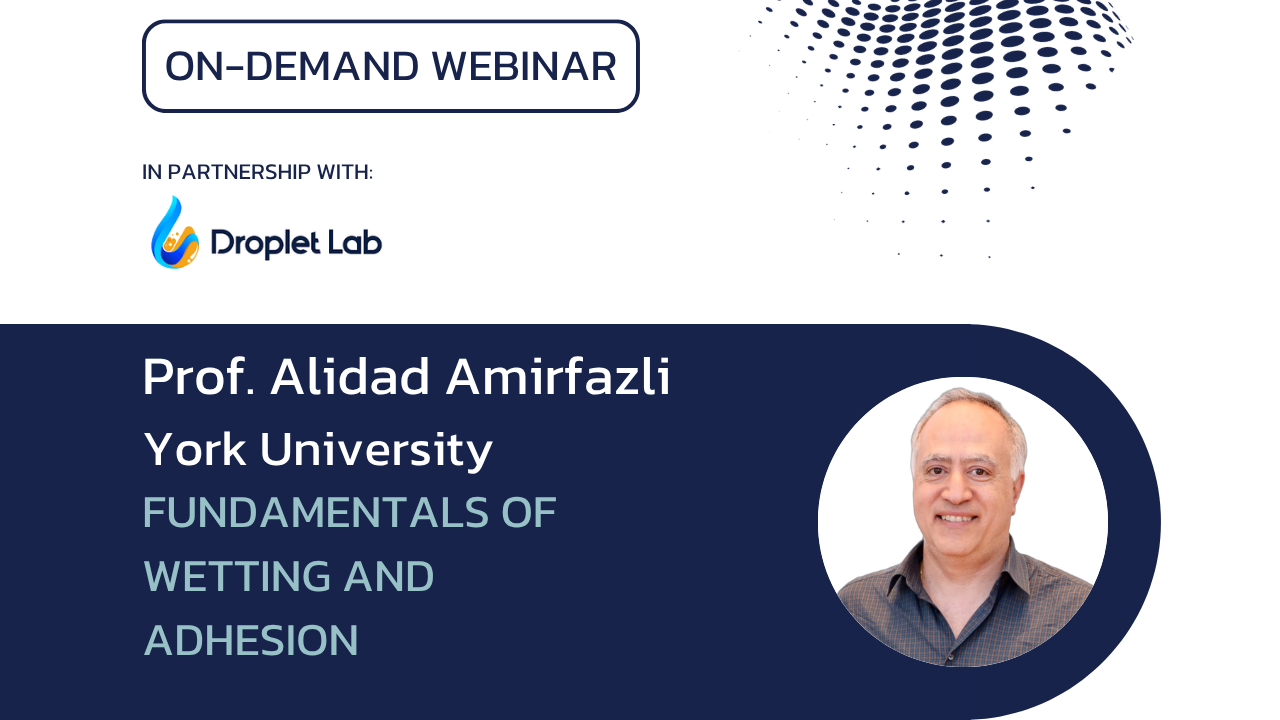
Prof. Alidad Amirfazli of York University explains what a contact angle actually tells you, what it does not, and the vocabulary the field often gets wrong.
Full replay
Watch the complete guest lecture and follow the demonstrations, models, and audience questions in context.
What lies beneath is largely irrelevant to the immediate wetting response; even monolayer contamination can rewrite the result.
Without advancing and receding angles, an apparent contact angle is neither reliably repeatable nor fully interpretable.
A surface may repel a liquid yet hold the droplet strongly. Superhydrophobicity requires both a high angle and low adhesion.
Two side-view angles provide only an estimate; the resisting force depends on the entire contact line.
At speeds above roughly 1 mm/min, hydrodynamics increasingly influence the measured angle.
Transcript lightly edited for clarity. Timestamps correspond to the recorded webinar.
00:00 · Welcome
Sam McMasterHello everyone and welcome to the 55th Surface Ventures keynote webinar. Great to see so many of you already saying hi in the chat. If you can, please tell us where you're joining from today. My name is Dr. Sam McMaster. I'm the content manager here at Surface Ventures, and we are a nonprofit organization. Our mission is to provide world-class surface and materials science education for both academia and industry.
Sam McMasterToday it is my great pleasure to introduce Professor Alidad Amirfazli of York University in Canada. Alidad is the founding chair of the Department of Mechanical Engineering at York University in Toronto, where he's currently a professor. His research interests include surface engineering, heat transfer, and fluid mechanics, particularly focusing on droplet–surface interactions, and recently integrating AI into his research. Dr. Amirfazli has contributed significantly to his field with numerous publications and patents, and has been recognized with several awards and honors.
Sam McMasterOur partner today is Droplet Lab, and we will be joined by Abhi Bhandankar, who will be speaking later in the event about Droplet Lab and showing several videos of the equipment. As we go along, please type your questions into the chat and they'll be marked for the Q&A.
04:27 · Contact angle and the contact line
Alidad AmirfazliWelcome everybody. My name is Alidad Amirfazli, and today I'm going to talk to you about the fundamentals of wetting and adhesion. This is meant to be creating a common language, a common understanding of some of the important principles in interfacial phenomena, and it should be viewed as somewhat of a primer and a bit of a thought-provoking piece. The goal here is to build a common language and also bring to your attention some of the intricacies and subtleties that one has to pay attention to, which is not normally seen within the community, unfortunately.
Alidad AmirfazliWe are going to start with contact angles. It sounds very simple but complicated. I say simple because the contact angle is the angle that you see in red, which signifies the tangent drawn to the shape of a droplet — an interface of a droplet — as it makes contact with the surface.
Alidad AmirfazliAnd one thing we have to remember is a contact angle is a thermodynamic property. This has implications: regardless of the configuration, if the surface and the liquid are fixed, the contact angle remains the same. So if I have sessile droplets on the right side of the screen, and the liquid and solid are the same as in the capillary rise configuration, then the contact angle in either system would be the same.
Alidad AmirfazliThe second vocabulary item we need is the contact line. The contact line is the bold line in the bottom figure — the perimeter where the liquid meets the solid surface. This line is common between the three phases of liquid, vapour and solid. That is where the surface tension acts and where the contact angle is measured.
Alidad AmirfazliEven if you have a puddle rather than a droplet, you would have the same contact angle where the liquid meets the surface. There might be a hydrostatic region where there's no capillary pressure — the flat part of the puddle — and that's a different ball game. But near the contact line, where hydrostatic and capillary pressure balance, the thermodynamics as expressed by the contact angle are identical.
Alidad AmirfazliNow, wetting and spreading. Wetting is defined by the value of the contact angle. In the top left quadrant, the surface changes from the black-and-white one to the coloured one, but the liquid stays the same — water in both cases. By virtue of changing the surface, the contact angle and hence the wettability changes. In the top frame the droplet has beaded up; in the bottom, water on glass, the liquid spreads.
Alidad AmirfazliThis is even more dramatic in the panel to the right, where I have the same surface. Here I have hexadecane, a light oil. It has completely spread and essentially stained the surface. But the water droplet has beaded up and is not spreading.
09:12 · Why only the top 5–10 angstroms matter
Alidad AmirfazliWhat constitutes these differences? It is the very top five to six angstroms of what that surface sees. This is really dramatized with an example from our own work from maybe twenty years ago. I have a surface where the substrate is gold over silicon. Then I've put molecules on it — everything about these molecules is the same except their terminal group. In one case the terminal group is carboxylic acid, which is hydrophilic, meaning liquid-loving. That's the very top layer in the atomic sense. The background of the surface is all methyl groups, which are hydrophobic.
Alidad AmirfazliAnd lo and behold, in the right frame, the liquid only spread over the hydrophilic parts, and it is not even spilling onto the hydrophobic background. So this is proof to always remember that it does not really matter what is underneath the top five to ten angstroms of a surface. What determines wettability is only that very top layer — what the liquid sees. That is one of my messages. If you remember it, it has quite profound consequences whether you're doing research or industrial work.
11:06 · Where wetting comes from
Alidad AmirfazliIt's quite natural to understand that wettability comes from microscopic interaction between the liquid and the substrate. In atomic simulations you can see water — these blue spheres — where they have a higher affinity. On the left side the liquid molecules interact more strongly, meaning the interaction between the blue and the yellow spheres is stronger than between blue and grey. On one side the liquid tends to spread, on the other it retracts, because we would like to reduce the surface energy. That's a consequence of the thermodynamic laws.
Alidad AmirfazliPeople have done molecular simulations. If you have molecules in the form of a blob approaching a surface and the interaction is low, you see a droplet sitting up on the surface. If the force is switched to an attractive one, the same blob starts to spread. So depending on the interactions, we can have a range of contact angles all the way from 0 to approaching 180 degrees.
12:24 · The Young equation and force balance
Alidad AmirfazliWhat is the governing equation that lets us make sense of this interaction in a formulated way? That is the famous Young equation. Essentially it says: the surface tension of the liquid, gamma-LV, multiplied by the cosine of the contact angle, should be equal to the interfacial tension of the solid–liquid subtracted from the solid–vapour.
Alidad AmirfazliThis equation can be derived from first principles and thermodynamics, but it can also be represented by a force balance. If I look at the liquid surface tension — the green arrow — and multiply by the cosine of the angle, I get the projection in the plane of the surface. That is additive to the solid–vapour surface tension and opposed by the solid–liquid part.
Alidad AmirfazliThis works in its current form for solid surfaces that are homogeneous, smooth and rigid. There are variations depending on whether any of these assumptions are relaxed. You may have heard of the Cassie–Baxter and Wenzel equations. We're not going into that depth today, but I wanted to mention it.
Alidad AmirfazliOne thing I'd like to emphasize: this is the horizontal force balance. So what happens to the vertical? I can equally take the sine of the contact angle multiplied by the interfacial tension of the liquid and get a vertical component. The assumption was that the surface is rigid. If it's rigid, that vertical force is taken as an internal stress causing an extremely small deformation that isn't noticeable.
Alidad AmirfazliBut if the solid is soft — in this work from thirty years ago, done very nicely by Chuck Extrand, a good colleague — he progressively increased the softness of the surface. Once the surface becomes quite soft, the vertical force manifests as visible deformation. This ridge, a faint ring, forms. So that force really exists, but for many industrial applications with rigid surfaces, one can ignore it.
16:19 · Advancing, receding and hysteresis
Alidad AmirfazliYou see already it's quite delicate, because it depends on small changes on the surface. This means that if you place a droplet and advance it over that surface — adding volume so the liquid front moves — or if you recede it, removing volume and dewetting the surface, the values of the angles will be different.
Alidad AmirfazliPrior to the fifties — before Zisman, through careful experimentation, showed that there are advancing and receding contact angles — people were just placing a drop on the surface at their will and making a measurement. They were measuring intermediate values between advancing and receding. So there were lots of controversies, where one person said the contact angle of water on polyethylene is X, and another placing a different droplet said no, it's Y. This showed that to get repeatable information about the surface, we have to do advancing and receding, not just place a droplet.
Alidad AmirfazliLet's add another word to our terminology. If you place a droplet without advancing or receding, we call that an apparent contact angle. That angle can be quite varied and generally is not very useful for further interpretation, because of the variability and repeatability issues. But if you advance and recede, you get repeatable values, and each has a meaning.
Alidad AmirfazliAs I increase the volume, the droplet grows. As the volume reduces, the contact line stays pinned for a while before it recedes. If we look at the red line, the radius remains fixed and only starts to go down after the contact line begins moving. Through that period, if you watch the green line, the contact line is fixed and the contact angle varies until you arrive at the receding angle.
Alidad AmirfazliContact angle hysteresis, the difference between advancing and receding, provides valuable information, because this value is representative of how rough the surface is, how heterogeneous it is, or how a liquid may react with the surface. That's the benefit of advancing and receding measurements: with a very simple measurement you get an idea of whether the surface is rough or heterogeneous, or whether there's a reaction going on, especially if the contact angle is drifting.
21:19 · Why a single drop tells you little
Alidad AmirfazliOne thing we have to remember — and that's my second message today — is that simple observation of a drop on a surface will not generally provide useful information. We have to use the proper instrumentation to do advancing and receding, get the contact angle hysteresis, and have a richer analysis of the topic that is of interest to you.
Alidad AmirfazliHysteresis has mechanical implications, because it determines not only how reproducible results are but also droplet dynamics. For a droplet on an inclined surface, advancing and receding determine at what tilt the droplet starts to move — because the difference between them measures how sticky the liquid is to the surface.
22:30 · Where hysteresis comes from
Alidad AmirfazliIf I have an ideal surface — something fictional — that is perfectly smooth and perfectly [homogeneous] at the atomic level, it doesn't matter if I go forward or backward. I see the same type of surface, the same molecular interaction. There is no change in the angle at which the liquid interface meets the solid plane.
Alidad AmirfazliBut imagine the surface is perfectly smooth and heterogeneous, meaning the chemical composition of the peach-coloured and brown-coloured patches differ. Different chemistry means a different contact angle. What happens when the liquid front arrives at the junction between these two patches? It arrives at the prescribed contact angle for the brown patch. This is where the interface has to pivot and adapt to the new reality of the interactions. During that pivoting there is a multiplicity of contact angles. This is the whole origin of the apparent contact angle I mentioned.
Alidad AmirfazliNow take the same material but with roughness, idealized as a ramp. If the liquid travels to the apex of the ramp, I have the same contact angle. But at the apex the interface has to pivot. I keep the same slope, because the interaction is unchanged, but the angle has to shift.
Alidad AmirfazliSo with these two cases I show how heterogeneity and roughness are the mechanistic origins of contact angle hysteresis. All of this can also be shown by thermodynamic analysis, and we have a couple of papers on those if you're interested.
25:46 · Repellency vs. mobility vs. superhydrophobicity
Alidad AmirfazliRepellency versus droplet mobility is a very important issue. Repellency is less discussed in the literature; droplet mobility or adhesion is discussed quite a lot; and superhydrophobicity is discussed a great deal. We have to make this distinction — that's my third message. It's very important to have the proper vocabulary.
Alidad AmirfazliRepellency means a high contact angle — how a liquid is by and large rejected from a surface. Mobility means whether the liquid, regardless of its contact angle, can move over a surface with ease, meaning by slightly tilting the surface. Mobility is related to contact angle hysteresis.
Alidad AmirfazliIf I have repellency and mobility together, then I have superhydrophobicity. And repellency and mobility can be mutually exclusive. In the top video the contact angle is low, but I slightly tilt the surface and the droplet moves right away. So it's not a repellent surface, but the drop is very mobile. In the bottom video the surface is very repellent and the drop is also very mobile. That we term a superhydrophobic surface.
29:42 · Measurement methods
Alidad AmirfazliCommon methods are the sessile drop, to get advancing and receding contact angles; the tilted plate method, which is quite popular; and the Wilhelmy plate method, where a surface is plunged into a pool of liquid. The last is not very favourable these days, because contamination in a pool of liquid is an issue.
Alidad AmirfazliMy fourth message: not all measurements made by these different methods are created equal, and that very much depends on the application.
Alidad AmirfazliIn the tilted plate method you place a droplet on a horizontal surface, tilt it, and observe at what plate angle the droplet starts to move. Through the recorded image you get the upstream and downstream angles the droplet makes with the surface, representative of advancing and receding. With the Wilhelmy plate, you plunge and withdraw the surface, and from the force measurement you back out the contact angle. In either case you can measure hysteresis, which indicates adhesion or droplet dynamics, and is susceptible to roughness, heterogeneity, reaction, or softness.
31:02 · Why droplet shedding matters
Alidad AmirfazliThere are many applications where you want a droplet to move over a surface. Think of a condenser plate where droplets have condensed — you want them to shed so the surface cleans up and you get renucleation, giving dropwise rather than filmwise condensation. Or you may want droplets of pesticide to stay on a leaf rather than slip away under gravity. Or staining on windows, self-cleaning surfaces. There are open microfluidic systems where people use electrostatic forces to drive a droplet, fuel cells in the energy sector, or systems that use shear flow.
Alidad AmirfazliBut this is the kicker: depending on what your driving force is, you may have different values for the contact angle hysteresis, and therefore the measurement you make, and the tool you use, start to make a difference.
33:01 · Droplet adhesion is a 3D phenomenon
Alidad AmirfazliIf a droplet starts to move on an inclined surface, or is exposed to shearing airflow, the ultimate test is how the adhesion force interacts with the external force. If adhesion is stronger, the droplet isn't going anywhere. If the external force is stronger, it moves.
Alidad AmirfazliWe have to understand that adhesion is a 3D phenomenon. That's my fifth message. A lot of the time when people look at the simplified formulas, they think it's 2D and that they just need contact angles at two points to get the adhesion force. It's good for estimation, but it's not the whole story.
Alidad AmirfazliTake a droplet with an elliptical contact line. We have the surface tension and the contact angle theta. Projecting into the plane of movement gives gamma-xy. But if the direction of movement is along the x-axis, to understand the resistive force I have to do a secondary projection against this omega angle, which depends on the slope of the contact line. To get the full adhesion force I have to integrate these two projections over the entire length of the contact line.
Alidad AmirfazliSo adhesion force depends on the surface tension, the variation of the contact angle along the contact line, and the length and slope of the contact line. In other words, the shape matters.
Alidad AmirfazliOn technical-grade surfaces, droplets may have any of these shapes seen from above. It might be perfectly circular, as in the bottom right, or a peculiar shape based on the finish of the surface. It doesn't matter whether it's driven by gravity or by shearing airflow — in this video you blow on the droplet and it starts to move.
35:49 · Simplified contact line shapes
Alidad AmirfazliLots of people have recognized this, but to avoid the complexity they simplify the contact line shape: close my eyes and call it a circle, which is true for an ideal surface, or a sausage, or an ellipse, or a double ellipse. Sometimes they have also used incorrect experimental procedure.
Alidad AmirfazliOne of the most common equations in the literature relates the tilting angle alpha to the droplet's maximum and minimum — advancing and receding — contact angles. The surface tension is there, the sliding angle, multiplied by mg as the driving force. You have R, representative of the characteristic length of the droplet.
37:02 · The fudge factor
Alidad AmirfazliBut what is this k? This k is a fudge factor that captures all the variation of the contact angle along the contact line, and the shape and slope and length of the contact line, all together in one empirical factor usually found by calibration. It is a shortcut to measuring two angles from a side view. If you have calibrated and understood what this k might be, you can find the sliding angle for a system.
Alidad AmirfazliIt's my academic joke that I call it the fudge factor of graduation — meaning the student wants to graduate at some point and says, okay, I'll take this k, make the calibration, and get on with my life.
38:39 · Capturing the whole contact line
Alidad AmirfazliThis is something I did when I was at the University of Alberta. To capture all the variability of the contact angle around the contact line and the shape of the contact line, you should be able to look at the droplet from the top and the side, and have the camera go around the droplet measuring the contact angle all along the contact line, so the integral can be done.
Alidad AmirfazliHere you see how, from the leading part at over 120 degrees, values change to the trailing part at around 30 degrees, as the azimuthal angle goes around the contact line. There are ways of reconstructing this contact line so you don't need an assumed shape — essentially through Fourier transforms. The general formulation exists only if you have the appropriate instrumentation. Otherwise we can use the regular instrumentation if you know that k value.
39:37 · Matching the method to the application
Alidad AmirfazliConsider a fuel cell: a droplet is generated, grows, and the surface is tilted. As it grows, gravity becomes more dominant and the droplet moves. Now consider protein crystal growth: you place the droplet and flip the surface, and you want the droplet to stay, because that's how you create your crystals. These are two different applications where naive use of the tilted plate method will not be useful.
Alidad AmirfazliTo demonstrate that, we do two different types of measurement and compare them with the sessile drop, to understand when results from different instruments are interchangeable. A lot of labs say, well, I only have the sessile drop method, I'm happy. I want to show that it may not be sufficient. Others have the tilted plate method and say that's already good. In applications you're going to see that the sessile drop method is demanded.
Alidad AmirfazliSo: is the minimum and maximum seen in a tilted plate always the same as the advancing and receding seen using a sessile droplet? We did two types of experiment. One the traditional way, placing the droplet and tilting the plate. The other, pre-tilting the surface and adding different volumes to see when the droplet starts to slide. We used industrial-grade rough surfaces and an idealistic surface — Teflon coated over a very smooth silicon wafer with roughness of about 1 nanometre.
43:03 · The result
Alidad AmirfazliThis is the kicker, and it's a very important result. When we place the droplet on an already inclined surface, the sliding angle, especially for smaller droplets, is vastly different than when we place a droplet and then incline it. And this is for the superhydrophobic textured surface.
Alidad AmirfazliWhy? The top view gives the insight. The shape of the droplets resulting from different ways of doing the experiment, using the same measurement tool, is different. And the shape of the contact line determines the adhesion force and hence when it slides. If you had a fuel cell application, doing it the traditional way gives you a premature value for sliding, and you mess up the flooding calculation for your fuel cell membrane.
Alidad AmirfazliBut on a nearly ideal surface, like the Teflon-coated silicon wafer, considering the error bars it doesn't make any difference. That makes sense: on an ideal surface the contact line is always a circle.
44:18 · The receding angle is the sensitive one
Alidad AmirfazliThis plot is important, because it demonstrates that especially the receding angle is very sensitive to the type of measurement we do. In the top table, for the non-ideal AKD surface, the receding or minimum angle is 86 degrees. But in the sessile drop it's less than 10 degrees. So I cannot do sessile drop measurements if my application involves an inclined surface, and vice versa. If my surface is idealized, within the range of errors it really doesn't matter which system you use.
Alidad AmirfazliThis is a confusion in the literature, where people always think about the equivalency of methods, because they are thinking about an ideal surface. On technical-grade surfaces one has to be very careful.
Alidad AmirfazliAnother example is shedding of a droplet exposed to airflow, which you see in icing applications. As we ramp up the air velocity the droplet oscillates and starts to move. Advancing and receding contact angles form before the droplet moves, and that determines the level of adhesion. There's a Langmuir paper from 2009 in my name you can look at. Because the external driving force is different, the way we measure matters. If I use the tilted plate method here I will not get the useful information required. I have to use the sessile droplet method.
Alidad AmirfazliSo: what is my application, what is the driving force — that determines which measurement method is most useful. Laboratories may, depending on what they're doing, need more than one method.
48:11 · Dynamic contact angles
Alidad AmirfazliThe last point is dynamic contact angles, which are very different from what I've talked about so far. Contact angle is a thermodynamic property, and by advancing and receding we always have to work at a very low rate — less than really 1 millimetre per minute. Above that we call it a high rate, and you're not dealing with thermodynamics anymore. You're dealing with hydrodynamics plus thermodynamics. These fluid mechanics effects remove the thermodynamic laws that gave us Young's equation.
Alidad AmirfazliIn this old but very credible work, repeated a couple of times, at a low receding or advancing rate the values equal the equilibrium-type contact angles. Advancing and receding are equilibrium states as well — metastable, not absolute. When you go to advancing angles affected by fluid mechanics you go beyond the advancing angle, so you get a larger angle; and when receding, hydrodynamic effects put your angle below the receding angle measured at low rates.
Alidad AmirfazliThe message is that dynamic contact angle is not necessarily a thermodynamic property. It's a geometric condition depending on the fluid mechanics, which means it depends on velocity.
50:51 · The Kistler model
Alidad AmirfazliThe models that exist, like the Kistler model used in simulation, rarely consider the pinning effect I emphasized — that pivoting and variation. They model the system so that it just creates a jump, which gives some problems. If I zoom in, you have a very narrow flat range, and that's the low-rate contact angle. So remember, the Kistler model does not capture that pivoting or the values of the apparent contact angle. In start-up flows this is very important.
Alidad AmirfazliThis is nice work from Blake, where by changing viscosity at a given velocity you get different contact angles — again an indication that this is not a thermodynamically significant contact angle. With that, there are a couple of slides with references you might find useful. Thank you so very much for your attention.
54:05 · Droplet Lab
Abhi BhandankarHi everyone, I'm Abhi. I'm the owner and CEO at Droplet Lab. Droplet Lab [came out of] Professor Alidad Amirfazli's surface engineering lab at York University. He's one of the leading scientists in surface science, with over 250 publications.
Abhi Bhandankar[The Dropometer] makes contact angle, surface tension, surface energy and sliding angle measurements — both static and dynamic — user-friendly and portable, without compromising on accuracy. [It's used by] organizations ranging from Fortune 500 companies, commercial space companies, Ivy League universities and government research labs.
Abhi BhandankarThe instrument's accuracy is independently validated in peer-reviewed literature. Across 2,049 synthetic drops with known ground truth, spanning 10 to 162 degrees, the algorithm's average error is 0.01%, published in Review of Scientific Instruments. Separately, we benchmarked against a KRÜSS DSA100E — the reference instrument in the space — on five real surfaces, imaging the same drop simultaneously from perpendicular axes. Static and advancing/receding angles agreed. For surface tension the average error is 0.001% over 750 synthetic drops, published in Colloids and Surfaces A.
Abhi BhandankarWhile matching that level of accuracy, the Dropometer does it at roughly one-sixth the cost of a benchtop goniometer like the DSA100E. Same rigor, very different price point.
Abhi BhandankarBefore the live measurement, here is how fast the instrument comes together: base plate, phone mount, syringe holder, sample stage, and the LED backlight — ready in under 30 seconds. All components lock in with magnetic switches, so no specialized training is required.
55:50 · Instrument demonstration
DemonstratorWe have different types of algorithms to measure — either polynomial, which is purely geometrical, or Young–Laplace, which takes the physics into consideration, the pressure inside the droplet and how it's deformed by gravity. From the shape, it connects the physics to it. Now we're going to calibrate the needle.
Alidad AmirfazliSo you calibrate it if you use Young–Laplace or polynomial?
DemonstratorOnly for Young–Laplace, because it depends on physics and geometry. We need to move from the pixel domain to the physical domain, millimetres. On polynomial it's not activated. Then we draw around the needle and press calibrate. If it's green, we're doing good.
Alidad AmirfazliOh, nice. So you don't need to be so precise?
DemonstratorNot at all. Just around it, in the proximity, and it captures it. Then we go to the surface and move these indicators to find the baseline, and click calculate. Now it's solving the Young–Laplace equation on that droplet shape.
Alidad AmirfazliI noticed they mentioned a new AI version where you don't need to do even this step.
Alidad AmirfazliSo now you've got the contact angles from left and right, using Laplace.
DemonstratorWith Young–Laplace it averages right and left. With the polynomial one it gives right and left separately.
Alidad AmirfazliYou did the static contact angle measurement, but a lot of standards — and researchers and people in industry — are interested in advancing and receding contact angles. Can you do that too?
DemonstratorOf course. In the same app, on the same project, we set the camera again and do the dynamic contact angle measurement, all using the exact same setup. This time we use a feature called multi-snap. I choose how many images to capture within what duration — let's say 30 images within 20 seconds. Once I hit capture it starts taking images, and I dispense, increasing the size so it moves outwards on the surface. That's advancing.
DemonstratorNow I have an image set. I can work on one of them and it calculates the rest.
Alidad AmirfazliSo you take the first one, it treats the rest, and you don't need to do anything — it gives you all the angles.
DemonstratorExactly. Since I have the needle inside the droplet, I can't really use Young–Laplace — it depends on the whole droplet profile. Polynomial focuses on the contact line region only, so I can do it with the needle in or out.
Alidad AmirfazliAll these measurements are available through a spreadsheet that gets exported when you have a series of images?
DemonstratorYes, that's true.
Alidad AmirfazliFor your measurements you really don't need connectivity to the internet, unless you want to send the information somewhere else. Otherwise everything is done locally?
DemonstratorEverything is done offline, just on the app. All the algorithms are built into the app, so I'm doing everything offline unless I want to upload to a cloud so I can access it from everywhere. Then that part would require the internet.
Alidad AmirfazliSo we can do all these contact angle measurements to understand wettability, but we can also get the solid surface energy. Depending on which method we use — Neumann's method, Fowkes' method, or the van Oss–Good method — we may need a number of different liquids. You select the method, fill the syringes with different liquids, make the measurements on the same solid surface, and you get the solid surface energy.
62:46 · Audience Q&A
Sam McMasterOur first is more of a comment, from Ernie, who said: my interest is to identify the most favourable surface finish for both iron and aluminium in an automotive intake port on a cylinder head that would resist fuel droplet adhesion, instead of the fuel moving through the port suspended in air as an air/fuel mixture.
Alidad AmirfazliThis is a fairly complex question, so I encourage you, Ernie, to get in touch with me for more discussion. A few things come into play. Temperature is one — this being a cylinder head, that affects the contact angle through changes in surface tension. The finish of the surface, and the atmospheric condition. A lot of the time the contact angle is a manifestation of the Laplace pressure that determines curvature, and in an internal combustion engine where pressures are higher than atmospheric, that's another factor.
Sam McMasterOur next question is from Alexander, who says: current goniometers are extremely imprecise instruments, and on superhydrophobic surfaces the error is very large, as in that Robin Ras paper. So they provide meaningless information. What are the best alternatives? Also, hysteresis is an indirect measure of plastron in underwater superhydrophobicity.
Alidad AmirfazliI'm quite familiar with the paper Alexander is mentioning, and I would sometimes take issue with what has been mentioned in it. It's true that for superhydrophobic surfaces the resolution of the imaging, the technique, the lighting all come into play, and sensitivity to where the cutoff line is becomes important. But with modern techniques and modern cameras these issues are less dramatic than is made out in that paper, I would argue. Robin is a good friend and we have had discussions on this, and that's what makes the science interesting.
Alidad AmirfazliFor indirect ways, it's the Wilhelmy plate, because there you measure force rather than direct optical observation. But one has to be careful about contamination with the large pool volumes. I would not write off the sessile drop method or a properly done tilted plate method for superhydrophobic surfaces.
Sam McMasterManglesh asks: can highly soft PDMS substrates — mixing ratio greater than 30:1 — be made superhydrophobic? I tried a commercial spray coating, but because the substrate is extremely soft the coating particles penetrate into the PDMS instead of forming the required rough micro/nanostructure.
Alidad AmirfazliFor superhydrophobicity you need proper chemistry, which is generally hydrophobic chemistry, and proper roughness. What I suggest: you may want to provide a more hydrophobic coating first, because a partially cured PDMS surface — which is what you get at 30:1 rather than 10:1 — tends to express more hydrophilic parts. Then, the particles in commercial sprays are generally fine, meant to create undulations over a solid surface. Because your surface is soft and the particles sink, you may want to use functionalized silica particles that are larger, in the micrometre range.
Sam McMasterOne from Yuliia, who asks: do you have solutions for adhesion measurements at high temperatures?
Alidad AmirfazliIt depends how high a temperature we are talking about, because 60 or 70 degrees is one thing versus 500 degrees, which is a different ballgame. Reach out to me and we can chat about that.
Sam McMasterOur final question is from Mete: any idea which fast advancing angle provides prediction power for drop impact experiments? It seems not to matter for max spreading, but affects the splashing threshold.
Alidad AmirfazliIf you're interested in the dynamic contact angle of a process such as droplet impact, there are models that give some estimation of the velocity of the spreading lamella. Take that velocity and, as a first approximation, put it in the Kistler model and get an estimation of what the contact angle should be based on the velocity you estimated. That builds on a low-rate measurement you have already done.
72:41 · Close
Sam McMasterThat is all the questions we can take today. Thank you all very much, and thank you to Alidad and Abhi for their presentations. If you're interested in the equipment from Droplet Lab, do take a look at their website. If you're interested in more of these keynote webinars from Surface Ventures, please check our website as well. Thank you very much.
Editorial notes
Square brackets mark corrections to sentences that lacked a main verb as spoken, or to a verbal slip where the meaning was clearly inverted.
The accuracy figures in the Droplet Lab segment have been corrected against the published papers: Review of Scientific Instruments (2018), DOI 10.1063/1.5022370, and Colloids and Surfaces A (2017), DOI 10.1016/j.colsurfa.2017.08.019.
The goniometry uncertainty paper discussed in the Q&A is Vuckovac et al., Soft Matter 2019, 15, 7089–7096.
A. J. B. MilneA. Amirfazli; Drop Shedding by Shear Flow for Hydrophilic to Superhydrophobic Surfaces†. Langmuir 15 December 2009; 25 (24): 14155–14164.
E. Pierce, F.J. Carmona, A. Amirfazli, Understanding of sliding and contact angle results in tilted plate experiments, Colloids and Surfaces A: Physicochemical and Engineering Aspects, Volume 323, Issues 1–3, 2008, Pages 73-82, ISSN 0927-7757,
Maja VuckovacMika LatikkaKai LiuTommi HuhtamäkiRobin H. A. Ras; Uncertainties in contact angle goniometry. Soft Matter 2019; 15 (35): 7089–7096.
Neumann, David, Zuo (eds.). Applied Surface Thermodynamics, 2nd ed. CRC Press (2010)
Pierre-Gilles Gennes , Françoise Brochard-Wyart , David Quéré. Capillarity and Wetting Phenomena: Drops, Bubbles, Pearls, Waves. Springer (2004)
H. ChenJesus L. Muros-CobosA. Amirfazli; Contact angle measurement with a smartphone. Rev. Sci. Instrum. 1 March 2018; 89 (3): 035117.
H. Chen, Jesus L. Muros-Cobos, Juan A. Holgado-Terriza, A. Amirfazli, Surface tension measurement with a smartphone using a pendant drop, Colloids and Surfaces A: Physicochemical and Engineering Aspects, Volume 533, 2017, Pages 213-217, ISSN 0927-7757,
Slides © A. Amirfazli. Transcript © Droplet Smart Tech Inc.