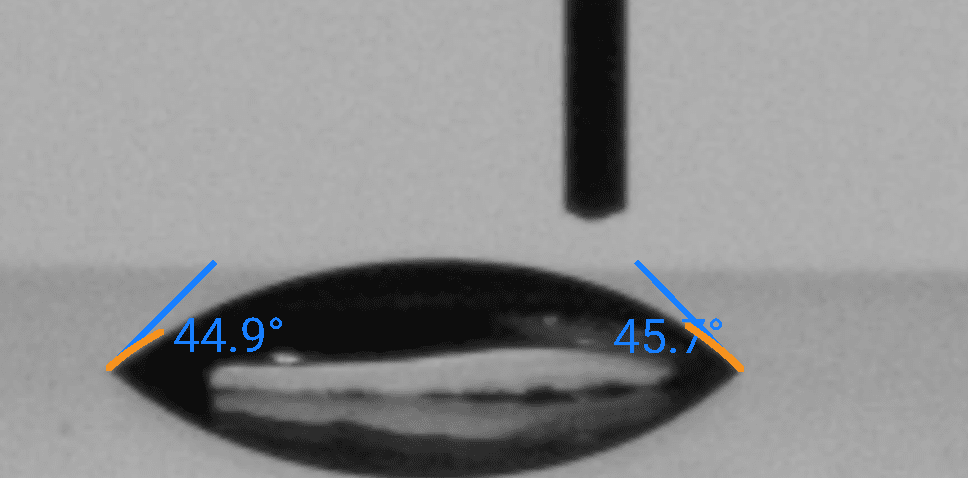
Self-Cleaning and Anti-Soiling Coating Validation, Including Solar PV
Quantify whether a self-cleaning or anti-soiling coating is actually working, superhydrophobic or superhydrophilic, on glass, PV modules, and outdoor-exposed surfaces, before soiling losses or a failed coating batch cost you performance.
Who this is for: PV module and coating R&D teams, solar asset O&M and reliability engineers, architectural glass and building-facade manufacturers, and QA/QC teams verifying anti-soiling coating performance before shipment or field deployment.
Positioning: Dropometer does not replace field soiling-loss measurement (power-output monitoring, gravimetric dust-loading tests) or accelerated weathering and durability testing. It adds a fast, quantitative wettability screen, contact angle, hysteresis, and roll-off angle, for both major self-cleaning mechanisms, so a coating batch that won't actually self-clean gets caught before it ships or gets installed.
Droplet Lab Team
Droplet Lab builds precision instruments and software for surface science measurement, specialising in contact angle analysis and surface tension characterisation. Used by researchers across materials science, pharmaceuticals, coatings, and advanced manufacturing, Droplet Lab's Dropometer has contributed to studies published in peer-reviewed journals including Advanced Functional Materials (Impact Factor 19). The team combines instrument engineering with deep domain knowledge in wettability science with a focus on practical accuracy.

The Cost Of Getting It Wrong
10×
higher hidden cost vs. visible scrap cost: rework, re-inspection, downtime, and warranty claims are rarely captured
Lean Six Sigma research consensus
$1 → $10
upstream prevention typically saves $10 in internal rework and up to $100 in external warranty and recall costs, for the specific failure modes an upstream screen actually catches
COPQ prevention-to-failure ratio
Sources: ASQ, Learn Lean Sigma, Fabrico COPQ Guide 2026. Figures are industry-wide benchmarks, not Droplet Lab claims. On this page specifically, soiling is not a marginal cost: the IEA's Photovoltaic Power Systems Programme reports that soiling losses cost the global solar industry billions of dollars per year, an industry-specific figure worth knowing on top of the generic COPQ benchmarks above. This instrument verifies coating wettability well; it does not measure field soiling loss, power-output impact, or long-term photocatalytic activity directly, all of which need their own field data to close the loop.
What this workflow does and what it does not
Quick technical reference for coating R&D, PV reliability, and QA teams evaluating fit before reading further.
Evidence Box (QC-Ready)
A self-cleaning or anti-soiling coating can pass an initial application check while not actually achieving the wetting behavior it needs to shed dust and soiling, especially on solar PV modules and outdoor glass, resulting in field soiling losses discovered only after a power-output drop or a maintenance visit.
A quantitative pre-shipment and R&D screening tool covering both major self-cleaning mechanisms, superhydrophobic (lotus-effect) and superhydrophilic (photocatalytic), measuring the wetting behavior that predicts field self-cleaning performance.
Contact angle, interpreted in the direction appropriate to the coating's self-cleaning mechanism
Contact angle hysteresis and sliding/roll-off angle, primarily relevant to superhydrophobic coatings
Surface energy trend data
Spot variability and zone mapping across the coated surface
Correlate PASS/MONITOR/FAIL thresholds against your own field soiling-loss or power-output data, set separately for superhydrophobic and superhydrophilic mechanisms, since the two target opposite contact-angle behavior.
DI water as the probe liquid
Fixed droplet volume and timepoint
Minimum 5 replicates per zone
Record which self-cleaning mechanism the coating uses alongside every reading
Wetting behavior predicts self-cleaning tendency, it does not measure actual dust adhesion, particle-size-specific soiling behavior, or long-term photocatalytic activity under real UV exposure.
What are you trying to solve?
The Dropometer serves four roles across a self-cleaning and anti-soiling validation program. Each has a different primary risk.
Coating R&D (Mechanism Selection)
Choosing between a superhydrophobic and a superhydrophilic/photocatalytic approach, and screening candidate formulations for actual self-cleaning performance before field trials.
PV / Solar O&M Reliability Engineer
Tracking anti-soiling coating degradation on installed modules over time, and correlating that decline with power-output loss.
QA / QC Manager
Needing a numeric release gate on coated glass or panels before shipment, rather than a visual check or a marketing claim from the coating supplier.
Compliance / Customer Documentation
Requiring documented, defensible evidence of anti-soiling coating performance for customer acceptance, NCR responses, or supplier audits.
Is this the right screen for your process?
This is not a universal solution. Check the conditions below before investing further time.
Good fit if
Less relevant if
Two Self-Cleaning Mechanisms, Two Opposite Contact-Angle Targets
The single most consequential mistake in anti-soiling verification is applying the wrong mechanism's threshold.
Self-cleaning and anti-soiling coatings work through one of two fundamentally different, and fundamentally opposite, mechanisms. Superhydrophobic (lotus-effect) coatings push contact angle high and roll-off angle low, water beads up and rolls off the surface, carrying loose dust and dirt with it. Superhydrophilic, typically photocatalytic TiO2-based, coatings do the opposite: they push contact angle down toward near-zero, so water spreads into a continuous sheet that flows across the surface and washes contaminants away, often paired with UV-driven photocatalytic breakdown of organic soiling.
Both mechanisms are real, both are used commercially on solar PV modules and architectural glass, and both are backed by peer-reviewed research. That's exactly why a verification program that applies a single "higher contact angle is better" rule across every coating will get half its calls wrong: a superhydrophilic coating performing exactly as designed will look like a failure under a hydrophobic-coating threshold, and a degrading superhydrophobic coating can look fine under a hydrophilic-coating threshold. The soiling losses at stake aren't trivial, the IEA's Photovoltaic Power Systems Programme reports soiling costs the global solar industry billions of dollars annually, so getting the interpretation direction right matters well beyond a single coating batch.
This workflow measures contact angle, hysteresis, and roll-off angle, then interprets the result against the specific mechanism the coating is built on, not a generic threshold. The honest limit: wetting behavior predicts self-cleaning tendency, it doesn't measure actual field soiling loss, which also depends on dust composition, rainfall, tilt angle, and cleaning schedule.
What Does an Anti-Soiling Coating Failure Actually Look Like?
A coating that looked fine at installation isn't preventing dust accumulation in the field, power output is declining faster than expected, or coating performance is inconsistent across a batch of panels or glass, without a quantitative way to tell whether the coating itself has failed, or whether it was never verified against the right threshold in the first place.
Root Causes
Why:
- Curing conditions, coating thickness, or formulation variation shift the achieved contact angle away from the target for that coating's mechanism.
How to detect:
- Contact angle, hysteresis, or roll-off angle deviates from your mechanism-specific baseline
Corrective action:
- Recalibrate the formulation, application process, or cure conditions against your qualified recipe
Why:
- Applying a "higher contact angle is better" threshold to a superhydrophilic photocatalytic coating, or the reverse, produces a false PASS or a false FAIL, independent of the coating's actual condition.
How to detect:
- A coating gets accepted or rejected using a threshold built for the other mechanism
Corrective action:
- Confirm and record which self-cleaning mechanism is in play before setting or applying any PASS/FAIL threshold
Why:
- Photocatalytic self-cleaning depends on ongoing UV activation and can degrade from surface fouling or coating wear, a distinct failure mode from a simple wettability drift.
How to detect:
- Contact angle rises over time on a coating that should stay near-zero under continued UV exposure
Corrective action:
- Verify UV exposure history and coating integrity specifically, not just a single wettability reading
Why:
- UV exposure, wind-blown particle abrasion, and general weathering degrade either coating mechanism over an outdoor service life.
How to detect:
- Gradual decline in coating performance tracked over a scheduled field-monitoring interval
Corrective action:
- Implement a field verification interval tied to your own measured degradation rate, not a fixed calendar guess
Why:
- Field soiling loss also depends on dust particle size and composition, rainfall frequency, panel tilt angle, and mechanical cleaning schedule, none of which a wettability measurement captures directly.
How to detect:
- Wetting measurements are within baseline but field power-output soiling loss is still high
Corrective action:
- Route the investigation to site-specific soiling monitoring (gravimetric dust load, power-output ratio) and mechanical or O&M cleaning practices rather than continuing to iterate on coating verification alone
Not sure which root cause applies to your process?
A surface science specialist can review your soiling or field-performance history and help you identify whether a wettability screen would add a useful upstream gate.
Building a defensible anti-soiling qualification record
Surface readiness measurement produces the type of numeric, traceable output that a subjective visual "water still beads a little" or "looks self-cleaning" judgment cannot. If your quality system requires documented evidence of process control for NCR responses, CAPA files, incoming inspection records, or customer audits, contact angle, hysteresis, and roll-off data provide that evidence in a format your QA documentation already requires.
Audit trail
Numeric contact angle, hysteresis, and roll-off values with replicate spread, timestamps, coating mechanism, and batch or panel identification; replacing subjective self-cleaning impressions with defensible numeric logs.
CAPA evidence
When a power-output decline or customer complaint triggers a Corrective and Preventive Action file, wetting data from before and after a formulation or application-process change provide quantitative evidence of the mechanism involved, not anecdotal description.
NCR documentation
Non-conformance reports that include numeric wetting data allow you to assign root cause to formulation drift, mechanism-threshold confusion, photocatalytic activity loss, or weathering with evidence, not inference.
Supplier qualification
Incoming coated glass or panel lot inspection using contact angle, hysteresis, and roll-off provides a numeric acceptance criterion for supplier qualification, independent of the supplier's own marketing claims.
Process control records
Contact angle and roll-off trend logs by coating batch and mechanism demonstrate statistical process control at the pre-shipment step; relevant to Six Sigma, SPC, and DMAIC programs targeting soiling-related field complaints.
Anti-soiling qualification record
A pre-shipment or field-monitoring wetting check gives R&D and QA a numeric basis for release or re-qualification, instead of finding out about a failed coating only after a power-output drop or customer complaint.
What to Measure
Contact angle (mechanism-dependent)
Why it matters: The primary indicator of surface wetting state, but the target direction depends entirely on which self-cleaning mechanism is in play.
How to interpret: For a superhydrophobic coating, a higher angle indicates stronger performance. For a superhydrophilic or photocatalytic coating, a very low, near-zero angle indicates stronger performance.
When it is not enough: Meaningless without first confirming which mechanism the coating uses.
Contact angle hysteresis and sliding/roll-off angle
Why it matters: Measures whether water actually rolls off the surface carrying dust with it, or just beads and sits, the mechanism specific to superhydrophobic self-cleaning.
How to interpret: Lower hysteresis and roll-off angle indicate better self-cleaning for a superhydrophobic coating.
When it is not enough: Not a relevant metric for a superhydrophilic or photocatalytic coating, which self-cleans through a sheeting water flow, not a roll-off mechanism.
Surface energy trend
Why it matters: Tracks a coating's drift over time or across batches, relevant to both self-cleaning mechanisms.
How to interpret: Compare against your own qualified baseline for that specific coating mechanism, not a generic published number.
When it is not enough: A snapshot reading; needs correlation with your own field soiling-loss or power-output data to be meaningful.
Spot variability (zone mapping)
Why it matters: Detects uneven coating application across a panel or glass sheet that a single-point reading would miss.
How to interpret: High variability flags an application-process issue worth investigating.
When it is not enough: Flags where a problem exists without confirming which specific cause is responsible.
Validated Measurement Approach
Independent benchmarking and publication-based validation references.
Benchmark Validation
Dropometer contact angle and pendant-drop surface tension methods have been benchmarked against KRÜSS DSA100E reference measurements. The instrument is referenced in peer-reviewed journals including Bioactive Materials (Impact Factor 20) and Advanced Functional Materials (Impact Factor 19).
See peer-reviewed validationPublication Evidence
Our instruments are referenced in peer-reviewed journals, theses, and conference publications.
Browse citationsHow Dropometer Fits Your Workflow
Dropometer is best used to confirm a coating's self-cleaning mechanism first, then build a mechanism-specific baseline to gate pre-shipment release and field re-qualification against.
Confirm the coating mechanism
Identify whether the coating is superhydrophobic or superhydrophilic/photocatalytic before setting any threshold: This determines which direction "better" points for every subsequent measurement
Establish a mechanism-specific baseline
Measure contact angle, hysteresis, and roll-off (for a superhydrophobic coating) or contact angle alone (for a superhydrophilic coating) on a known-good, freshly applied sample: This baseline is what every future batch or field reading gets compared against
Set a pre-shipment or field release gate
Verify against the mechanism-specific baseline before shipment, or at a scheduled field-monitoring interval: PASS: within baseline band → release or continue field service MONITOR: borderline result → re-verify or schedule closer follow-up FAIL: out of band → hold, recoat, or flag for field investigation
Correlate to field outcomes
Link wetting data to your own soiling-loss or power-output measurements: This calibration is what turns a wetting reading into a defensible, mechanism-specific gate
We completed our gage R&R study on the unit and it performed very well.
Brandon Barbee
Corporate Quality Engineer - Zeus Industries - Polymer Manufacturing
Download the Self-Cleaning Coating Verification SOP Template
An editable SOP template your team can adapt for your coating mechanism, substrate, and application process. Includes measurement protocol, mechanism-confirmation guidance, gate-setting guidance, and a QC log format ready for your documentation system.
Sample Coating Verification: Superhydrophobic vs. Superhydrophilic Mechanisms
Representative output format. Values are illustrative, not a universal specification.
Dropometer contact angle, hysteresis, and roll-off angle measurement on coated glass or PV cover glass. This is the type of output used to decide whether a coating batch releases or a field panel needs re-qualification.
Sample Coating Verification: Superhydrophobic vs. Superhydrophilic Mechanisms
| Sample | Contact Angle (°) | Roll-Off Angle (°) | Mechanism | Status |
|---|---|---|---|---|
| Superhydrophobic coating, fresh (baseline) | 152° | 8° | Superhydrophobic | PASS |
| Superhydrophobic coating, 12 months field exposure | 121° | 24° | Superhydrophobic | MONITOR — confirm against field soiling data |
| Superhydrophilic coating, fresh (baseline) | 4° | n/a | Superhydrophilic | PASS |
| Superhydrophilic coating, 12 months field exposure | 22° | n/a | Superhydrophilic | MONITOR — check photocatalytic activity and UV exposure history |
The two fresh coatings establish opposite-direction baselines, a near-180 degree angle for the superhydrophobic sample, a near-zero angle for the superhydrophilic sample, both correctly PASS at their own baseline. After 12 months of field exposure, the superhydrophobic coating's contact angle has dropped and roll-off angle has risen, a real self-cleaning-performance decline. The superhydrophilic coating's contact angle has risen from near-zero, also a real decline, even though the number itself is far smaller in absolute terms and far lower than the hydrophobic sample's number throughout. Reading either coating against the other's threshold would produce a wrong conclusion; reading each against its own mechanism-specific baseline gives the right one. This output would be included in the anti-soiling qualification record used to decide whether a coating batch or field panel needs attention.
Self-cleaning and anti-soiling troubleshooting guide
Start condition: power output is declining, cleaning frequency is up, or coating performance looks inconsistent across a batch. Use the signal pattern to identify the most likely cause.
Contact angle, hysteresis, or roll-off deviates from your mechanism-specific baseline
Likely cause: Coating formulation or application drift.
Action: Recalibrate formulation, application process, or cure conditions against your qualified recipe.
A coating gets accepted or rejected in a way that doesn't match its field performance
Likely cause: The wrong mechanism's threshold was applied during verification.
Action: Confirm which self-cleaning mechanism the coating uses and re-verify against the correct threshold direction.
Contact angle rises over time on a coating that should stay near-zero
Likely cause: Photocatalytic activity loss on a hydrophilic/TiO2-type coating.
Action: Verify UV exposure history and coating integrity, not just a single wettability reading.
Gradual decline tracked over a field-monitoring interval
Likely cause: Environmental and weathering degradation (UV exposure, particle abrasion).
Action: Implement a field verification interval tied to your measured degradation rate.
Wetting measures within baseline but field soiling loss is still high
Likely cause: Site-specific factors (dust composition, rainfall, tilt angle, cleaning schedule), not the coating itself.
Action: Route the investigation to field soiling monitoring and O&M cleaning practices.
Common questions before adoption
No, and this is the single most important thing to get right on this page. A superhydrophobic coating targets a high contact angle and low roll-off angle. A superhydrophilic, photocatalytic coating targets a very low, near-zero contact angle. Confirm the mechanism before setting any threshold.
No. It measures wetting behavior, which predicts self-cleaning tendency. Actual soiling loss and power output need field monitoring, gravimetric dust-loading data, or power-output ratio measurement to confirm.
A fresh, unweathered sample's contact angle is a strong indicator, a very high angle (well above 90 degrees) points to superhydrophobic; a very low angle (near zero) points to superhydrophilic. If it's ambiguous, ask the supplier directly before setting a verification threshold.
No. It's a wettability screen for pre-shipment release and field monitoring. Confirm long-term durability with your established accelerated weathering or field-exposure testing.
Yes. Comparing contact angle, hysteresis, and roll-off angle across candidate formulations at matched conditions is one of the more direct uses of this protocol, provided each candidate is evaluated against its own mechanism's target direction.
No. A rising contact angle on a photocatalytic coating points toward photocatalytic activity loss (UV exposure history, coating integrity), a different corrective action than the formulation or weathering causes typical of a superhydrophobic coating's decline.
Yes. The Dropometer produces numeric contact angle, hysteresis, and roll-off data with replicate records, timestamps, coating mechanism, and batch or panel identification, usable in NCR responses, CAPA files, and supplier or customer audit packages.
What Changes When You Verify Self-Cleaning Performance Before Shipment or Field Decline
Before and with Dropometer; operational outcomes
| Metric | Before Dropometer | With Dropometer | Indicative Benchmark |
|---|---|---|---|
| Failure discovery point | A power-output drop or customer complaint, after installation | Contact angle, hysteresis, and roll-off screening before shipment or on a field schedule | "Soiling losses cost the global solar industry billions of dollars annually" (IEA-PVPS) |
| Mechanism-threshold errors | A single generic "higher angle is better" rule applied to every coating | Mechanism-specific thresholds set separately for superhydrophobic and superhydrophilic coatings | "Eliminates a documented, opposite-direction misread between the two mechanisms" |
| Candidate coating screening | Full field trials across each candidate formulation | Wetting-data comparison narrows candidates before a field trial | "Reduces trial-and-error in R&D formulation screening" |
| Batch-to-batch consistency | Unmeasured variability across coating batches or panel lots | Tracked per batch against a mechanism-specific baseline | "Replicate spread detects drift before it reaches a shipped product" |
| Audit documentation | Subjective visual or marketing-claim-based coating check; not defensible under audit | Numeric wetting logs with timestamps, mechanism, and batch/panel ID | "Applicable to NCR, CAPA, incoming inspection, and supplier qualification records" |
Instant ROI Snapshot
Anti-Soiling Coating ROI Snapshot
Estimate avoided recoat and requalification cost from coating batch failures.
Result
Monthly savings = preventable rework cost + preventable scrap cost + other monthly savings.
What Wetting Measurement Cannot Tell You About Self-Cleaning Performance
Knowing the limits of any measurement tool is part of using it responsibly.
Use this page to improve coating verification and pre-shipment screening, not to replace field soiling monitoring or durability testing. The Dropometer is one layer in a quality system, not a substitute for one.
Similar surface readiness workflows
Hydrophobic Coating Performance Verification
A related contact-angle and roll-off verification workflow, focused on ceramic coating maintenance in an automotive detailing context rather than solar and architectural anti-soiling. This page is the canonical reference for self-cleaning and anti-soiling validation, including solar PV.
Windshield Rain Repellent Performance
A related hydrophobic-mechanism performance workflow, using the same contact angle and roll-off measurement approach on a different substrate.
Surface Cleanliness Verification
The general contamination-screening methodology relevant to distinguishing a genuine coating failure from a surface contamination issue.
How this page was created
Editorial and technical transparency notes for this page.
Drafting assistance
Initial draft created with AI assistance (Claude Opus 4.8), then rewritten for technical clarity.
Technical review
Reviewed and edited for technical accuracy by a surface-science specialist.
Verification steps
Identifiers, units, thresholds, and key claims checked against cited sources before publication.
Updates
Reviewed every 12 months or when the underlying standard changes.
Report a correction
Spotted an issue in this summary? Send a correction request and our team will review it.
Correction Request
We work hard to keep this standards summary accurate and up to date. If you spot an error (wrong revision/year, missing requirement, incorrect interpretation, or broken link), tell us and we'll review it.
Contact us to report a correction