Contents
Surfactants, CMC, Emulsions and Foams

Emulsion Stability Mechanism & Phase Separation Control with Emulsifier Efficiency Screening

Reduce emulsion stability risk (creaming, coalescence, phase separation, inversion) by quantifying interfacial surfactant performance—static + dynamic surface tension—and converting it into defensible QC gates.

Who this is for: Formulation chemists, R&D scientists, and QC teams responsible for emulsion stability, water-in-oil emulsions, foam performance, and emulsifier selection under cost, performance, and regulatory constraints.

Positioning: Dropometer does not replace full stability of emulsions testing (aging, centrifugation, droplet size distribution, rheological properties). It adds fast, quantitative interfacial measurements—surface tension, adsorption kinetics, and wetting—that allow you to predict and control emulsion stability mechanisms early in the workflow.

Written by
Surface Science Applications Team
Reviewed by
QC & Formulation Science Reviewer
Last updated
2026-0 2-09
Written by
zoya
No biography added yet.
Read More
Written By

No biography added yet.

Evidence Box (QC-Ready)

Problem this solves

Late discovery of phase separation in emulsions—creaming, coalescence, flocculation, or Ostwald ripening—because interfacial tension and surfactant activity were not quantified early. In any oil-water colloid system, instability begins at the liquid-liquid interface before visible failure.

Dropometer role in workflow

A rapid screening tool to quantify emulsifier surface activity, dynamic interfacial behavior, and wetting—supporting faster emulsification process optimization and QC drift detection.

Primary outputs

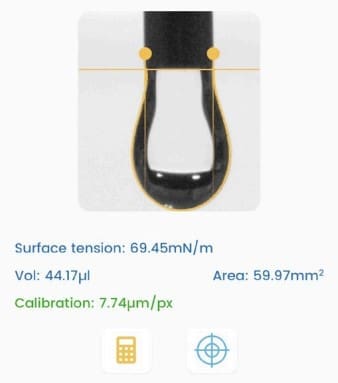
Pendant-drop surface tension (static + dynamic) via Young–Laplace fitting (up to 75 mN/m, ±0.03 mN/m accuracy)
Contact angle (10°–175°) for wetting and Pickering emulsion particle evaluation
Interfacial behavior trends vs concentration (CMC identification)

Calibration requirement

Correlation of interfacial properties to real emulsion stability outcomes (droplet size distribution, viscosity, separation index, shelf-life).

Protocol defaults (starting point)

Pendant-drop method for interfacial tension measurement
Dynamic mode when adsorption kinetics influence emulsification
Controlled temperature, concentration prep, and replicate measurements

Known limitations

Surface tension alone does not guarantee stable emulsions
Rheology, droplet size, and processing conditions also govern stability of oil-in-water emulsions
Fast transient adsorption events may exceed camera resolution (10 fps)

How this page was created 4 checklist items
01

Transparency Note

Drafting assistance: Initial draft created with AI assistance (Claude 4.8 Opus Pro), then rewritten for technical clarity by Droplet Lab Staff

02

Transparency Note

Technical review and editing by a surface-science specialist for accuracy

03

Transparency Note

Identifiers, units, thresholds, and key claims checked against cited sources before publication

04

Transparency Note

Reviewed every 12 months or when underlying standards or instrument specifications change

Executive Summary

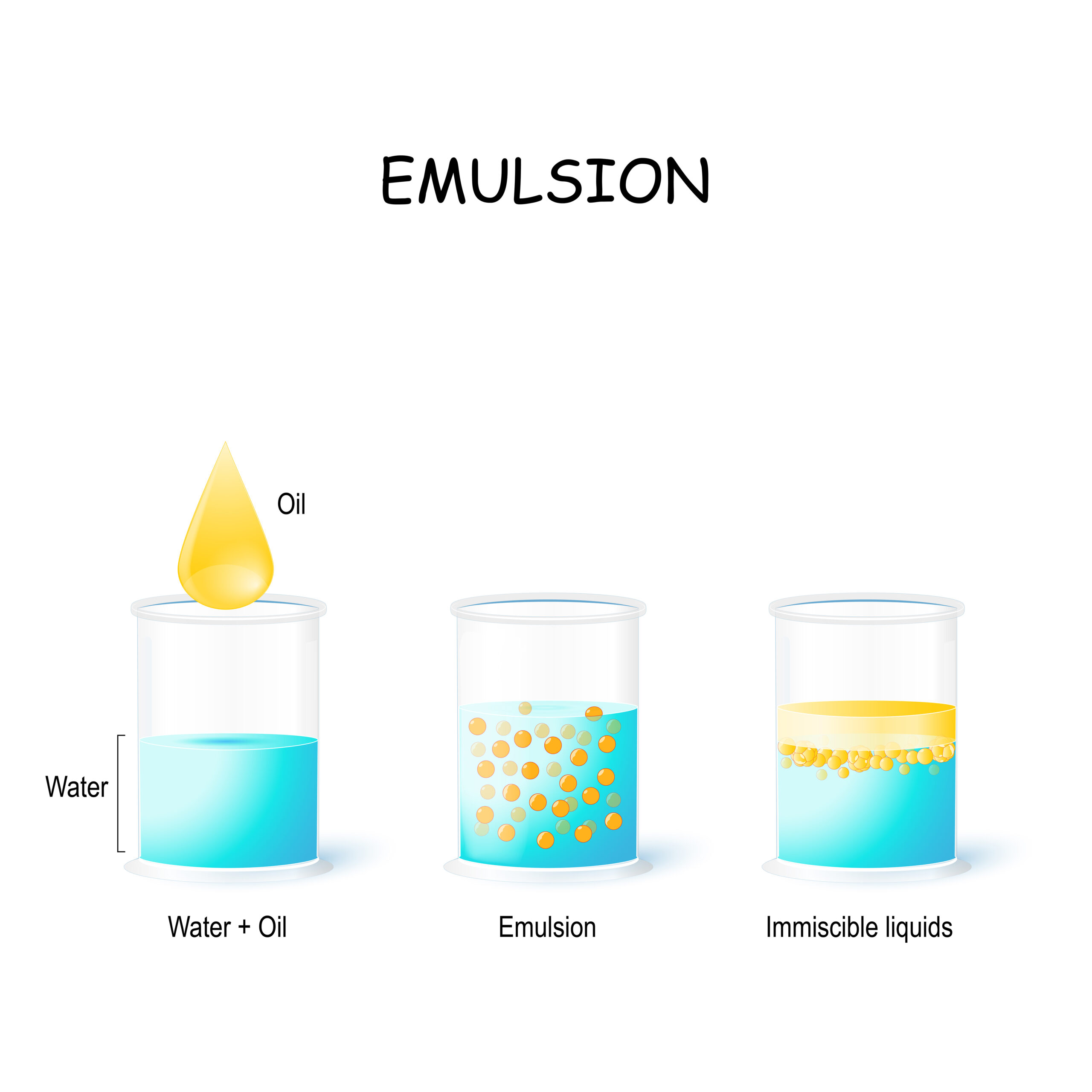
An emulsion is a dispersion of two immiscible liquids (typically oil and water) where one forms the dispersed phase and the other the continuous phase. These systems are thermodynamically unstable, meaning phase separation is inevitable without proper stabilization.

Most failures in emulsion stability originate from poorly understood interfacial mechanisms:

  • Inefficient surfactant adsorption
  • Slow reduction of interfacial tension
  • Weak interfacial film formation
  • Poor control of droplet size distribution

Using Dropometer, teams can:

  • Quantify surfactant efficiency and identify CMC
  • Compare emulsifier systems across real formulation conditions
  • Detect early drift in interfacial properties
  • Build QC gates that prevent late-stage instability

Outcome: Faster development of stable emulsions, reduced reformulation cycles, and improved control over emulsion stability mechanisms across production.

Emulsion Stability & Phase Separation

Your emulsions formed during R&D or production appear stable initially but later fail due to phase separation, coalescence, or creaming. This happens because interfacial behavior—the key driver of emulsion stability—is not measured early.

  • Visible phase separation (cream layer, sedimentation, oiling off)
  • Growth of larger droplets over time
  • Batch-to-batch variability in emulsion stability
  • Foam collapse or instability
  • Failure after transport or temperature cycling
  • Inconsistent water-in-oil emulsions or oil-in-water systems

Why It Happens

Why:

  • Insufficient reduction of interfacial tension leads to unstable droplets

How to detect:

  • Higher surface tension vs baseline

Corrective action:

  • Optimize surfactant type or concentration

Why:

  • Surfactant cannot stabilize newly formed interfaces during emulsification

How to detect:

  • Slow drop in dynamic surface tension

Corrective action:

  • Use faster adsorbing surfactants or blends

Why:

Poor mechanical strength of interfacial layer leads to coalescence

How to detect:

  • Similar surface tension but different stability outcomes

Corrective action:

  • Change emulsifier chemistry or use polymers/particles

Why:

Large droplets and low viscosity increase creaming

How to detect:

  • Stable interfacial tension but ongoing separation

Corrective action:

Adjust thickener and rheological properties

Why:

Change in composition flips continuous phase

How to detect:

  • Conductivity shift + interfacial change

Corrective action:

  • Adjust emulsifier HLB and formulation balance

What to Measure

Surface Tension vs Concentration

Why it matters: Measures surfactant efficiency

How to interpret: Lower values → better interfacial activity

When it is not enough: Critical for optimizing emulsifier dose

Critical Micelle Concentration (CMC)

Why it matters: Identifies efficient concentration range

How to interpret: Prevents overuse of surfactant

When it is not enough: Guides cost-performance balance

Dynamic Surface Tension

Why it matters: Tracks adsorption kinetics

How to interpret: Critical for emulsification process and foam formation

Contact Angle

Why it matters: Measures wetting behavior

How to interpret: Important for solid particles in Pickering emulsion systems

Complementary Measurements

Why it matters: Droplet size distribution analysis

How to interpret: Rheological properties

When it is not enough: Conductivity for phase identification

How Dropometer Fits Your Workflow

1

Identify the Failure Mechanism

Determine whether instability arises from coalescence, flocculation, or Ostwald ripening

2

Screen Interfacial Performance

Measure interfacial tension across concentrations
Rank emulsifier systems
3

Analyze Adsorption Kinetics

Use dynamic measurements to evaluate real-time stabilization

4

Correlate with Stability Data

Link interfacial metrics to stability of emulsions outcomes

5

Deploy QC Gates

Establish pass/fail thresholds for emulsion stability control

Validated measurement approach

Independent benchmarking and publication-based validation references.

Benchmark Validation

Our Contact angle and pendant‑drop surface tension methods have been benchmarked against KRÜSS DSA100E reference measurements.

See peer‑reviewed validation

Publication Evidence

Our instruments are referenced in peer‑reviewed journals, theses, and conference publications

Browse the full citations list

Baseline + gates (calibration first)

Build defensible PASS / MONITOR / FAIL gates for emulsion stability & phase separation control by correlating interfacial metrics to your actual stability outcomes.

Recommended calibration study

  • Separate gates per oil phase class + emulsifier type + thickener system + salt/pH class
  • 10–20 batches spanning known “good” and “bad” outcomes
  • ≥2 (repeatability check)

QC-Ready Quick Protocol (SOP Card)

Goal: Control emulsion stability mechanism early using interfacial measurements

Sample Handling

  • Use consistent water quality
  • Record pH, conductivity, temperature

Setup

  • Pendant-drop method
  • Fixed lighting and calibration

Measurement

  • Run concentration series
  • Measure static + dynamic surface tension
  • Record multiple replicates

Release Rules

  • Always correlate with droplet size and rheology
  • Use control charts for QC

Decision Tree (Triage)

Start condition: Emulsion shows instability

High surface tension

Action: Adjust surfactant

Slow kinetics

Action: Modify formulation

Stable tension but separation

Action: Fix rheology

Sudden failure

Action: Check phase inversion

Pitfalls + Limits

  • No universal surface tension threshold for emulsion stability
  • CMC ≠ optimal formulation dose
  • Rheology and droplet size remain critical
  • Must control experimental conditions

Report a correction

Spotted an issue in this summary? Send a correction request and our team will review it.

Correction Request

We work hard to keep this standards summary accurate and up to date. If you spot an error (wrong revision/year, missing requirement, incorrect interpretation, or broken link), tell us and we'll review it.

Contact us to report a correction