
Foam R&D & Process Control
Foam Control and Foam Quality Tuning with Surfactant Efficiency and Emulsion Stability
Tune foam up or down, predictably, by measuring the surface-active signals that actually drive foam formation, drainage, and batch variability.

Written by
Gurdeep Singh Saini
Holds a BASc in Mechanical Engineering (Ryerson) and an MASc from York University. He focuses on the custom AI behind the instrument.
COO at Droplet Lab
Read More

Technical Review by
Droplet Lab Team
Droplet Lab builds precision instruments and software for surface science measurement, specialising in contact angle analysis and surface tension characterisation. Used by researchers across materials science, pharmaceuticals, coatings, and advanced manufacturing, Droplet Lab's Dropometer has contributed to studies published in peer-reviewed journals including Advanced Functional Materials (Impact Factor 19). The team combines instrument engineering with deep domain knowledge in wettability science with a focus on practical accuracy.
Read More
Reviewed By
Droplet Lab Team
Droplet Lab builds precision instruments and software for surface science measurement, specialising in contact angle analysis and surface tension characterisation. Used by researchers across materials science, pharmaceuticals, coatings, and advanced manufacturing, Droplet Lab's Dropometer has contributed to studies published in peer-reviewed journals including Advanced Functional Materials (Impact Factor 19). The team combines instrument engineering with deep domain knowledge in wettability science with a focus on practical accuracy.




Validated Measurement Approach
Independent benchmarking and publication-based validation references.
Benchmark Validation
Dropometer contact angle and pendant-drop surface tension methods have been benchmarked against KRÜSS DSA100E reference measurements. The instrument is referenced in peer-reviewed journals including Bioactive Materials (Impact Factor 20) and Advanced Functional Materials (Impact Factor 19).
See peer-reviewed validationPublication Evidence
Our instruments are referenced in peer-reviewed journals, theses, and conference publications.
Browse citationsSample Surfactant Screening: Foam Suppression vs. Foam Stabilization Targets
Representative output format. Values are illustrative, not a universal specification.
Actual measurement output
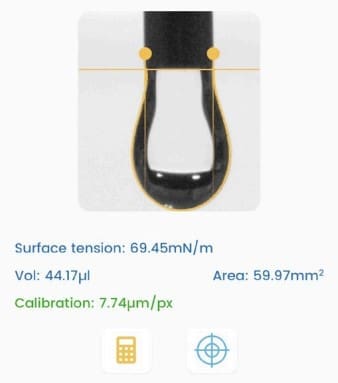
Dropometer pendant-drop dynamic surface tension measurement. This is the type of output used to select a surfactant candidate for a specific foam target.
Surfactant A's fast adsorption rate makes it a stronger candidate where the goal is minimal foam persistence during agitation. Surfactant B has a similar equilibrium surface tension to A but adsorbs far more slowly, meaning it would likely underperform as a defoamer despite looking comparable on a static reading alone. Surfactant C shows the elasticity signature associated with stable foam and is a stronger candidate for a foam-positive product; adding antifoam to that same system for an unrelated purpose visibly disrupts that signature, flagging a formulation conflict worth investigating before it shows up as an inconsistent finished product. This output would be included in the surfactant screening record used to select which candidate advances.
Report a correction
Spotted an issue in this summary? Send a correction request and our team will review it.
Correction Request
We work hard to keep this standards summary accurate and up to date. If you spot an error (wrong revision/year, missing requirement, incorrect interpretation, or broken link), tell us and we'll review it.
Contact us to report a correctionSources
1.
Abbott, S. Foam Elasticity. Practical Surfactants Science. https://www.stevenabbott.co.uk/practical-surfactants/foam-elasticity.php
2.
Chen, X. et al. Contact angle measurement with a smartphone. Review of Scientific Instruments, 89, 035117 (2018). https://pubs.aip.org/aip/rsi/article-abstract/89/3/035117/368179/Contact-angle-measurement-with-a-smartphone
3.
Surface tension measurement with a smartphone using a pendant drop. Colloids and Surfaces A: Physicochemical and Engineering Aspects. https://www.sciencedirect.com/science/article/abs/pii/S0927775717307744
4.
Fabrico. The Cost of Poor Quality (COPQ) in Manufacturing: 2026 Guide. https://www.fabrico.io/blog/cost-of-poor-quality-copq-manufacturing-guide/
5.
Making Strategy Happen. The Cost of Quality: The 1-10-100 Rule. https://www.makingstrategyhappen.com/the-cost-of-quality-the-1-10-100-rule/