Contents
Additive Manufacturing

Polymer 3D Print Adhesion Diagnostics for FDM, SLA & Additive Manufacturing Workflows

Eliminate filament adhesion issues, resin layer separation failures, and inconsistent 3D print outcomes in additive manufacturing by introducing a fast, quantitative wetting diagnostic before every build.

Who this is for: Process engineers, QA/QC teams, and R&D specialists working in polymer 3D printing, including FDM (fused deposition modeling), SLA (stereolithography), and advanced additive manufacturing technologies.

Positioning: Dropometer is a precision surface science tool designed to test wettability and surface energy—key drivers of adhesion in 3D printing processes. It helps you identify whether failures in a 3D printed part originate from surface condition, resin behavior, or process parameters. It does not replace mechanical testing but ensures your validation efforts are focused and efficient.

Written by
Droplet Lab Technical Writing Team
Reviewed by
Surface Science Specialist (Additive Manufacturing Applications)
Last Updated
2026-02-12
Written by
zoya
No biography added yet.
Read More
Written By

No biography added yet.

Evidence Box (QC-Ready)

Problem this solves

Unpredictable failures in polymer additive manufacturing—including first-layer detachment, poor filament adhesion, resin peel failures, and delamination—caused by uncontrolled surface wetting and material inconsistencies.

Dropometer role in workflow

A rapid surface wetting and resin test tool used for:

Pre-print release decisions
Troubleshooting adhesion issues
Monitoring process stability across batches

Primary outputs

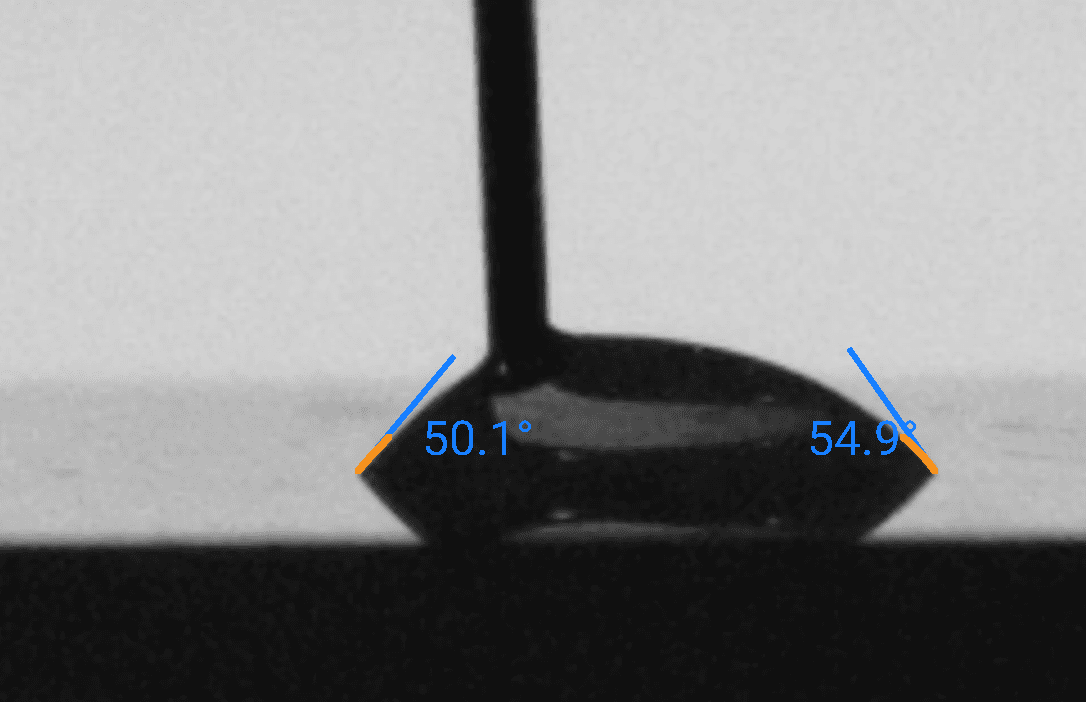
Contact angle (10°–175°, 0.01° resolution)
Surface energy trends (up to 100 mN/m)
Resin surface tension via pendant drop (up to 75 mN/m)
Spot variability and mapping for non-uniformity detection

Calibration requirement

All results must be correlated with real 3D printing outcomes (print success, adhesion strength, scrap rate) to define PASS/MONITOR/FAIL gates.

Protocol defaults

DI water for surface testing
Fixed droplet volume (≥0.05 µL)
Fixed capture time
≥5 replicates per zone

Known limitations

Wettability indicates risk, not guaranteed adhesion
Rough polymer surfaces increase measurement scatter
Does not replace mechanical testing of printed parts

How this page was created 4 checklist items
01

Transparency Note

Drafting assistance: Initial draft created with AI assistance (Claude 4.8 Opus Pro), then rewritten for technical clarity by Droplet Lab Staff

02

Transparency Note

Technical review and editing by a surface-science specialist for accuracy

03

Transparency Note

Identifiers, units, thresholds, and key claims checked against cited sources before publication

04

Transparency Note

Reviewed every 12 months or when underlying standards or instrument specifications change

Executive Summary

In additive manufacturing, most adhesion problems are diagnosed after failure—wasting time, materials, and machine availability. This use case introduces a pre-print wetting diagnostic step that transforms how teams manage polymer 3D printing reliability.

By integrating a simple contact angle and surface energy test, teams can:

  • Detect contamination before printing
  • Stabilize resin behavior in SLA processes
  • Reduce variability in FDM filament adhesion
  • Improve mechanical properties of printed parts through consistent first-layer bonding

This approach shifts your workflow from reactive troubleshooting to proactive control—improving yield and reducing scrap in modern manufacturing processes.

The Problem in Polymer 3D Printing

Adhesion failures in 3D printing of polymer materials—especially in FDM, SLA, and other additive manufacturing methods—often appear random but are typically driven by surface energy variation and wetting inconsistency.

  • First layer not sticking in FDM prints
  • Warping or lifting of polymer parts
  • Resin prints detaching in stereolithography
  • Delamination affecting mechanical performance
  • Inconsistent results across identical print parameters

What to Measure

Contact Angle (Wettability Test)

Why it matters: Indicates surface readiness for adhesion

How to interpret: Higher angle = poor wetting

When it is not enough: Does not directly measure strength

Spot Variability (Surface Uniformity)

Why it matters: Detects localized defects

How to interpret: High variability = inconsistent adhesion

When it is not enough: Needs mapping for root cause

Surface Energy (Polymer Interaction)

Why it matters: Predicts interaction with filament or resin

How to interpret: Trend-based comparison

When it is not enough: Not chemical identification

Resin Surface Tension (SLA)

Why it matters: Impacts layer formation and peel forces

How to interpret: Drift indicates instability

When it is not enough: Sensitive to handling

How Dropometer Fits Your Workflow

1

Identify failure mode in your 3D printing process

2

Establish baseline for a known-good print surface

3

Apply pre-print wetting test

4

Use rule-out logic to isolate cause

5

Add resin testing for SLA stability

Validated measurement approach

Independent benchmarking and publication-based validation references.

Benchmark Validation

Our Contact angle and pendant‑drop surface tension methods have been benchmarked against KRÜSS DSA100E reference measurements.

See peer‑reviewed validation

Publication Evidence

Our instruments are referenced in peer‑reviewed journals, theses, and conference publications

Browse the full citations list

Baseline + gates (calibration first)

Define quantitative thresholds for print readiness

Recommended calibration study

  • 10–20 representative conditions spanning “prints fine” → “fails”
  • At least 2 operators (repeatability proof)
  • Include a golden control each run
  • Track outcomes: print success rate, first-layer coupon adhesion, detach rate, peel events, scrap hours

Outputs you should lock

  • Droplet volume (automatic dosing can go down to 0.05 µL)
  • Capture time (fixed timepoint reporting)
  • Probe liquid source + storage rules
  • Replicate count + zones (spot map)
  • Summary stats (median + IQR) and pass rules

QC-Ready Quick Protocol (SOP Card)

Sample Handling

  • Use gloves
  • Avoid touching print surface
  • Track cleaning time

Setup

  • Maintain consistent lighting and leveling
  • Use same droplet settings

Measurement

  • ≥5 spots per test
  • Record median + variability

Release Rules

  • Re-test inconsistent droplets
  • Store data for audit

Decision Tree (Triage)

Start condition: Adhesion issue in 3D print

High contact angle

Action: Clean/re-treat surface

High variability

Action: Identify contamination zones

Stable wetting

Action: Adjust print parameters

Resin drift

Action: Replace or stabilize resin

Pitfalls + Limits

  • No universal thresholds—must calibrate
  • Rough surfaces require more measurements
  • Wettability ≠ mechanical strength
  • Resin testing requires strict handling

Report a correction

Spotted an issue in this summary? Send a correction request and our team will review it.

Correction Request

We work hard to keep this standards summary accurate and up to date. If you spot an error (wrong revision/year, missing requirement, incorrect interpretation, or broken link), tell us and we'll review it.

Contact us to report a correction