Benchmark validation
Contact angle and pendant-drop methods benchmarked against KRÜSS DSA100E
See peer-reviewed validation
Expert contribution
Static, equilibrium surface tension is rarely the value that controls spraying, coating or cleaning. What matters is how quickly a surfactant lowers surface tension at the surface age of your process.


Disclosure: An unpaid, independent contribution; Prof Abbott has no commercial affiliation with Droplet Lab.
Process timescales
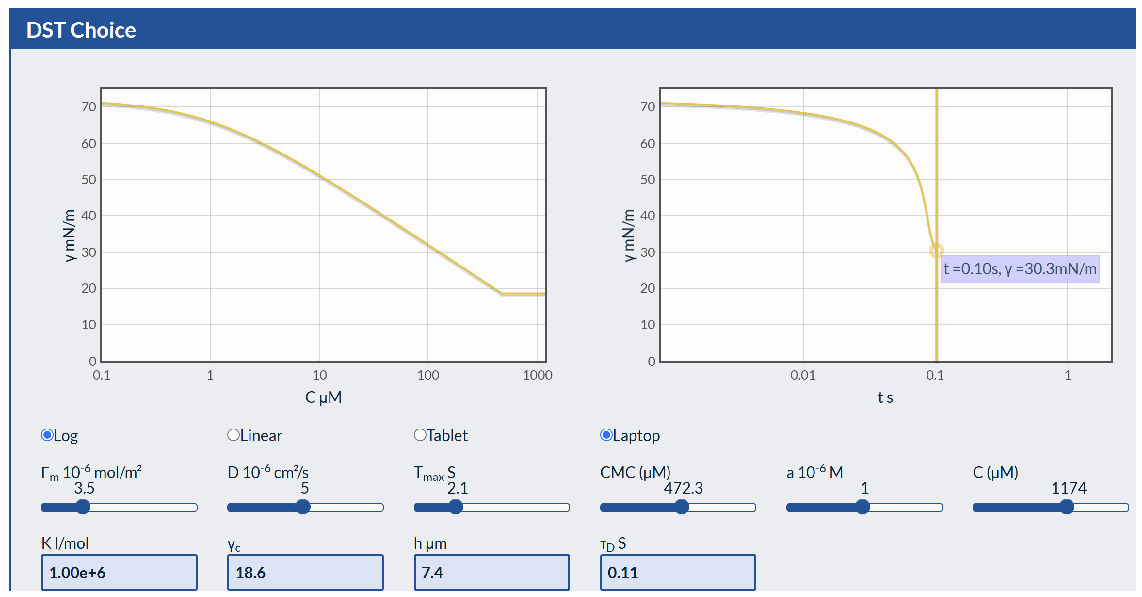
Measuring the surface tension of a liquid can be hard work. You often have to wait minutes for the value to stabilise and it is very susceptible to small contaminants. It is also a waste of time. Almost no one has a real use for these static surface tensions. Think about it. You are spraying, coating, cleaning. The interactions that matter take place in milliseconds. What matters is how quickly the surface tension falls to a value that helps the spray to spread, the coating to become even and the cleaning to happen. For this you need to measure the dynamic surface tension. And you will quickly find something that is counterintuitive. Many “good” surfactants with low CMC (Critical Micelle Concentrations) and low equilibrium surface tensions are useless. Instead, you often choose a “poor” surfactant. Let’s see this in action using one of my free dynamic-surface-tension app.
The left-hand graph is the classic curve of surface tension with concentration. With a CMC of 100 μM this is a “good” surfactant. Now look at the right-hand graph. After 1 s, the surface tension has dropped only to 60 mN/m. Your process has probably finished by this time, so the surfactant has had no time to do anything. Why is it so slow coming to the surface? It’s nothing to do with diffusion – most surfactants diffuse at similar rates. Instead it’s because most of the surfactant is tied up with big, lumbering micelles, with very little free surfactant able to get to the surface.
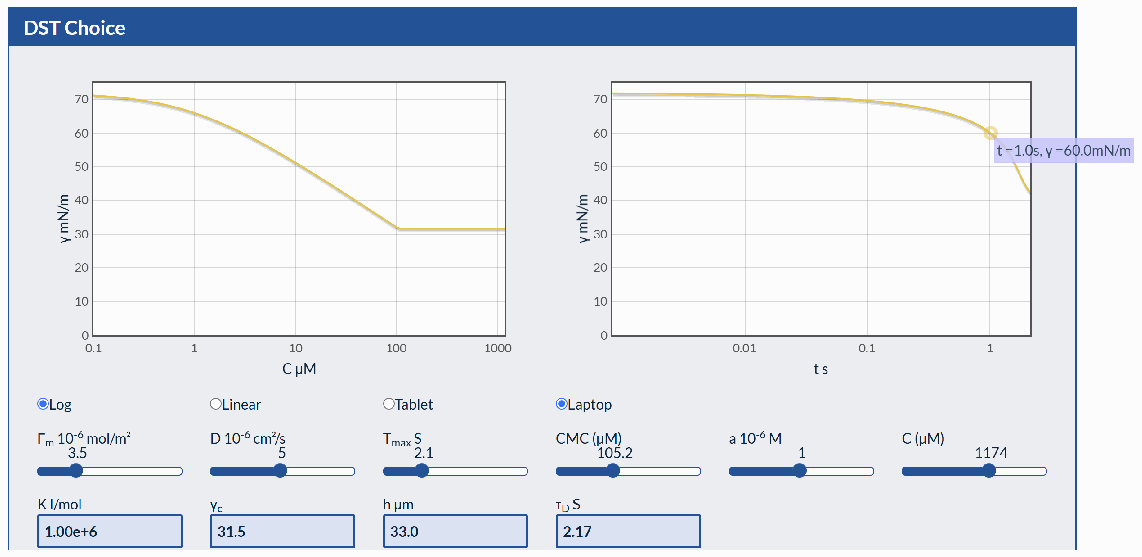
Now let's keep everything the same but change the CMC to about 470 μM.
By 100 ms the surface tension has fallen to 30 mN/m. The reason is that there is a large amount of free (non-micellar) surfactant that can quickly go to the surface. And that’s why you need to measure dynamic surface tension, DST.
For those who want a fuller explanation, the theory behind the app is described in the paper James K. Ferri and Kathleen J. Stebe, Which surfactants reduce surface tension faster? A scaling argument for diffusion-controlled adsorption, Advances in Colloid and Interface Science 85, 2000, 61-97.
Pendant-drop method
In principle, measuring DST is easy. The shape of a droplet hanging from a tube (“pendant drop”) depends on the size of the tube, the drop’s mass and the surface tension at that instant. As a short explanation, a high value of the surface tension will make the drop more spherical than a low value – as described by the Young-Laplace equation.
So, use a syringe to produce a drop growing at some controlled rate, take an image every 33 ms, use image analysis to get the volume (and, from the liquid density, its mass) and fit the shape to the Young-Laplace equation (not as easy as it sounds!) to extract the surface tension at that moment. At every instant you therefore know the DST.
It is more complicated than that in practice. You need to perform measurements at multiple speeds to capture drops at an optimal size for accurate calculations, so it needs smart algorithms to cover the desired timescales.
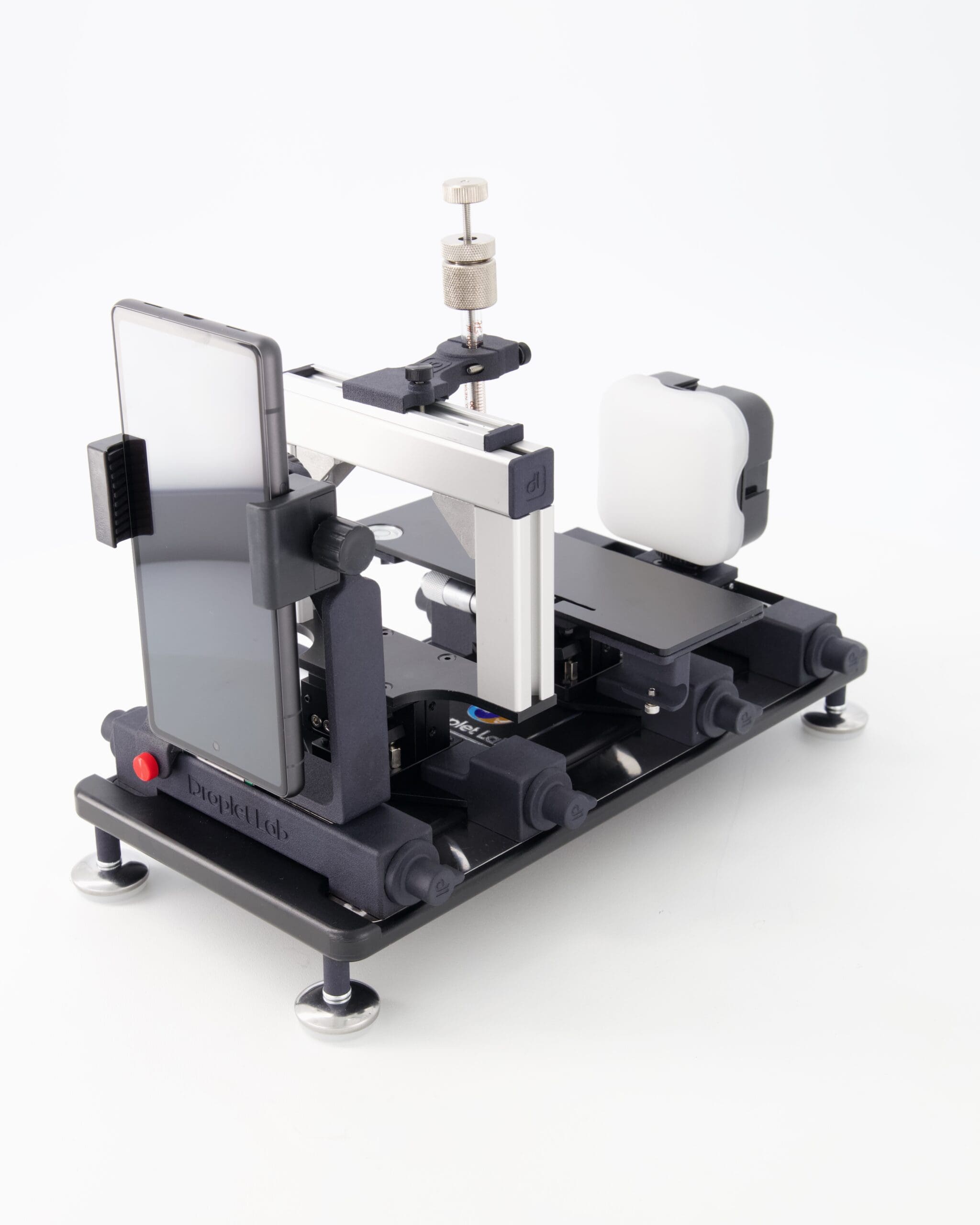
For a comparison of static and dynamic methods, see the surface tension measurement guide. The Dropometer pendant drop tensiometer measures surface tension from drop shape on a smartphone based setup.
Traditionally the method has required expensive equipment, making it out of reach for many labs. But we’re in the 21st century. 3D printing, excellent digital microscopes, fast control software and mobile computing make it possible to combine precision with affordability. It’s great that Droplet Labs have turned this important technique into an affordable package.
The team at Droplet Labs haven’t compromised on accuracy. Producing an OK prototype was one thing. The real challenge was to create a package that delivered reliable values, using standard, challenging test cases to compare results to those from well-known high-price devices. Only when components, engineering, assembly and software gave the required precision, accuracy and reliability were they happy to put the device on the market
From the Droplet Lab team
Surface age is the time since a new surface was created. A fresh drop, bubble or spray droplet starts with almost no surfactant at its interface, so its surface tension starts close to that of pure water, about 72 mN/m at 25°C.
Surfactant molecules then travel from the bulk to the interface by diffusion and adsorb there. As the surface concentration rises, the surface tension falls towards its equilibrium value. Dynamic surface tension is surface tension as a function of surface age, and the shape of that curve depends on the diffusion and adsorption kinetics of each surfactant (Eastoe and Dalton, 2000).
Increasing surfactant concentration usually speeds this up, because more molecules sit close to the new surface. Above the CMC, much of the surfactant is held in micelles, so the supply of free molecules matters as much as the total amount, as the example above shows (Ferri and Stebe, 2000). Two surfactants with similar equilibrium values, for example a nonionic surfactant and sodium dodecyl sulfate, can still behave very differently at short surface ages.
The same dynamic behavior is linked to interfacial rheology, which describes how a surface resists being stretched. It helps explain why some surfactant solutions build a stable foam and others do not, and why one solution can wet a fast moving substrate while another cannot.
Bubble pressure tensiometry blows a stream of gas bubbles through a fine capillary into the liquid. The internal pressure of each gas bubble peaks when the bubble is a hemisphere with the same radius as the capillary. At that point the Laplace pressure links the measured differential pressure and the capillary radius directly to surface tension.
The bubble formation rate sets the surface age. Fast bubbling gives short surface ages and slow bubbling gives long ones, so one run covers a whole surface age range. Accurate surface age determination needs the instrument to separate the time a bubble spends growing from the time it takes to detach. At very fast rates, viscosity also adds to the measured pressure and has to be corrected for.
Portable bubble pressure tensiometers typically cover surface ages from about 10 milliseconds to tens of seconds. The KRÜSS Scientific BPT Mobile, for example, lists 10 ms to 30 s in its technical data.
Each method covers a different time window, so choose by the surface age of your process. The pendant drop range assumes an image rate like the 33 ms described above.
| Method | Surface ages covered | Best suited to | Watch for |
|---|---|---|---|
| Maximum bubble pressure method | About 10 ms to tens of seconds on portable instruments | Inkjet printing, spraying and other fast processes | Viscosity at high bubble rates; needs enough liquid to immerse the capillary |
| Pendant drop | From tens of milliseconds to minutes or hours | Slow adsorption, equilibrium values and interfacial tension between two liquids | Fit quality, and evaporation over long runs |
| Wilhelmy plate or du Noüy ring | Equilibrium only | Static surface tension and CMC curves | Not designed for fresh surfaces |
Evidence
The contact-angle and pendant-drop surface-tension methods have been benchmarked against KRÜSS DSA100E reference measurements. Droplet Lab instruments are also referenced in peer-reviewed journals, theses and conference publications.
Benchmark validation
Contact angle and pendant-drop methods benchmarked against KRÜSS DSA100E
See peer-reviewed validationPublication evidence
Instruments reference in peer-reviewed journals, theses and conference publications.
Browse the full citations listNever measure only the static surface tension. Measure the dynamic surface tension at the timescale of your process.
If DST was previously unaffordable, the device from Droplet Lab has made it practical.
Book a short call to discuss your liquid, timescale and measurement requirements with Droplet Lab.
Static surface tension is the value a liquid settles at after minutes of waiting, and it is rarely what matters in practice. Dynamic surface tension (DST) is the value at the actual timescale of your process. Spraying, coating and cleaning all happen in milliseconds, so what matters is how fast surface tension drops, not where it eventually ends up.
Because most of that surfactant is tied up in micelles, leaving very little free surfactant available to reach the surface quickly. A “poorer” surfactant with more free molecules available can lower surface tension faster, even though its equilibrium value looks worse on paper.
Two common methods are the pendant drop and the maximum bubble pressure method. In the pendant drop method, a drop is grown from a tube at a controlled rate, imaged at fixed intervals, and its shape is fitted to the Young-Laplace equation to give surface tension at each instant. Bubble pressure tensiometry times a stream of gas bubbles instead, which reaches shorter surface ages.
CMC is the critical micelle concentration, the point at which surfactant molecules start forming micelles instead of staying free in solution. A higher CMC generally means more free surfactant is available to diffuse to a fresh surface quickly, which is why a “good” low CMC surfactant by equilibrium standards can be the wrong choice for a fast process.
It traditionally required specialised, high-cost equipment. Advances in 3D printing, digital microscopes, control software and mobile computing have made it possible to build accurate DST measurement into an affordable package.