



Contents
Case Study

Water contact angle showed the least wettable coating was not the best protected.

Last Updated
October 26, 2026
Industry
Materials science research, electroplated coatings
Location
Sofia, Bulgaria
Customer since
2024
Published with Droplet Lab
C. R. Acad. Bulg. Sci., 2026
Named in a 2026 peer reviewed paper Drop shape method validated against a KRÜSS DSA100E in peer review Two peer reviewed validation papers on the method

A coatings group at the Institute of Metal Science, Bulgarian Academy of Sciences, plated copper coatings with silver particles onto stainless steel. Corrosion tests ranked the coatings, but said nothing about how water meets each surface. With a Droplet Lab Dropometer, the group measured water contact angle on all four coatings and found that the least wettable one did not resist corrosion best.

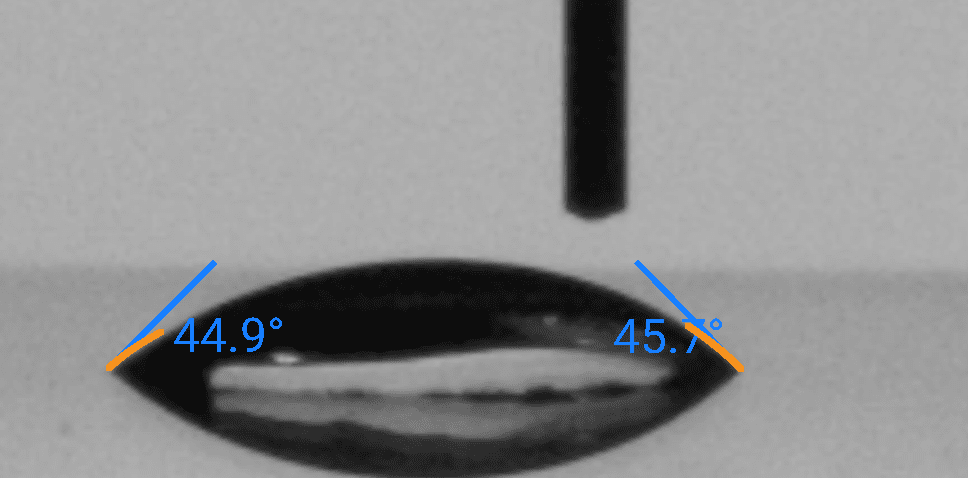
Example Droplet Lab drop frame: a water drop on glass with fitted contact angles of 44.9° and 45.7°. Illustration only, not data from this study.
Abhimanyu Photo
Written by
Abhimanyu Bhandankar
Holds an MBA from Schulich School of Business and a BE in IT. He joined Droplet Lab in July 2019 and now leads sales and marketing.
CEO at Droplet Lab
Read More
Gurdeep-Saini-Photo
Technical Review by
Gurdeep Singh Saini
Holds a BASc in Mechanical Engineering from Ryerson University (now Toronto Metropolitan University) and an MASc from York University. He develops the automatic edge and baseline detection behind the Dropometer's analysis.
COO at Droplet Lab
Read More
Abhimanyu Photo
Written By

Abhimanyu Bhandankar

CEO at Droplet Lab

Holds an MBA from Schulich School of Business and a BE in IT. He joined Droplet Lab in July 2019 and now leads sales and marketing.

Gurdeep-Saini-Photo
Reviewed By

Gurdeep Singh Saini

COO at Droplet Lab

Holds a BASc in Mechanical Engineering from Ryerson University (now Toronto Metropolitan University) and an MASc from York University. He develops the automatic edge and baseline detection behind the Dropometer's analysis.

Primary outcome: finer silver made the acidic coating less wettable, but not more corrosion resistant

Water contact angle, copper coating from the acidic electrolyte

5 µl deionized water drop, Droplet Lab Dropometer, values from Fig. 3 of Yankova et al., C. R. Acad. Bulg. Sci. 79 (2026) 479

3 µm silver particles 77.9°
20 nm silver particles 82.6°

Switching the silver particles from 3 µm to 20 nm raised the water contact angle of the acid plated copper coating from 77.9° to 82.6°. Yet the most corrosion resistant coating in the study was an alkaline one at 69.7°, with a corrosion rate of 0.028 mm/y on the group's potentiostat. All four coatings stayed below 90°, so all are hydrophilic by the paper's definition.

82.6 °

Highest water contact angle, CuAcid + Ag 20 nm, the least wettable coating.

0.028 mm/y

Lowest corrosion rate, CuAlk + Ag 20 nm, a coating at 69.7°.

5 µl

Deionized water drop volume on each coating.

4 coatings

Two electrolytes, each with 3 µm or 20 nm silver particles.

Executive Summary

Who

A materials research group at the Institute of Metal Science, Equipment and Technologies with Hydro and Aerodynamics Centre “Acad. A. Balevski”, Bulgarian Academy of Sciences, Sofia. The group develops electroplated and thermochemical coatings, including selectively plated copper coatings that contain silver particles.

Problem

The group ranked its coatings by corrosion potential, current density and rate. It wanted more information about the coating surfaces themselves. A common assumption is that a less wettable coating keeps salt water away and so corrodes less. The group needed a wetting number for each coating to test that.

Solution

A Droplet Lab Dropometer for static water contact angle. The group set the instrument up from Droplet Lab's videos before its first remote call, then measured a 5 µl deionized water drop on each of four coatings plated onto 316L stainless steel.

Time to Value

2 December 2024: first enquiry. 7 January 2025: instrument received in Bulgaria. 9 January 2025: remote onboarding and software access. 10 October 2025: manuscript received by the journal. 27 April 2026: paper published.

Results

Water contact angles ran from 69.7° to 82.6°. In the acidic electrolyte, 20 nm silver raised the angle from 77.9° to 82.6°. The least corroding coating, CuAlk + Ag 20 nm at 0.028 mm/y, was among the most wettable. The paper concludes that wettability alone does not decide corrosion resistance.

Highlights

69.7° to 82.6°

Water contact angle across four coatings

5 µl

Drop volume

0.028 mm/y

Lowest corrosion rate, at 69.7°

2026

Paper published

Institute of Metal Science, Bulgarian Academy of Sciences, at a glance

Research focus

Electroplated and thermochemical coatings, including selectively plated copper coatings with silver particles.

Products / applications

Copper and silver coatings studied for corrosion resistance and biocidal behaviour, under a Bulgarian National Science Fund project.

Measurement stage

Laboratory research, published in a peer reviewed journal in April 2026.

Users

Researchers in the coatings group.

Materials and surfaces tested

Copper coatings about 20 µm thick with 3 µm or 20 nm silver particles, on 316L stainless steel, with deionized water.

Key constraints

Four similar looking surfaces, differences of a few degrees, and a supplier on another continent.

The challenge: corrosion numbers alone did not describe the surface

The group could rank coatings by corrosion rate, but not by how water meets each surface.

How coatings were compared before

The group tests corrosion on a potentiostat in 3.5 wt.% NaCl. That gives a corrosion potential, current density and rate for each coating. It gives no direct measure of wettability, the way water spreads on the surface.

Why these coatings are hard to compare

The coatings are selectively plated, so the surface depends on silver particle size and on the electrolyte. Two particle sizes and two electrolytes give four surfaces that look alike but behave differently, with contact angles only a few degrees apart. This is a common problem in plated and electroplated coating wettability and corrosion work.

What was at stake

The paper calls the degree of wetting “a critical indicator of surface properties, such as adhesion, corrosion resistance, surface energy, biocompatibility”. Without a wetting number from contact angle measurement, the group could not test whether the less wettable coatings were also the better protected ones.

The insight: measure the surface, not only the corrosion current

What Was Deployed

A Droplet Lab Dropometer for contact angle measurement, used for static water contact angle. In the published study, the group placed a 5 µl deionized water drop on each selectively plated copper coating on 316L stainless steel coupons (30 × 20 × 3 mm) and measured the contact angle. The paper describes the measurement as made “using a Droplet Lab dropometer”. Corrosion was measured separately on a potentiostat in 3.5 wt.% NaCl, so each coating had a wetting result and a corrosion result side by side.
The Origin

A shipping question from Sofia

On 2 December 2024, the Institute of Metal Science wrote to Droplet Lab with a practical question: did Droplet Lab ship to Bulgaria? It did, and the group placed its order within days, invoiced in US dollars to suit the Institute's bank transfer.

The parcel reached Bulgaria in mid December and waited in customs over the holidays. It arrived on 7 January 2025. Droplet Lab sent its assembly and contact angle videos the same morning, and by the remote onboarding call on 9 January the team had already set the instrument up.

On that call the group explained why it had bought it. It works with electroplated and thermochemical coatings, and wanted to extend its research and add more information about its surfaces. Contact angle was the first measurement it named.

Before vs After

Metric Before After
Surface data reported for each coating Corrosion tests only: potential, current density and rate Corrosion tests plus water contact angle, 5 µl drop
Water contact angle, acidic electrolyte, 3 µm to 20 nm silver 77.9° (3 µm silver) 82.6° (20 nm silver)
Water contact angle, alkaline electrolyte, 3 µm to 20 nm silver 69.8° (3 µm silver) 69.7° (20 nm silver)
Corrosion rate, acidic electrolyte, 3 µm to 20 nm silver 0.103 mm/y (3 µm silver) 0.090 mm/y (20 nm silver)
Corrosion rate, alkaline electrolyte, 3 µm to 20 nm silver 0.039 mm/y (3 µm silver) 0.028 mm/y (20 nm silver)

Rollout timeline

Timeline (high level)

December 2024: Enquiry and order

  • Enquiry about shipping to Bulgaria on 2 December
  • Order placed and invoiced in US dollars for bank transfer
  • Shipped from Canada on 13 December

December 2024 to January 2025: Customs and delivery

  • Held in Bulgarian customs over the holidays
  • Received on 7 January 2025

January 2025: Setup and onboarding

  • Assembly and contact angle videos sent on 7 January
  • Instrument set up by the team before the call
  • Remote onboarding and software access on 9 January

2025: Measurements

  • 5 µl water drops on four plated copper coatings
  • Manuscript received by the journal on 10 October 2025

April 2026: Published

Paper published on 27 April 2026 in C. R. Acad. Bulg. Sci. 79 (4)

Proof and validation: what the paper shows, and what it does not

Test method

Static water contact angle with a 5 µl deionized water drop on four selectively plated copper coatings (about 20 µm thick) with 3 µm or 20 nm silver particles, plated from an acidic (pH 0.5) or alkaline (pH 8.5) electrolyte onto 316L stainless steel. Measured with a Droplet Lab Dropometer. Corrosion was measured on a separate potentiostat.

Sample size and operators

Not reported in the paper. One contact angle value is given per coating, measured by researchers in the group.

Repeatability / reproducibility

Not reported in the paper. No standard deviation or number of drops is given, so the published data supports a comparison between coatings, not a repeatability claim.

Notes / assumptions

Source: R. Yankova, I. Rusev, I. Koleva, D. Veselinov, “Corrosion resistance and wettability of selective plated copper-based coatings containing silver particles”, C. R. Acad. Bulg. Sci. 79 (4) (2026) 479 to 488, doi:10.7546/CRABS.2026.04.09. Values on this page are read from Fig. 3 of the paper. The paper's text gives the two alkaline coatings as 70 to 72°, while Fig. 3 labels them 69.8° and 69.7°; this page uses the figure values.

Outcomes to date

Measured Outcomes

82.6°

CuAcid + Ag 20 nm

The least wettable of the four coatings. Not the most corrosion resistant: its corrosion rate was 0.090 mm/y (Yankova et al., C. R. Acad. Bulg. Sci. 79 (2026) 479).

77.9°

CuAcid + Ag 3 µm

The same acidic electrolyte with larger silver particles. Moving to 20 nm silver raised the angle by 4.7°.

69.7°

CuAlk + Ag 20 nm

Among the most wettable coatings, yet the most corrosion resistant, at 0.028 mm/y on the group's potentiostat.

Operational Outcomes

Published output

Water contact angle on every coating in a 2026 peer reviewed paper.

Wetting next to corrosion

Each coating now has a wetting result and a corrosion result, which let the group test, and reject, a common assumption.

Set up remotely

Instrument set up in Bulgaria from videos and one remote call.

What's next

Delivered

Water contact angle on four silver loaded copper coatings, published April 2026
Remote onboarding and software support from Canada

Planned

Invitation to contribute drop images to Droplet Lab's open contact angle dataset (the group's decision)

Frequently asked questions

What did the Dropometer measure in this study?

Static water contact angle with a 5 µl deionized water drop on four selectively plated copper coatings with silver particles, on 316L stainless steel. Corrosion was measured separately on a potentiostat in 3.5 wt.% NaCl, so each coating had a wetting result and a corrosion result.

Does a less wettable coating resist corrosion better?

Not in this study. Water contact angles ran from 69.7° to 82.6°, and the least corroding coating, at 0.028 mm/y, was among the most wettable at 69.7°. The paper concludes that wettability alone does not decide corrosion resistance.

How was the instrument set up in Bulgaria?

The instrument arrived on 7 January 2025. Droplet Lab sent its assembly and contact angle videos that morning, and the team had set it up before the remote onboarding call on 9 January. The paper was published on 27 April 2026.

Next Step

Ranking coatings by corrosion rate, but missing a wetting number for each surface?

A Droplet Lab Dropometer measures water contact angle on small coated coupons, so wetting can be reported next to your corrosion results. The drop shape method is validated against a KRÜSS DSA100E in peer review. Book a 15 minute demo and bring one of your coupons, or request a quote.