Contents

Client Citation Analysis

Corrosion Resistance and Wettability of Selective Plated Copper-Based Coatings Containing Silver Particles

Bulgarian Academy of Sciences researchers asked how silver particle size and plating bath pH change the corrosion resistance and wettability of selective plated copper coatings on 316L steel. The Dropometer measured water contact angles from 69.7° to 82.6°, while a potentiostat showed the alkaline bath with 20 nm silver corroded slowest. The coating with the highest contact angle was not the most corrosion resistant.

At-a-Glance Summary

Primary surface measurement reported

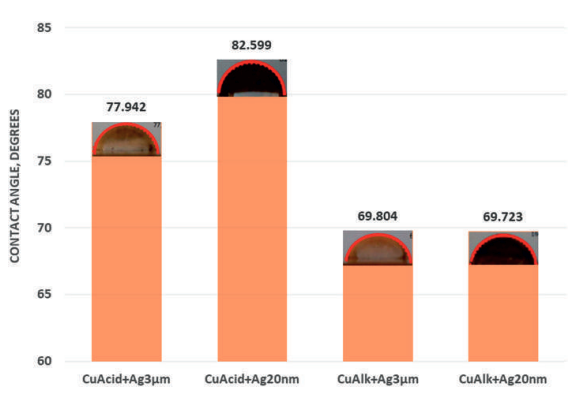
Static water contact angle on four copper silver coatings, reported as one value per coating in Fig. 3. Replicates, temperature and fitting method are not stated in the paper.

Research question

How do silver particle size (20 nm or 3 µm) and plating bath pH (acidic or alkaline) change the corrosion resistance and wettability of selective plated copper coatings on 316L stainless steel?

Headline finding

Coatings plated from the alkaline bath corroded slowest, but coatings from the acidic bath had the higher water contact angles. The authors conclude that wettability alone does not rank corrosion protection; compactness and electrochemical stability matter more.

Paper Details

Authors
Radostina Yankova, Ivan Rusev, Ina Koleva, Deyan Veselinov
Affiliation
Institute of Metal Science, Equipment and Technologies with Hydro- and Aerodynamics Centre "Acad. A. Balevski" (IMSETHAC), Bulgarian Academy of Sciences, Sofia, Bulgaria
Journal
Comptes rendus de l'Académie bulgare des Sciences (Proceedings of the Bulgarian Academy of Sciences), peer reviewed journal article
Year
2026
Volume
79 (Tome 79)
Issue / Article
No 4, pages 479–488
Licence
Licence not stated in the text; no Creative Commons statement appears. Check the publisher page before reusing figures.
Water contact angle (Dropometer) plus electrochemical corrosion tests (potentiostat)
Measurement scope
Methods used
  • Static water contact angle, one value per coating
  • Open circuit potential over immersion time
  • Potentiodynamic polarization at 0.5 mV/s in 3.5 wt.% NaCl
Four selective plated copper coatings with silver particles, about 20 µm thick, on 316L stainless steel (30 × 20 × 3 mm)
Samples tested
Coatings
  • CuAcid + Ag 3 µm
  • CuAcid + Ag 20 nm
  • CuAlk + Ag 3 µm
  • CuAlk + Ag 20 nm
Deionized water, 5 µL drop
Liquids
Probe liquid
  • Surface tension of the water not reported
  • No second probe liquid, so no surface energy calculation

Classification

This paper uses water contact angle to compare the wettability of copper silver coatings plated from two different baths.

What Was Measured

Primary surface / interfacial measurement

Static water contact angle of a 5 µL deionized water drop on each of the four plated coatings, measured with a Droplet Lab Dropometer and shown as a bar chart in Fig. 3.

Supporting measurements

A Corrtest CS350 potentiostat in a three electrode cell (platinum counter, Ag/AgCl reference) measured open circuit potential and Tafel polarization in 3.5 wt.% NaCl at room temperature. From these the authors report Tafel slopes, corrosion potential, corrosion current density and corrosion rate (Table 1). Coating thickness was checked by cross sectional analysis; that instrument is not named.

Instruments Mentioned

Dropometer (Droplet Lab, location not stated in the paper)

Water contact angle of a 5 µL deionized water drop on each coating. The paper writes it as "Droplet Lab dropometer".

Corrtest CS350 potentiostat/galvanostat

Open circuit potential, potentiodynamic polarization, Tafel slopes, corrosion current density and corrosion rate in 3.5 wt.% NaCl.

DC power supply with sheathed graphite electrode

Selective plating of the copper silver coatings to about 20 µm.

Low speed cutting machine

Cutting the 316L stainless steel substrates to 30 × 20 × 3 mm with coolant.

Role of the Droplet Lab instrument

The team used a Droplet Lab Dropometer to measure the water contact angle on all four plated coatings. Each measurement used a 5 µL drop of deionized water.

The Dropometer data form the whole wettability section of the paper. They show that acidic bath coatings were less wettable (77.9° and 82.6°) than alkaline bath coatings (69.8° and 69.7°).

The Dropometer did not take part in the corrosion testing. Every corrosion number in the paper, including the 0.028 mm/y best result, came from the potentiostat.

The paper does not report drop age, replicate count, temperature or the fitting method for the contact angle readings.

The contact angles let the authors test whether a less wettable coating also resists corrosion better. Here it did not, and that negative result is the main wettability conclusion of the paper.

Bring This Measurement Into Your Lab

If you need to check how a plating bath or particle change shows up on the coating surface, measure water contact angle on the same coupons you send for corrosion testing. See how the Dropometer handles this measurement.

Method Snapshot

Droplet Lab measurement protocol

Parameter Value as reported
Instrument Droplet Lab Dropometer (written as "Droplet Lab dropometer")
Measurement Water contact angle
Liquid Deionized water
Drop volume 5 µL
Fit / model not stated in the paper
Temperature not stated in the paper
Needle / dispensing not stated in the paper
Replicates not stated in the paper
Timing after deposition not stated in the paper
Software not stated in the paper
Samples Four coatings, about 20 µm thick, on 316L stainless steel

Coating preparation (context, not Droplet Lab)

Parameter Value as reported
Substrate 316L stainless steel, 30 × 20 × 3 mm
Substrate preparation Mechanical polishing, electropolishing, chemical etching and surface activation
Acidic bath pH 0.5; CuSO4 20%, H2SO4 10%, water 70%
Alkaline bath pH 8.5; copper methanesulfonate 30%, ethylenediamine 20%, water 50% (formulas as given in the paper)
Silver particles 20 nm (colloidal solution, 20 ppm) or 3 µm (ultrasonic dispersion and vacuum filtration)
Coating thickness About 20 µm, checked by cross sectional analysis

Key Findings

Contact angles spanned 69.7° to 82.6°

Dropometer readings placed all four coatings below 90°, so every coating stayed on the hydrophilic side of the usual threshold.

The plating bath set wettability more than particle size

Acidic bath coatings read 77.9° (3 µm Ag) and 82.6° (20 nm Ag). Alkaline bath coatings read 69.8° and 69.7°, with almost no change from particle size.

Smaller silver raised the angle only in the acidic bath

Switching from 3 µm to 20 nm silver raised the contact angle by about 4.7° in the acidic bath. In the alkaline bath the change was 0.1°.

Alkaline bath with 20 nm silver corroded slowest

Potentiostat data, not Dropometer data, gave this coating the lowest corrosion current (2.46 × 10⁻⁶ A/cm²) and corrosion rate (0.028 mm/y). The acidic 3 µm coating was worst at 0.103 mm/y.

Higher contact angle did not mean better corrosion resistance

The acidic 20 nm coating had the highest contact angle but corroded two to three times faster than the alkaline coatings (0.090 versus 0.039 and 0.028 mm/y). The authors conclude coating compactness and stability matter more than wettability.

Measured Values by Sample

Water contact angles measured with the Dropometer, read from Fig. 3 of the paper.

Water contact angle by coating (5 µL deionized water)

Sample Water contact angle
CuAcid + Ag 3 µm 77.9°
CuAcid + Ag 20 nm 82.6°
CuAlk + Ag 3 µm 69.8°
CuAlk + Ag 20 nm 69.7°

Figures & Visuals

Only Fig. 3 contains Droplet Lab data. Fig. 1 and Fig. 2 show potentiostat corrosion data.

Figure 3: Water contact angle of the four coatings

Bar chart of the water contact angle on each copper silver coating, measured with the Dropometer. Licence not stated in the text and no Creative Commons statement appears, so do not reproduce without permission. Credit: Yankova et al., C. R. Acad. Bulg. Sci. 79(4), 2026.

Why It Matters

A higher water contact angle is often expected to mean better corrosion protection. This study shows that a contact angle reading needs pairing with a corrosion test before ranking coatings for protection.

Wettability is a surface fingerprint, not a corrosion score

The contact angle clearly separated coatings from the two baths. It did not predict which coating corroded slowest.

A fast check on bath chemistry

A gap of about 8° to 13° between acidic and alkaline bath coatings shows that the plating bath leaves a measurable mark on the surface.

Four coatings, one probe liquid, one drop volume

Acidic bath coatings read 8° to 13° higher than alkaline ones

Best corrosion result came from a lower contact angle coating

Contact angle and potentiostat data answer different questions

Expert Perspective

Expert Perspective

Wettability is set by the top five to ten ångström of a surface — what the liquid actually sees. It doesn't matter what lies beneath; that outermost layer is what you are really measuring.

Dr Alidad Amirfazli

Professor, Department of Mechanical Engineering, York University, Co-founder and Scientific Advisor, Droplet Lab

Practical Takeaways

Pair contact angle with an electrochemical test

Use water contact angle to confirm a bath or particle change reached the surface. Use polarization data to rank corrosion protection.

Report the details the paper left out

Drop age, replicate count, temperature and spread make plated coating contact angles comparable between labs and batches.

FAQ

Frequently Asked Questions

What did the Dropometer measure in this study?

It measured the water contact angle on four selective plated copper coatings containing silver particles. Each reading used a 5 µL drop of deionized water. The corrosion data came from a separate potentiostat.

Did the most water repellent coating resist corrosion best?

No. The acidic bath coating with 20 nm silver had the highest contact angle at 82.6°. The alkaline bath coating with 20 nm silver, at 69.7°, had the lowest corrosion rate of 0.028 mm/y.

Why were the alkaline bath coatings more wettable?

The paper links wettability to surface chemistry and microstructure set by the plating bath. It does not report roughness or surface chemistry data, so the exact cause is not measured here.

Are any of the coatings hydrophobic?

No. All four readings were below 90°, ranging from 69.7° to 82.6°. The authors describe them as moderately hydrophilic to near hydrophobic.

Citation

Use the formal reference below when citing the original paper.

Formal Reference

Yankova, R., Rusev, I., Koleva, I., & Veselinov, D. (2026). Corrosion resistance and wettability of selective plated copper-based coatings containing silver particles. Comptes rendus de l'Académie bulgare des Sciences, 79(4), 479–488. https://doi.org/10.7546/CRABS.2026.04.09

Short Cite + DOI

Yankova et al., C. R. Acad. Bulg. Sci. 2026, 79(4), 479–488. DOI: 10.7546/CRABS.2026.04.09