Contents

Client Citation Analysis

Valorization of Wheat Straw Cellulose into Biodegradable Packaging Films for Fresh Produce Preservation

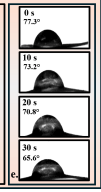
Can cellulose from wheat straw make a packaging film that protects fresh grapes? South Dakota State University optimized the film with a Box Behnken design and tested it on grapes. The Dropometer read the optimized film's water contact angle: 77.3° at first, falling to 65.6° over 30 s.

At-a-Glance Summary

Primary surface measurement reported

Static sessile drop water contact angle, read over 30 s and fitted to a decay equation to give a wetting rate constant.

Research question

Which mix of wheat straw cellulose, calcium chloride and glycerol gives a strong, flexible, moisture resistant film, and does that film keep grapes fresh at room temperature?

Headline finding

The optimized film (0.5 g cellulose, 556.35 mM CaCl2, 1.5% glycerol) is hydrophilic with moderate wetting kinetics, and it kept grapes intact for 15 days while polystyrene film led to cracked berries.

Paper Details

Authors
Sharad Bhattarai and Srinivas Janaswamy
Affiliation
Department of Dairy and Food Science, South Dakota State University, Brookings, SD, USA
Journal
Foods (MDPI)
Year
2026
Volume
15
Issue / Article
Issue 17 (publisher page; not printed in the text), Article 3111
Licence
Creative Commons Attribution (CC BY), as stated in the paper; version number not given in the text
Sessile drop water contact angle (Dropometer) plus mechanical, barrier, optical, hydration, antioxidant, FTIR and soil biodegradation tests by other methods
Measurement scope
Methods used
  • Water contact angle read initially and at 10, 20 and 30 s
  • Angle decay fitted to give a wetting rate constant
  • Tensile strength and elongation on a texture analyzer
  • Water vapour permeability by a gravimetric cup method
15 Box Behnken runs (WC1 to WC15) for strength, elongation and vapour permeability; contact angle on the optimized film only
Samples tested
Films
  • Optimized film: 0.5 g cellulose, 556.35 mM CaCl2, 1.5% glycerol
  • Optimized film thickness 0.06 ± 0.009 mm
  • No contact angle reported for WC1 to WC15
Water
Liquids
Probe liquid
  • Water grade for the contact angle test not stated
  • Only one probe liquid, so no surface energy was calculated

Classification

This study uses water contact angle as one of many checks on a cellulose packaging film made from crop residue.

What Was Measured

Primary surface / interfacial measurement

Water contact angle of the optimized film, read with the Dropometer from a smartphone image of a sessile drop. Readings were taken at the start and at 10, 20 and 30 s, and the fall in angle was fitted to a decay equation.

Supporting measurements

A texture analyzer gave tensile strength and elongation. A desiccant cup method gave water vapour permeability. Other tests covered colour, thickness, moisture, solubility, water uptake, UV and visible transmittance, DPPH antioxidant activity, FTIR, soil biodegradation and grape quality over 15 days.

Instruments Mentioned

Dropometer (Droplet Lab, Markham, ON, Canada, as stated in the paper)

Sessile drop water contact angle of the optimized film, initially and at 10, 20 and 30 s, using its dropper and smartphone imaging

Texture Analyzer TA-HD plus (Stable Micro Systems)

Tensile strength and elongation at break of film strips

Desiccator cup method with CaSO4 and saturated K2SO4

Water vapour permeability at 25 °C

Nix Pro 2 colour sensor

Hunter L*a*b* colour, whiteness, yellowness and total colour difference

UV-1600PC UV and visible spectrophotometer (VWR)

Light transmittance, transparency, UV blocking and DPPH antioxidant absorbance

PerkinElmer Spectrum 100 FTIR

Infrared spectra of the extracted cellulose and the optimized film

Vernier caliper, hot air oven, refractometer and pH meter

Thickness, moisture content and solubility, and grape soluble solids and pH

Role of the Droplet Lab instrument

The Dropometer measured one property: the water contact angle of the optimized wheat straw cellulose film. A sessile water drop was placed with the instrument's dropper and imaged with a smartphone.

The angle started at 77.3 ± 1.9° and fell to 65.6 ± 1.8° over 30 s. The authors fitted this decline to a decay equation and reported a wetting rate constant of 0.005 s⁻¹.

Contact angle did not drive the formulation choice. The optimization used tensile strength, elongation and vapour permeability, and the grape trial used weight loss, chemistry and visual checks. Contact angle was measured only on the final film.

The time resolved angle showed that the film surface is hydrophilic and wets at a moderate rate. That fits the paper's reading of the solubility and water uptake data, without being a deciding result on its own.

Bring This Measurement Into Your Lab

Want to track how water wets your packaging films over the first 30 seconds, reading by reading? See how the Dropometer handles this measurement.

Method Snapshot

Droplet Lab measurement protocol

Parameter Value as reported
Instrument Dropometer (Droplet Lab), with its precise dropper
Method Sessile drop on the film surface
Liquid Water; grade not stated for this test
Drop volume Not clearly stated in the paper
Image capture Smartphone
Software and fit Sessile drop software; fitting model not stated
Time points Initial, 10 s, 20 s and 30 s
Kinetics Angle decay fitted to Equation 21, giving k = 0.005 s⁻¹
Sample Optimized film only (0.5 g cellulose, 556.35 mM CaCl2, 1.5% glycerol), 0.06 ± 0.009 mm thick
Film side, conditioning, temperature, humidity Not stated in the paper
Replicates Triplicate under the general statistics statement (Section 2.6)
Reported as Mean ± standard deviation

Key Findings

Hydrophilic film surface

The Dropometer gave an initial water contact angle of 77.3 ± 1.9° on the optimized film, below the 90° line the authors use for hydrophobic.

Moderate, steady wetting

The angle fell to 65.6 ± 1.8° over 30 s, giving a wetting rate constant of 0.005 s⁻¹, which the authors class as moderate.

Consistent with water uptake data

Separate tests found 21.36 ± 4.26% solubility and 42.89 ± 0.14% water absorption after 120 min, which the authors relate to the moderate wetting seen in the angle readings.

Strong film with a fair moisture barrier

The optimized film reached 30.82 ± 4.70 MPa tensile strength and 0.59 ± 0.06 × 10⁻¹⁰ g m⁻¹ s⁻¹ Pa⁻¹ vapour permeability, close to model predictions.

Grapes stayed intact

Grapes under the wheat straw film lost about 21% weight by day 15 but did not crack, while grapes under polystyrene film cracked by day 9.

Measured Values by Sample

The paper reports contact angle for the optimized film only; values at 10 s and 20 s appear in Figure 2e but not in the text.

Dropometer water contact angle, optimized wheat straw cellulose film

Sample and time point Value
Optimized film, initial angle 77.3 ± 1.9°
Optimized film, 10 s Shown in Figure 2e; not stated in the text
Optimized film, 20 s Shown in Figure 2e; not stated in the text
Optimized film, 30 s 65.6 ± 1.8°
Wetting rate constant from the decay fit 0.005 s⁻¹
Box Behnken runs WC1 to WC15 Contact angle not measured or not reported

Figures & Visuals

One figure panel contains Dropometer data. The paper is published open access under a Creative Commons Attribution (CC BY) licence, as stated in the text.

Figure 2e: Water contact angle over time

Panel e plots the optimized film's water contact angle at 10 s intervals up to 30 s, measured with the Dropometer. Panels a to d show transmittance, water absorption, biodegradation and colour from other methods. Credit: Bhattarai and Janaswamy, Foods 2026, CC BY.

Why It Matters

Cellulose films from crop residue absorb water, so packaging developers need to know how fast a surface wets, not only its first angle. A short time series shows that difference.

A single angle can mislead

This film read 77.3° at first but 65.6° after 30 s. Reporting only one time point would hide the steady spreading and uptake.

A rate constant makes films comparable

Fitting the decline to a decay equation gives one number, here 0.005 s⁻¹, that can be compared across cellulose films.

Part of a wider SDSU programme

The same group has used the Dropometer on alfalfa, soyhull and corncob films, so results sit alongside earlier work from one lab.

Hydrophilic film surface with moderate wetting

Contact angle read at four time points over 30 s

Supports solubility and water uptake results

Optimized film kept grapes free of cracking for 15 days

Expert Perspective

Expert Perspective

A contact angle is a thermodynamic property: fix the liquid and the solid and the same angle appears whether the drop sits on a plate or climbs a capillary.

Dr Alidad Amirfazli

Professor, Department of Mechanical Engineering, York University, Co-founder and Scientific Advisor, Droplet Lab

Practical Takeaways

Read the angle over time

On absorbing films, take readings at fixed times such as 0, 10, 20 and 30 s rather than one snapshot.

Report the drop volume clearly

Drop size affects how fast a drop spreads and soaks in. State the volume and its units with every result.

Record test conditions

This paper does not give temperature, humidity or which film side was tested. Logging them makes your results easier to repeat.

FAQ

Frequently Asked Questions

What did the Dropometer measure in this study?

It measured the water contact angle of the optimized wheat straw cellulose film by the sessile drop method. Readings were taken at the start and at 10, 20 and 30 s. All other properties came from other instruments.

Is the wheat straw film hydrophobic?

No. The initial angle was 77.3 ± 1.9°, which the authors class as hydrophilic. The angle then fell to 65.6 ± 1.8° over 30 s as the drop spread and soaked in.

What does the wetting rate constant tell you?

It summarises how fast the contact angle falls over time. The paper reports 0.005 s⁻¹ and, citing earlier work, places this between fast wetting (above 0.01) and slow wetting (below 0.002) surfaces.

Did contact angle decide the final film recipe?

No. The recipe was chosen to maximise tensile strength and elongation and to minimise vapour permeability. Contact angle was measured afterwards on the chosen film as part of its characterization.

Citation

Use the formal reference below when citing the original paper.

Formal Reference

Bhattarai, S., & Janaswamy, S. (2026). Valorization of wheat straw cellulose into biodegradable packaging films for fresh produce preservation. Foods, 15(17), 3111. https://doi.org/10.3390/foods15173111

Short Cite + DOI

Bhattarai and Janaswamy, Foods 2026, 15, 3111. DOI: 10.3390/foods15173111