
Surface science explainer
Exploring the Science Behind Water’s High Surface Tension
Water's surface tension is about 72.8 mN/m at 20 °C, far higher than most everyday liquids (Vargaftik et al., 1983). The reason is hydrogen bonding: molecules at the surface lose bonding partners, so the liquid pays an energy cost for every bit of surface it creates.


Droplet Lab Team
Droplet Lab builds precision instruments and software for surface science measurement, specialising in contact angle analysis and surface tension characterisation. Used by researchers across materials science, pharmaceuticals, coatings, and advanced manufacturing, Droplet Lab's Dropometer has contributed to studies published in peer-reviewed journals including Advanced Functional Materials (Impact Factor 19). The team combines instrument engineering with deep domain knowledge in wettability science with a focus on practical accuracy.
Why does water have such a high surface tension?
Short answer: water molecules hold on to each other through hydrogen bonds, and a molecule at the surface has fewer neighbours to bond with. Creating more surface means breaking more of those bonds, so water resists it strongly.
Pure water at 20 °C has a surface tension of 72.75 mN/m (Vargaftik et al., 1983). Ethanol, by comparison, sits near 22 mN/m and most oils sit between 20 and 30 mN/m (Jasper, 1972). That gap explains why water beads on a waxed car while oil spreads across it.
What is surface tension, in plain terms?
Inside a liquid, each molecule is pulled equally in every direction by its neighbours. At the surface, there are no liquid neighbours above, so the molecule feels a net pull back into the liquid.
The liquid responds by keeping its surface as small as possible. That is why free droplets become spheres and why a drop hanging from a needle has a predictable shape.
Surface tension is reported in mN/m, which is the same as mJ/m². You can read it as a force along a line or as the energy needed to make one square metre of new surface. For a full walkthrough of the methods, see the surface tension measurement guide.
How do hydrogen bonds raise water's surface tension?
Each water molecule can donate two hydrogen bonds and accept two more. In the bulk liquid, molecules form a constantly shifting network of these bonds.
A molecule at the surface cannot complete that network, because half of its potential partners are missing. The missing bonds are an energy cost, and surface tension is the measure of that cost per unit area.
Liquids held together only by weaker dispersion forces, such as hexane, pay a much smaller cost. Their surface tension is correspondingly lower.
How does water compare with other liquids?
Water value from Vargaftik et al. (1983). Other values are typical literature values at 20 °C from the Jasper (1972) compilation; published values for glycerol and ethanol vary by about 1 mN/m between sources.
| Liquid | Surface tension at 20 °C (mN/m) | Main attraction between molecules |
|---|---|---|
| Water | 72.8 | Hydrogen bonding |
| Glycerol | about 64 | Hydrogen bonding |
| Diiodomethane | 50.8 | Dispersion (strong, polarisable iodine) |
| Hexadecane | 27.5 | Dispersion |
| Ethanol | about 22 | Hydrogen bonding, short chain |
| n-Hexane | 18.4 | Dispersion |
Why does water's surface tension fall as it warms up?
Heat makes molecules move faster and breaks hydrogen bonds more often. With a weaker network, there is less energy lost by sitting at the surface.
The IAPWS reference correlation gives about 72.0 mN/m at 25 °C and about 58.9 mN/m at 100 °C (IAPWS, 2014). Near room temperature, that is a drop of roughly 0.15 mN/m for every degree Celsius.
In practice, a 5 °C swing in a lab changes the reading by close to 1 mN/m. Record the liquid temperature with every surface tension measurement.
What lowers or raises water's surface tension?
Surfactants lower it strongly. Soap molecules crowd the surface and replace water molecules there, so fewer hydrogen bonds are lost. The guide to surfactants covers this in detail, and Experiment 2 lets students measure it.
Contamination does the same thing by accident. If pure water reads well below 72 mN/m at 20 °C, suspect a dirty syringe, needle or container before you suspect the instrument.
Common salts such as sodium chloride raise it slightly, because those ions are depleted from the outermost layer of the water. Larger, softer ions such as iodide behave differently and can gather at the surface (Jungwirth and Tobias, 2006).
How is water's surface tension measured?
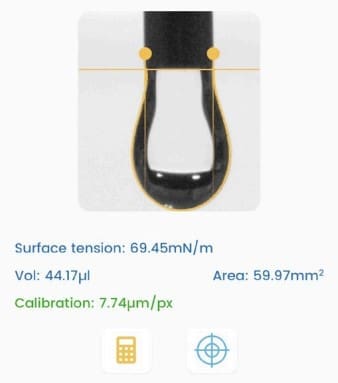
The pendant drop method images a drop hanging from a needle and fits its outline with the Young-Laplace equation. Force methods, such as the Wilhelmy plate and du Noüy ring, measure the pull of the liquid on a probe.
Pure water is the standard check for any of these methods. If your instrument reads close to the reference value at the recorded temperature, your needle, optics and fit are working.
Droplet Lab's smartphone pendant drop method was validated against a benchtop instrument in peer review. The papers are listed in the validation library.
Expert Quote
A pendant drop gives you surface tension only when the Young-Laplace fit follows the whole outline of the drop and you control how old the surface is. Read a fresh drop of a surfactant solution too early and you are measuring the clock, not the liquid.

Where can you go deeper?
These pages cover the methods, standards and data behind this post.
- Buying guide: Best Tensiometer for Teaching Labs
- Glossary: Surface tension
- Classroom experiment: Exp 3: Surface tension of water & temperature effect
- Open dataset: Surface Tension of Common Liquids
- Tool: Free Contact Angle Tool
- Related post: How Surface Tension Lets Insects Walk on Water
Measure water's surface tension in your own lab
See how a pendant drop measurement works on a phone based instrument, from drop to number, in a short call.
Frequently Asked Questions
About 72.8 mN/m at 20 °C and about 72.0 mN/m at 25 °C (Vargaftik et al., 1983; IAPWS, 2014). Always quote the temperature with the value.
Both. For a liquid, force per unit length (mN/m) and energy per unit area (mJ/m²) are the same quantity in different units.
Soap molecules gather at the surface with their water-loving heads in the water and their oily tails pointing out. They replace water molecules at the surface, so fewer hydrogen bonds are broken.
Sodium chloride raises it slightly, because its ions are depleted from the outermost layer of the water. Some larger ions, such as iodide, gather at the surface instead (Jungwirth and Tobias, 2006).