Benchmark validation
Contact angle and pendant-drop methods benchmarked against KRÜSS DSA100E
See peer-reviewed validation
Expert contribution
Static surface tension is rarely the value that controls spraying, coating or cleaning. The real question is how quickly the surface tension changes at process timescales.


Droplet Lab builds precision instruments and software for surface science measurement, specialising in contact angle analysis and surface tension characterisation. Used by researchers across materials science, pharmaceuticals, coatings, and advanced manufacturing, Droplet Lab's Dropometer has contributed to studies published in peer-reviewed journals including Advanced Functional Materials (Impact Factor 19). The team combines instrument engineering with deep domain knowledge in wettability science with a focus on practical accuracy.
Disclosure: An unpaid, independent contribution; Prof Abbott has no commercial affiliation with Droplet Lab.
Process timescales
Measuring the surface tension of a liquid can be hard work. You often have to wait minutes for the value to stabilise and it is very susceptible to small contaminants. It is also a waste of time. Almost no one has a real use for these static surface tensions. Think about it. You are spraying, coating, cleaning. The interactions that matter take place in milliseconds. What matters is how quickly the surface tension falls to a value that helps the spray to spread, the coating to become even and the cleaning to happen. For this you need to measure the dynamic surface tension. And you will quickly find something that is counterintuitive. Many “good” surfactants with low CMC (Critical Micelle Concentrations) and low equilibrium surface tensions are useless. Instead, you often choose a “poor” surfactant. Let’s see this in action using one of my free dynamic-surface-tension app.
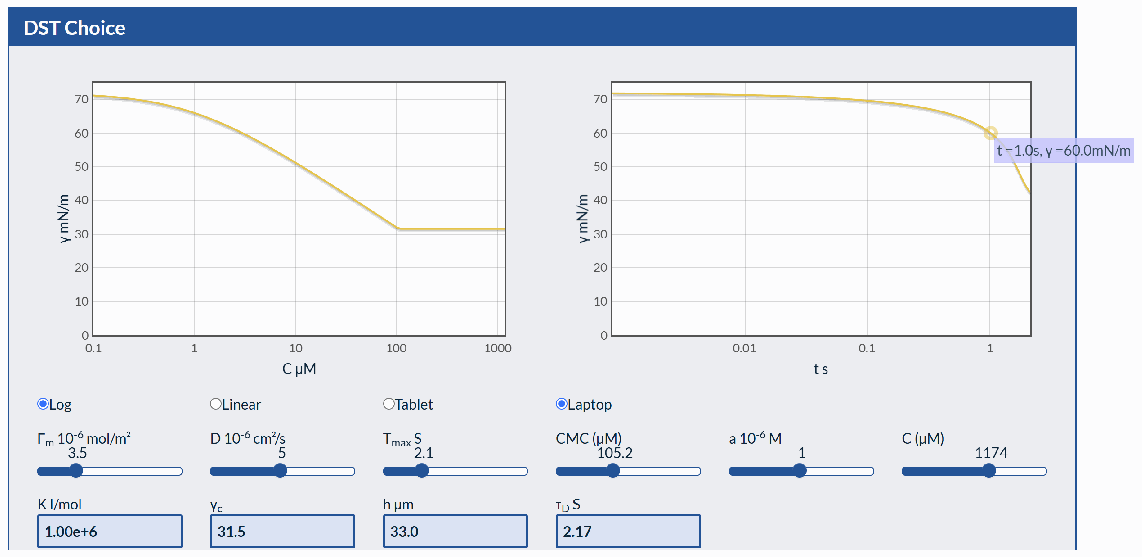
The left-hand graph is the classic curve of surface tension with concentration. With a CMC of 100 μM this is a “good” surfactant. Now look at the right-hand graph. After 1 s, the surface tension has dropped only to 60 mN/m. Your process has probably finished by this time, so the surfactant has had no time to do anything. Why is it so slow coming to the surface? It’s nothing to do with diffusion – most surfactants diffuse at similar rates. Instead it’s because most of the surfactant is tied up with big, lumbering micelles, with very little free surfactant able to get to the surface.
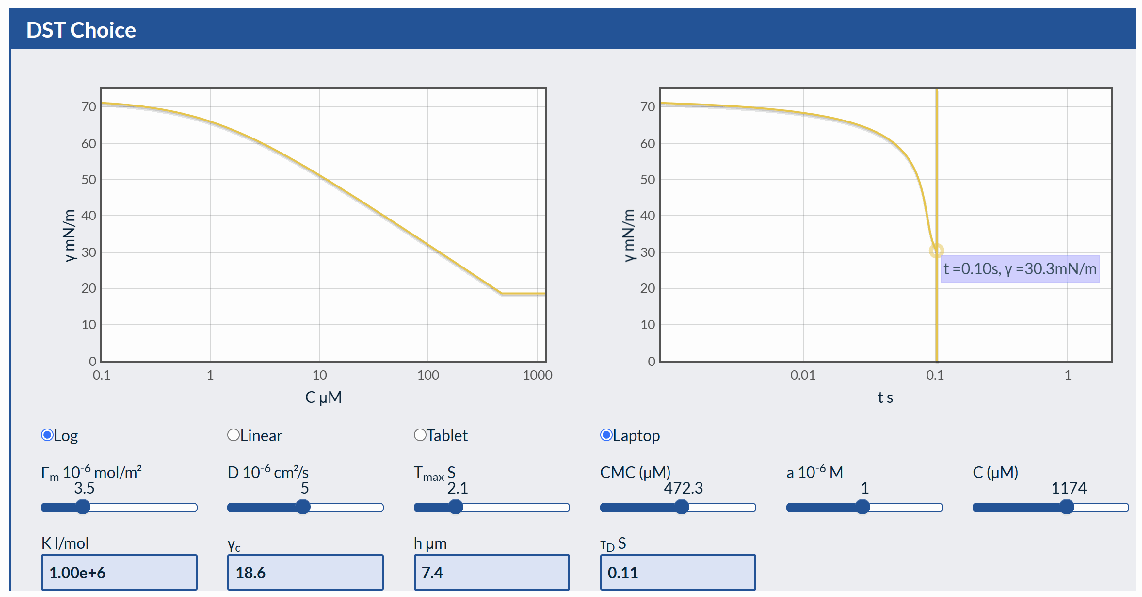
Now let's keep everything the same but change the CMC to about 470 μM.
By 100 ms the surface tension has fallen to 30 mN/m. The reason is that there is a large amount of free (non-micellar) surfactant that can quickly go to the surface. And that’s why you need to measure dynamic surface tension, DST.
For those who want a fuller explanation, the theory behind the app is described in the paper James K. Ferri and Kathleen J. Stebe, Which surfactants reduce surface tension faster? A scaling argument for diffusion-controlled adsorption, Advances in Colloid and Interface Science 85, 2000, 61-97.
Pendant-drop method
In principle, measuring DST is easy. The shape of a droplet hanging from a tube (“pendant drop”) depends on the size of the tube, the drop’s mass and the surface tension at that instant. As a short explanation, a high value of the surface tension will make the drop more spherical than a low value – as described by the Young-Laplace equation.
So, use a syringe to produce a drop growing at some controlled rate, take an image every 33 ms, use image analysis to get the volume (and, from the liquid density, its mass) and fit the shape to the Young-Laplace equation (not as easy as it sounds!) to extract the surface tension at that moment. At every instant you therefore know the DST.
It is more complicated than that in practice. You need to perform measurements at multiple speeds to capture drops at an optimal size for accurate calculations, so it needs smart algorithms to cover the desired timescales.
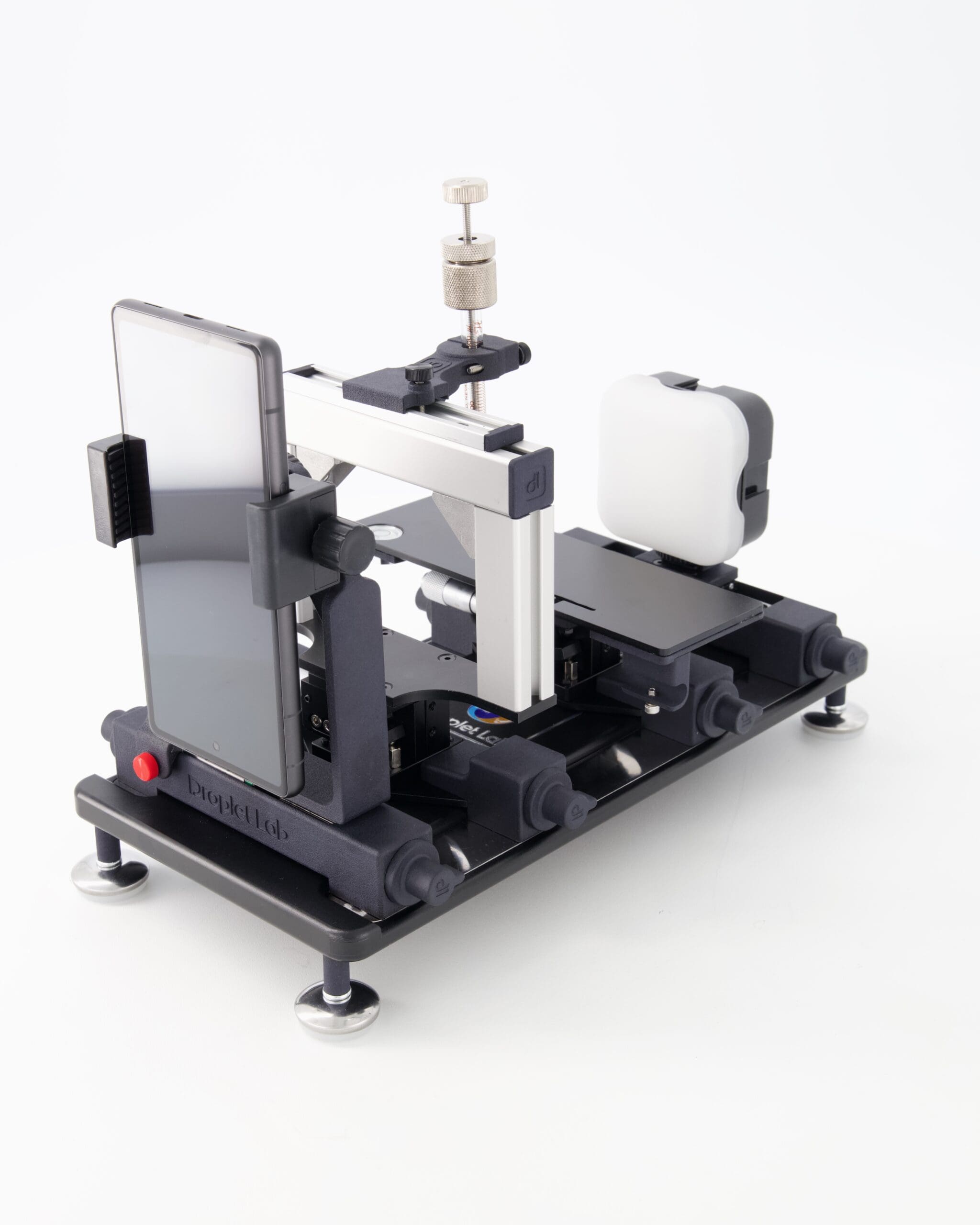
Traditionally the method has required expensive equipment, making it out of reach for many labs. But we’re in the 21st century. 3D printing, excellent digital microscopes, fast control software and mobile computing make it possible to combine precision with affordability. It’s great that Droplet Labs have transformed this important technique into an affordable package.
The team at Droplet Labs haven’t compromised on accuracy. Producing an OK prototype was one thing. The real challenge was to create a package that delivered reliable values, using standard, challenging test cases to compare results to those from well-known high-price devices. Only when components, engineering, assembly and software gave the required precision, accuracy and reliability were they happy to put the device on the market
Evidence
The contact-angle and pendant-drop surface-tension methods have been benchmarked against KRÜSS DSA100E reference measurements. Droplet Lab instruments are also referenced in peer-reviewed journals, theses and conference publications.
Contact angle and pendant-drop methods benchmarked against KRÜSS DSA100E
See peer-reviewed validationInstruments reference in peer-reviewed journals, theses and conference publications.
Browse the full citations listNever measure only the static surface tension. Measure the dynamic surface tension at the timescale of your process.
If DST was previously unaffordable, the device from Droplet Lab has made it practical.
Explore the Dropometer or discuss your liquid, timescale and measurement requirements with Droplet Lab.
Static surface tension is the value a liquid settles at after minutes of waiting, and it is rarely what matters in practice. Dynamic surface tension (DST) is the value at the actual timescale of your process—spraying, coating or cleaning all happen in milliseconds, so what matters is how fast surface tension drops, not where it eventually ends up.
Because most of that surfactant is tied up in micelles, leaving very little free surfactant available to reach the surface quickly. A “poorer” surfactant with more free molecules available can lower surface tension faster, even though its equilibrium value looks worse on paper.
Through the pendant-drop method—a drop is grown from a tube at a controlled rate, imaged at fixed intervals, and its shape is fitted to the Young–Laplace equation to extract surface tension at each instant. Doing this at multiple growth speeds captures the full range of timescales relevant to a given process.
CMC is the critical micelle concentration—the point at which surfactant molecules start forming micelles instead of remaining free in solution. A higher CMC generally means more free surfactant is available to diffuse to a fresh surface quickly, which is why a “good” low-CMC surfactant by equilibrium standards can be the wrong choice for a fast process.
It traditionally required specialised, high-cost equipment. Advances in 3D printing, digital microscopes, control software and mobile computing have made it possible to build accurate DST measurement into an affordable package.